The Three Pillars of Authority That Actually Drive B2B Growth
Most B2B companies pour resources into growth tactics while the foundation crumbles beneath them.
They chase visibility. They optimize funnels. They scale ad spend.
Then they wonder why pipeline stays thin, why deals stall, why every conversation starts from zero.
The missing piece is authority. Not the kind you claim in a tagline, but the kind buyers verify before they ever contact you.
I've watched this pattern repeat across hundreds of B2B companies. The ones stuck in feast-or-famine cycles confuse being seen with being trusted. The ones with sustainable growth treat authority as infrastructure.
Here's what actually works.
The Authority Gap Nobody Talks About
Your prospects spend 70% of their buying journey researching before they contact a vendor. They're auditing you in private. Checking your expertise. Looking for proof you understand their specific problem.
During that research phase, they ask three questions:
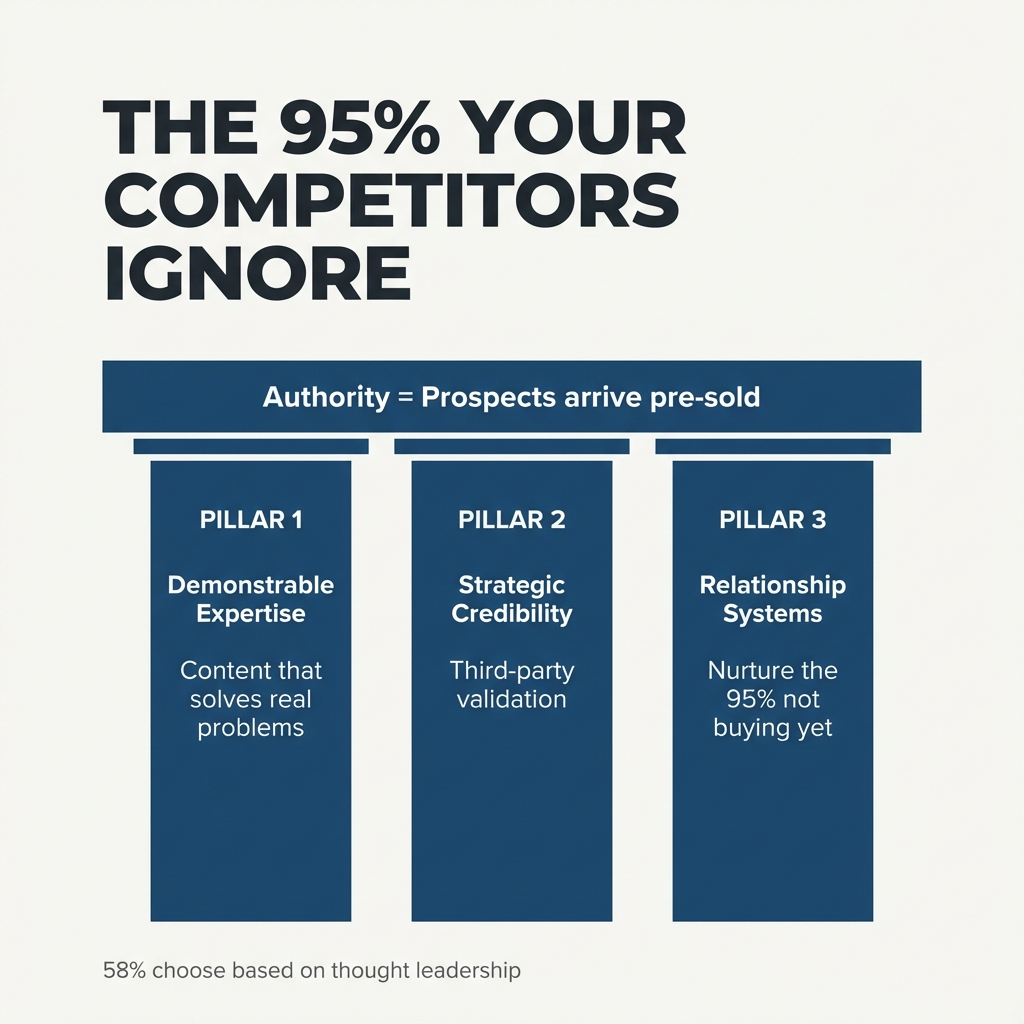
Can you solve this problem? (Demonstrable Expertise)
Should I trust you? (Strategic Credibility Signals)
Are you the obvious choice? (Intentional Relationship Systems)
Most companies answer none of these questions well. They publish generic content any competitor could claim. They lack third-party validation. They stay invisible to the 95% of buyers not ready to purchase yet.
The result? Every deal starts cold. Every conversation requires convincing. Every sales cycle drags.
Authority fixes this. When you build it correctly, prospects arrive pre-sold. They've already decided you're credible. The conversation shifts from "why you" to "how we work together."
But authority requires all three pillars working together. Miss one, and the whole structure weakens.
Pillar One: Demonstrable Expertise
Expertise without proof is just noise.
You need content that solves real problems your ideal buyers face. Not thought leadership theater. Not generic advice any vendor in your space could publish with a logo swap.
What demonstrable expertise looks like:
You publish a detailed breakdown of why 70% of implementations in your category stall after month three. You name the pattern. You show the failure points. You provide a clear playbook to avoid them.
Sales sends it before discovery calls. Prospects quote it back in meetings. They say "We realized we don't have X in place" or "Your competitor couldn't answer Y from your framework."
That's expertise doing the internal selling for you.
The content that actually arms sales:
Forget vanity metrics. The test is simple: does your sales team reference this content in real conversations? Does it help them handle objections?
If sales never mentions your content, you're creating marketing filler.
The content that works takes a strong stance. It addresses real sticking points: internal objections, competitor comparisons, confusing decisions. It lays out tradeoffs honestly, including where your solution isn't the right fit.
This feels risky. It's actually what builds trust.
When you publish a buyer's guide that maps directly to sales objections, prospects use it to evaluate you and your competitors. They come back saying "Your competitor couldn't answer these criteria." You've shifted the conversation from price to fit.
Why most B2B content fails:
The biggest waste I see is high-volume, generic "thought leadership" that never says anything sharp or commercially relevant.
Teams mistake activity for authority. They publish blogs, PDFs, and social posts that look professional but change nothing about who thinks of you or how sales conversations go.
If a piece could be published by any vendor in your category with just the logo swapped, it's not building authority. It's adding to the blur.
Public expertise reduces friction. Non-vendorish expertise earns peer sharing. That's the standard.
Pillar Two: Strategic Credibility Signals
Third-party validation isn't nice to have. It's the currency of modern B2B trust.
Buyers don't just want to hear what you say about yourself. They want to see what others say about you. Industry analysts. Subject-matter experts. Independent publications. Customers who've solved the problem you're selling.
The trust shortcuts that accelerate deals:
52% of B2B buyers use reviews when purchasing technology. Products with at least five reviews see conversion rates increase by 270%. For expensive B2B purchases, that jumps to 380%.
But reviews are just the start.
Press coverage signals "vetted and credible" in a way self-promotion never can. Case studies published on trusted domains carry weight. Being referenced in Reddit discussions or industry forums shows real world validation.
These credibility signals create trust dossiers. When a prospect researches you, they find proof from multiple independent sources. That eliminates the skepticism phase of the sales cycle.
The ROI of thought leadership done right:
The average ROI of thought leadership is 156%. 55% of decision-makers use it to vet organizations they may hire. 60% said thought leadership convinced them to buy a product they weren't previously considering.
But here's the catch: 44% of buyers prefer third-party content over vendor-produced material.
Your own content must meet a higher bar of credibility and usefulness. It needs to feel like advice, not a pitch.
How credibility signals compress sales cycles:
B2B buyers are 2X more willing to pay more to work with a company they deem credible and trustworthy. Credibility signals directly reduce friction in the buying process.
I've seen this play out repeatedly. After a major trade publication features a company, they get calls from regions where they've never sold before. Deals close faster. Win rates improve. The authority built through that third-party validation does the heavy lifting.
One company saw sales increase by 300% after earned media coverage. That's the power of strategic credibility signals combined with demonstrable expertise.
Pillar Three: Intentional Relationship Systems
The 95-5 rule changes everything about how you build authority.
Only 5% of your market is in-cycle and ready to buy right now. The other 95% are researching, learning, and forming opinions about who they'll choose when they're ready.
Most companies ignore the 95%. They optimize for the 5% in-market and wonder why growth plateaus.
Building networks that generate qualified opportunities:
Authority targets the 90-95% not ready to buy. You educate them consistently. You answer sophisticated questions. You show your point of view in public.
This requires a system, not sporadic campaigns.
The companies that escape feast-or-famine make one key shift: they treat authority as an operating system. They institutionalize a drumbeat of focused, high-value content and relationship-building that runs every week, regardless of how busy they are.
Demand and trust compound in the background.
Where execution actually breaks:
Here's the honest truth: most founders hit a wall at the repurposing stage.
They record a conversation. Maybe publish the long-form piece. Then the repurposing never happens consistently because nobody has clear ownership or templates.
Each small asset feels like a new creative project. Decision fatigue kills execution.
The fix is simple: remove thinking from that step. Turn it into a checklist that a generalist or assistant can run without constant input.
Design one default content pack: one pillar piece, three LinkedIn posts, one email, one internal sales asset. When this is defined up front, the question becomes "who is running the pack this week?" not "what should we make?"
The sustainable approach:
You don't need a massive team. You need a repeatable system.
Install a simple "one source, many assets" habit every week. Record one 30-45 minute session where a founder or subject-matter expert talks through a real customer problem, objection, or decision.
Turn that single recording into a pillar asset plus a handful of clips, posts, and an internal sales crib sheet.
You're not creating content from scratch. You're documenting conversations you're already having and packaging them.
The same raw material feeds LinkedIn posts, a short email, one resource for sales to send, and a reference point you can build on later. Every hour of founder time produces multiple touchpoints for the 95% and better ammunition for the 5% in active deals.
Why All Three Pillars Must Work Together
Authority is a system, not a single tactic.
Demonstrable expertise without credibility signals feels like vendor claims. Credibility signals without expertise lack substance. Relationship systems without both leave you visible but not trusted.
When all three pillars work together, the results are measurable.
The integration reality:
B2B buying cycles are getting shorter for companies that have built the authority foundation in advance. Buyers spend around 70% of their journey doing independent research, and buying committees typically include 6 to 10 stakeholders.
Your authority must reach and influence multiple people long before you're in the room.
Companies with strong authority see 20-30% shorter sales cycles. They report 12-15% improvement in pipeline quality within 90 days. Deal sizes increase without extra effort because authority positions you as the premium choice.
The time horizon nobody wants to hear:
Authority building requires a multi-quarter horizon. You need 120 days minimum to see meaningful traction. Knowledge graph entity establishment takes 6 to 12 months of cross-validated verification. Branded search momentum requires 12 to 18 months of consistent visibility.
This feels slow when pipeline looks thin today.
But here's what I tell every founder who pushes back: the companies stuck in feast-or-famine sprint for attention when pipeline is empty, then go dark as soon as delivery work ramps up. This resets trust and forces them back into net-new selling every quarter.
The companies that escape this cycle treat authority as infrastructure that runs every week, regardless of how full the pipeline is. Demand and trust compound while they're busy delivering.
Common Pitfalls and Honest Solutions
The panic pivot problem:
The hardest part of maintaining discipline is resisting the panic pivot to "more leads now" when short-term numbers hurt.
When the CEO sees a soft quarter, the easiest lever to pull is "run a campaign and get me more MQLs." Budget and time get reallocated from demand creation into demand capture because the latter is easier to attribute and defend.
Discipline means accepting a temporary dip in vanity volume while the quality of demand and close rates improve more slowly in the background.
How disciplined teams handle the pressure:
They run with a dual plan: a protected baseline for brand and demand creation that is non-negotiable, plus a flexible layer for short-term capture plays when pipeline is thin.
They pre-align leadership on what happens in a crunch: what can be dialed up (ABM, outbound, conversion optimization) and what cannot be sacrificed (weekly publishing, visibility with future buyers).
The protected baseline is usually 50 to 60% of marketing budget on demand creation and brand. Below that, you document the expected impact on future pipeline growth, deal velocity, and customer acquisition cost to make the tradeoff explicit.
Making the commitment feel safer:
Pair the allocation with clear leading indicators so leadership sees momentum before revenue catches up.
The two indicators that move executive confidence fastest: more high-intent people coming to you by name, and better efficiency in the opportunities you already have.
Track branded search and direct traffic trending up among your ideal customer profile. Watch for self-reported attribution on demo forms shifting away from "Google" and "Other" toward your thought leadership and brand.
When a CFO sees that a growing share of pipeline is coming from people who already knew the brand, it reads as lower customer acquisition cost and less dependence on paid capture.
The second bucket is pipeline quality: higher win rates and shorter sales cycles for inbound opportunities associated with branded or content touchpoints.
Even before total revenue spikes, showing "same or slightly more opportunities, but closing faster and more often" is usually what makes a CEO or CFO say "Keep funding this. It's making the whole system more efficient."
Measuring What Actually Matters
Authority doesn't require guesswork.
The leading indicators that show momentum:
Watch branded search and direct traffic as a separate line from generic or paid search. Look for steady growth over at least 8 to 12 weeks, not just one campaign window.
A meaningful pattern is high single to low double-digit growth in branded search volume each month, sustained over multiple months, while generic search stays flat or grows more slowly.
Track the brand versus generic ratio. If branded queries and direct visits grow to represent a larger share of total traffic and inbound opportunities, that's a strong awareness signal.
Tie the trend to downstream behavior: higher conversion rates and shorter cycles for visitors from branded and direct sources.
When you can say "Branded and direct are up consistently, they're a bigger slice of inbound, and they convert better than everything else," most executives read that as signal, not noise.
The lagging indicators that prove ROI:
58% of decision-makers choose a business based on its thought leadership. 61% are willing to pay premium prices for brands that articulate a clear vision. 63% of buyers say thought leadership is important in providing proof that an organization genuinely understands or can solve specific business challenges.
The metrics that matter: branded search trending up, direct traffic from your ideal customer profile, higher win rates for opportunities that engaged with your authority content, and shorter sales cycles for those same opportunities.
These indicators show momentum before revenue spikes. They give you the confidence to keep investing when the board asks hard questions.
Where to Start When You're Overwhelmed
If you could only do one thing, do this:
Pick one narrow problem you want to be known for and commit to talking about it in public every week for a year.
Choose a sharp, specific problem:
Define the single, painful, high-stakes problem your best customers lose sleep over, in their own words.
Make it your north star. If a topic doesn't help your ideal buyer understand, diagnose, or solve that problem, it's a distraction.
What "too broad" looks like versus sharp:
Too broad: "B2B companies struggle to grow."
Sharp: "Mid-market SaaS teams get stuck at $10 to 30M ARR because outbound plateaus and they never become the obvious choice in their category."
Too broad: "Marketing leaders need better leads."
Sharp: "Revenue teams waste 40 to 60% of their budget on leads that never convert because marketing optimizes for MQL volume instead of in-market opportunities."
A real person in your ideal customer profile should be able to say "That is exactly what is happening here" without translation.
If you can immediately list 10 to 20 specific stories, mistakes, and decisions under that problem, it's narrow enough to sustain a year of authority-building content without feeling repetitive.
Ship one useful insight every week:
Once a week, share one concrete insight, story, or tool about that problem on LinkedIn, in email, or via a simple article. Let the market learn alongside you.
Don't worry about format sophistication at first. Consistency of signal around that one problem will do more for authority than any complex content calendar.
Everything else is just details and distribution.
The Bottom Line
Authority is the foundation that makes everything else work.
When you build demonstrable expertise, strategic credibility signals, and intentional relationship systems together, you create a compound asset. Prospects arrive pre-sold. Sales cycles compress. Win rates improve. Deal sizes increase.
But it requires discipline. You have to protect the long-term program when short-term numbers hurt. You have to treat authority as infrastructure, not a campaign. You have to ship consistently for the 95% not ready to buy yet.
The companies that do this escape feast-or-famine. They build sustainable growth engines that compound over time.
The companies that don't stay stuck chasing the next lead, the next campaign, the next quick fix.
You already know which path you're on. The question is whether you're ready to commit to the one that actually works.


Comments
Post a Comment