How Putting Answers First Became the New Foundation of My Strategy
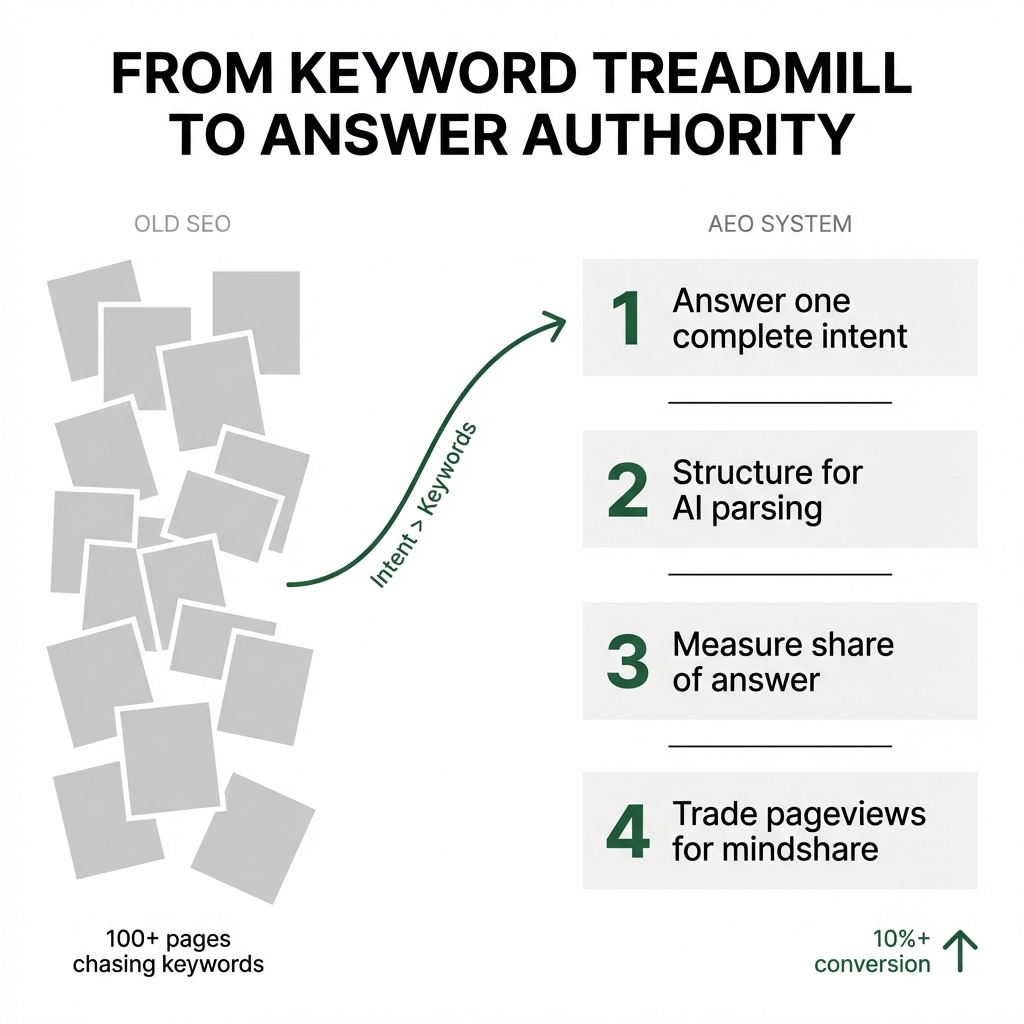
I didn't get exhausted by SEO. I got clear about what it was never meant to do alone.
Good SEO is still vital. Technical foundations matter. Keyword research validates real language patterns. Link building signals authority. None of that disappeared.
What changed was watching LLMs recognize intent in ways traditional keyword matching never could.
I saw search traffic wanting answers to their questions, not paid ads for solutions that might work. B2B buyers building inbound programs needed efficacy, not guesswork.
That's when I realized we'd been organizing our entire marketing infrastructure upside down.
The Shift from String Match to Goal Prediction
In legacy search, "best CRM for agencies" and "agency CRM tools" were essentially the same query. We optimized around exact phrases and variants.
Then I started seeing prompts like "I'm running a small marketing shop, what should I use to manage clients?" trigger the same underlying buying intent—with zero overlapping keywords.
The model treated queries as meanings in a vector space, not strings in an index. Synonyms, paraphrases, and messy questions all mapped to the same "job to be done."
That forced me to stop thinking in "target keywords" and start thinking in "canonical intents"—the actual problems people need solved.
What Had to Change First
The first thing I changed was the unit of production.
Every content brief had to be built around a complete user job, not a single query or keyword variant.
Previously, a brief might read: "Target 'cold email outreach' and related long-tails, 1k–1.5k words, include these subheadings."
Now the brief became: "Help a B2B founder go from zero to a working outbound system."
Keywords became flavor, not the spine.
That meant scoping content to cover the full workflow: context, strategy, examples, templates, pitfalls, next steps, in one coherent asset. I organized sections around questions and micro-intents the LLM would need to answer along the way, not around search-volume-driven headings.
The fundamental shift wasn't tooling. It was redefining what a "page" is: from a container for a keyword cluster to a container for a complete, end-to-end intent that an LLM can lift almost verbatim to serve the user.
Where SEO Actually Fits Now
This forced SEO to stop being "the team that picks keywords" and become the discipline that makes job-based content interpretable, discoverable, and consistently represented across AI and classic search surfaces.
SEO moved upstream into content planning instead of just polishing finished drafts. Content strategy owned the narrative and the jobs-to-be-done, while SEO owned structure: information architecture, schema, internal linking, and clarity of headings so models could reliably parse and recombine our material.
Traditional SEO became the infrastructure and signaling layer that ensures job-centric content actually gets seen, understood, and quoted, rather than a separate, keyword-driven track competing with content strategy.
Technical and on-page SEO remain the foundation. Crawlability, performance, clean URLs, metadata, and logical site architecture are still prerequisites for both search engines and LLMs to trust and reuse content.
Keyword research didn't disappear. It now validates and enriches canonical intents, surfacing real language, long-tail questions, and edge cases to bake into each job-focused asset rather than into dozens of micro-pages.
The Org Chart Problem
Most marketers still organize their teams and budgets with SEO at the top of the org chart.
They're solving a 2026 problem with a 2015 org chart.
User behavior is now answer-driven and AI-mediated. Teams need to optimize for being the best source on a topic, not just the best blue link for a head term. Generative engines and AI overviews reward semantic depth, topical authority, and clarity of explanation: outcomes of strong product marketing, subject-matter expertise, and content strategy, with SEO as an enabler.
When SEO sits at the top, everything gets distorted toward what's measurable in SERPs: rankings and clicks. This under-weights brand narrative, product education, lifecycle content, and community: exactly the things AI systems now use as trust and authority signals.
The healthier hierarchy:
Put customer and jobs-to-be-done at the top: organize around the problems your buyer needs solved and the journeys they go through, regardless of channel
Let content and product marketing own the story, the jobs, and the depth of expertise you bring to each topic
Position SEO as the infrastructure and signaling function that ensures the stories you're already committed to telling are structured, marked up, interlinked, and distributed so search engines and generative systems can reliably quote you
If you keep SEO as the parent strategy, you'll keep getting content that's easy to measure but hard to remember.
If you flip it so SEO is infrastructure, you get a marketing engine built for humans first and AI systems by design.
The Most Liberating Part
You get to step off the endless keyword and content treadmill.
You can pour your energy into a smaller set of things that actually matter to customers and to AI systems.
When SEO stops being the parent strategy, you no longer need 10 variations of the same article just to "cover the keyword map." You can consolidate that effort into one or two deeply useful, job-centric assets per intent and keep iterating those as your product and market evolve.
For overwhelmed teams, this means fewer briefs, fewer approvals, and fewer mediocre pages to maintain, without sacrificing visibility in both classic and AI search.
Once SEO is infrastructure, you gain permission to prioritize things that used to be "nice to have": opinionated thought leadership, narrative arcs across channels, and formats that actually fit the message: video, community, product education, not just what's easiest to rank.
You're no longer chasing every algorithm tweak. You're investing in clarity, authority, and structured stories that AI tools can parse and cite for years.
The net effect is psychological: you move from reacting to every SEO change to owning a clear, durable strategy where search is just one amplification layer, not the thing that runs your calendar.
What Winning Actually Looks Like
Winning with AEO means your brand becomes the trusted "default answer" for the jobs you care about, even when there's no click and no blue link to point at.
You consistently show up inside AI answers. Your brand, frameworks, or examples are cited or described when users ask high-value questions in assistants, AI overviews, and answer boxes.
Your visibility is measured as share of answer, not just share of clicks: how often you're mentioned or linked compared with a short list of competitors across a defined set of intents.
The traffic you do get from AI surfaces is smaller but higher intent. AI search traffic converts at 14.2% compared to Google's traditional 2.8%. The average AI search visitor is worth 4.4 times more than a traditional organic search visitor.
You're trading high-volume, low-intent traffic for low-volume, high-intent traffic.
The scorecard changes. You still track rankings and organic sessions, but next to that you track AI exposure rate, citation counts, and AI-attributed leads or revenue. You monitor which specific paragraphs, FAQs, or modules get pulled into answers, then refine those blocks for clarity, structure, and freshness so they stay "quote-worthy" over time.
Winning stops being an endless race for more pages and more rankings. It becomes a focused effort to own a finite set of critical answers, and to have those answers echoed faithfully by the AI systems your buyers already trust.
The Mental Shift That Makes It Click
Stop measuring success by "how many people came to my site?" and start measuring it by "how many buying decisions did my expertise quietly influence?"
In an AEO-first world, the scarce resource isn't impressions or even sessions. It's being the source the model chooses when it assembles an answer.
Instead of asking "Did I get the visit?", you ask "When my ideal buyer asked this question anywhere: in Google, in an assistant, in product search, how often was my explanation the one they effectively heard?"
That reframes organic traffic as one output of a bigger system whose real job is to make you the default teacher in your category.
If you can internalize that "being selected as the answer" is the new top-line KPI, the rest of the AEO playbook (structuring content, embracing zero-click, and tracking share of answer) suddenly stops feeling like a loss of control and starts feeling like compound influence.
Where to Start Tomorrow
Take your single highest-value question and turn it into the best, most clearly structured answer on the internet.
Then worry about everything else later.
How to do that tomorrow:
Pick one canonical question tied to revenue (e.g., "Is [your solution] worth it for [persona]?") and make one page the "answer home" for it: one intent, one URL
Rewrite that page so the first 100 to 200 words give a direct, standalone answer, followed by clean H2/H3 sections phrased as questions, with concise, scannable explanations under each
Add basic schema (FAQ, HowTo, Organization) and make the HTML structure boringly clean so AI systems can lift your definitions, steps, and examples without guessing
If you do that for just one high-stakes question, you've taken the first, highest-leverage step into AEO.
You've stopped publishing "content" and started publishing an answer that models can reliably select and reuse.
That's the shift. From chasing keywords to earning selection. From owning clicks to influencing decisions.
SEO isn't broken. It just finally has the right job.


Comments
Post a Comment