The CMO Paradox: When Scarcity Meets Expectation
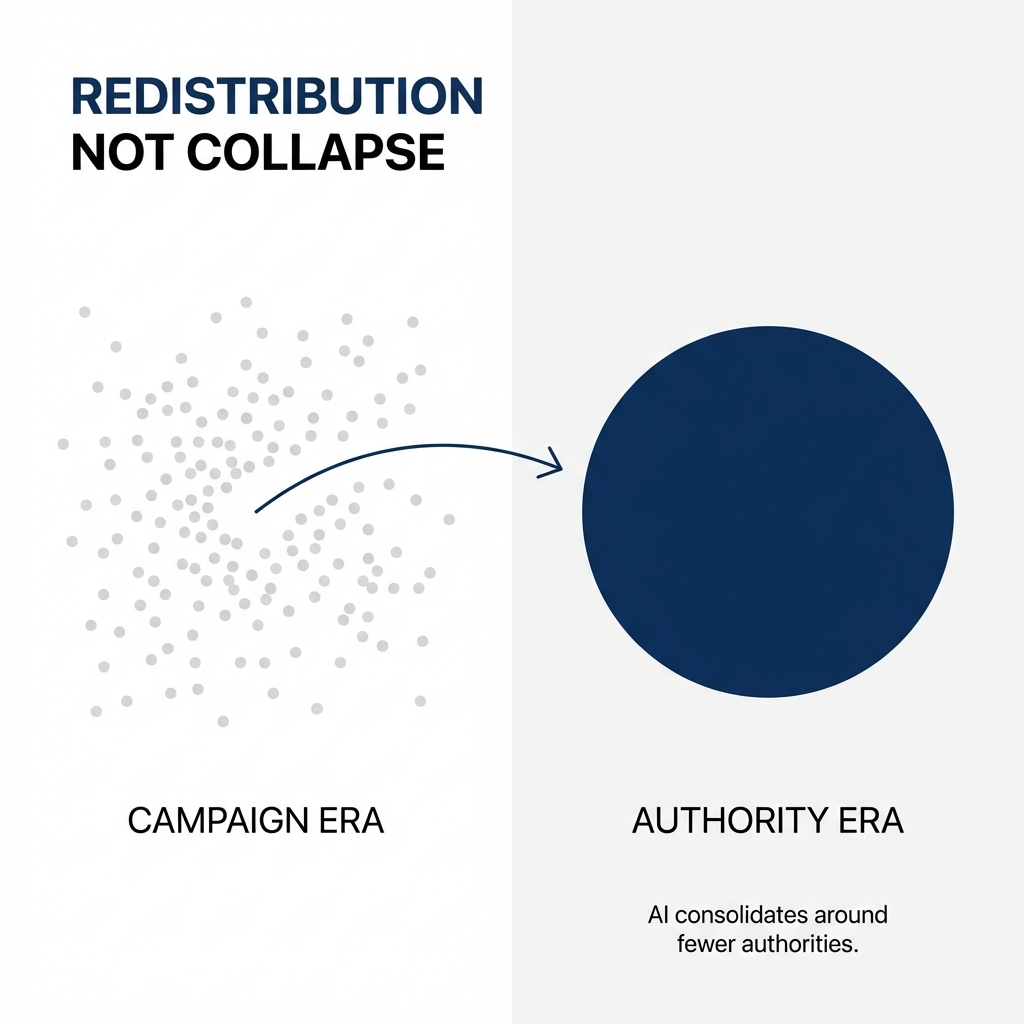
I've been observing something that most people are calling a crisis—but the data reveals a different pattern entirely.
What looks like chaos in the CMO function is actually a redistribution of authority, not a collapse of demand. The noise (algorithm changes, channel fatigue, uneven AI adoption) masks the underlying structural shift: AI engines are consolidating discovery around a smaller set of authorities that machines can recognize, verify, and recommend.
This represents an inflection point, not a crisis.
The Constraint-Innovation Structure
Budget limitations are functioning as strategic clarity catalysts in ways I haven't seen before. Marketing budgets have flatlined at 7.7% of company revenue, and 59% of CMOs report insufficient resources to execute their strategy.
But here's what the scarcity reveals: it forces CMOs to distinguish between performative marketing rituals and genuine pipeline-generating activities.
The brands treating this as an infrastructure problem (entity clarity, citations, structured data, authority signals) are quietly gaining share while everyone else argues about impressions. When your brand becomes the default answer inside AI and social platforms, you stop buying every click. You start harvesting intent the market already generates.
This filtering mechanism exposes what marketing was actually built for: buying temporary attention or building an authority engine the company can sell from for years.
The Asset Manager Mindset
CMOs who make this transition stop treating time as a series of campaigns and start treating it as compounding yield. The question shifts from "What did we get this quarter?" to "What did we add to the authority base that will pay us every quarter from now on?"
Their time horizon extends from quarters to half-lives. They care less about short-lived spikes and more about how long an authority asset (an AEO-optimized article, a PR placement, a structured knowledge layer) will keep generating qualified attention and AI recognition without additional spend.
What they stop doing reveals the shift:
Chasing trend-driven tactics that don't accrue
Producing one-off assets disconnected from a knowledge layer
Over-optimizing for vanity metrics that don't translate into being recommended more often
They effectively retire the habit of "renting attention" and spend their limited budget on authority infrastructure that future quarters can rely on, even when media budgets tighten or algorithms shift.
The Organizational Stress Test
When CMOs reallocate ownership and budget from "campaigns" to an explicitly named authority system, the first thing that breaks is organizational muscle memory.
Most teams are over-built for campaigns and under-built for systems. When you stop buying visibility and start building authority infrastructure, you quickly see whether you have people who can design entities, schemas, answer surfaces, and repeatable authority motions, or just people who can launch the next campaign.
The content operation gets exposed almost immediately. If content is really just "assets for campaigns," it won't survive being repurposed as the canonical, structured source of truth that AI systems and buyers rely on to recognize your authority.
Measurement becomes the stress test. When you ask, "How does this show up in AI discovery, trusted mentions, and qualified pipeline?" many dashboards go blank. That's where you see whether marketing was organized for performance theater or for compounding authority.
The Unit Economics Conversation
The argument that moves boards and CFOs is simple: authority infrastructure is the only way to keep acquiring revenue efficiently in an AI-first discovery environment where engines recommend authorities instead of ranking ads and pages.
CMOs who win this conversation do three things explicitly:
First, they reframe authority as cost-of-revenue, not cost-of-marketing. If AI engines like ChatGPT, Gemini, Perplexity, and SGE are now the front door to demand, then being recognized as the authority in that ecosystem becomes table stakes for hitting revenue plans at acceptable CAC.
Second, they tie authority infrastructure directly to unit economics. The conversation becomes about how AEO, executive visibility, and AI-ready content reduce dependence on paid channels, increase high-intent inbound, and improve close rates in markets where the brand is consistently recommended as the default solution.
Third, they make the "do more with less" constraint part of the case. The alternative to protected authority spend is more fragile spend: more auctions, more discounts, more sales effort to overcome a lack of trust.
Authority infrastructure functions as the only lever that simultaneously lowers the cost of attention, stabilizes discoverability across AI platforms, and compounds over time instead of resetting to zero each quarter.
What the Data Actually Shows
The pattern I'm observing isn't about CMOs being squeezed. It's about a fundamental replatforming of how marketing leadership operates.
Buyers haven't become harder to reach. They've become more selective about who they'll trust, faster. AI is simply accelerating that filter, which punishes shallow, campaign-first marketing and disproportionately rewards organizations whose leaders show up as clear, consistent, and credible authorities across every surface.
The inputs CMOs control—authority architecture, signal design, executive visibility—have never had more structural leverage than they do right now.
The crisis belongs to brands clinging to a page-ranking, ad-first world. The upside belongs to the ones willing to build the authority engines that AI and their market can no longer ignore.


Comments
Post a Comment