The Cosmological Collapse: When B2B Organizations Discover They Built Marketing on Spreadsheets Instead of Systems
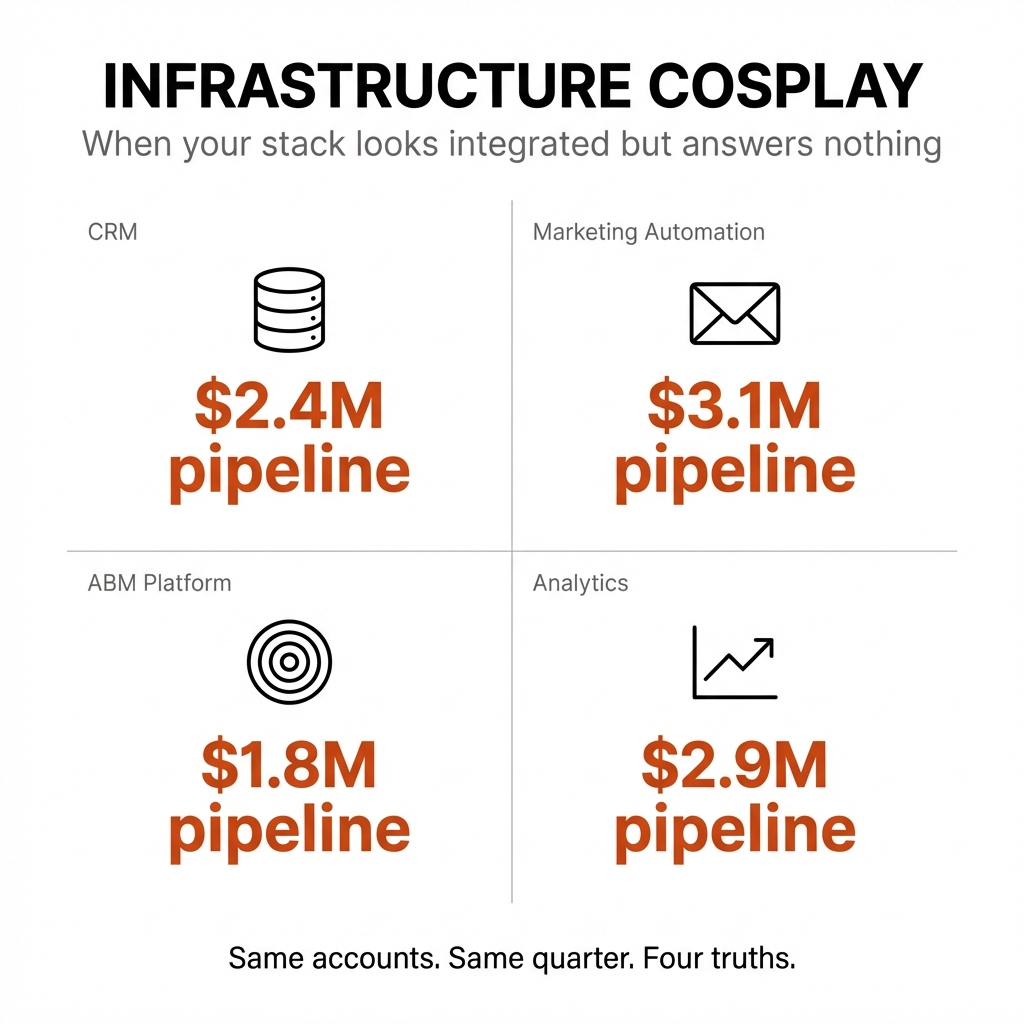
I've documented a recurring pattern: leadership asks a simple cross-channel question ("Which motions are moving our Tier 1 accounts?" or "Did SEO or ABM source this deal?") and discovers their infrastructure is actually infrastructure cosplay.
Marketing pulls three dashboards that contradict each other. RevOps needs a week of VLOOKUPs. Everyone arrives at the QBR with a different "truth." The same opportunity appears as "SEO-influenced" in one report and "ABM-sourced" in another.
This isn't a coordination problem. It's a systems design problem masquerading as a people problem.
The Structural Contradictions: Observable Evidence from Calendars and Budgets
The contradictions between SEO and Account-Based Everything programs manifest in three locations: meetings, metrics, and budgets.
Meeting Rituals as Cultural Artifacts
SEO meetings revolve around traffic, rankings, and MQL volume. ABM meetings revolve around 50–500 named accounts: coverage, penetration, and opportunity progression. The contradiction: the same organization operates with two definitions of "the market." They're describing different universes.
SEO prioritizes scalable, evergreen content designed to compound. ABM prioritizes bespoke plays for tier-1 accounts tied to quarterly targets. The content team gets double-booked, expected to ship both a scalable machine and a bespoke factory. One or both end up underfunded.
Metrics as Competing Scorecards
SEO celebrates volume: traffic, rankings, MQL count. ABM celebrates precision: account penetration, engagement per account. When SEO shows traffic growth, ABM says it "doesn't count" because it's not from target accounts. When one contact from a major logo converts, SEO calls it "low quality" while ABM celebrates first foothold.
The same contact exists in two narratives. Sales only cares which motion moved the deal.
Budget Territory as Ideological Battleground
SEO pitches compounding organic that lowers CAC over time. ABM pitches concentrating dollars where ACV is highest. The CFO sees overlapping line items and asks, "Why two tools?" Fights become tool versus tool, not strategy versus strategy.
Every budget cycle forces a choice: fix invisible SEO infrastructure or fund visible ABM plays that sales feels next quarter.
These are structural incompatibilities created by asking one team to play two games with two scoreboards.
The Infrastructure Illusion: Why Smart Organizations Mistake Tools for Systems
B2B organizations convince themselves that buying Salesforce, HubSpot, and Demandbase equals having infrastructure because the entire ecosystem (vendors, analysts, internal politics) rewards tool acquisition over architectural thinking.
Why the Illusion Persists
Platforms get sold as "the backbone" when they're optimized for a slice of GTM. Buyers equate logos with outcomes. Analyst narratives frame maturity as owning categories (CRM, MAP, ABM, CDP) rather than designing a unified data backbone.
Buying tools is visible progress. Investing in data modeling is invisible. Organizations fund what they can see and underfund connective tissue. Modern tools hide fragmentation with slick UIs. The result is infrastructure cosplay: professional surface, no skeleton.
RevOps runs manual integration with Zapier and exports. Because smart ops people make the mess work, leaders think the stack is sound. The belief: "Our people plus these tools equals system." Reality: people are duct tape. If they left, the infrastructure evaporates.
What Infrastructure Actually Requires: The Account-Centric Backbone
The contradictions stop when "SEO data" and "ABM data" become two lenses on the same account-centric model. That requires changing the data backbone, not the meetings.
What Real Infrastructure Requires
One account object: standardized IDs across all systems. Domain maps to account, every touchpoint ties to that ID. Without this, SEO is "users" and ABM is "accounts." They can't reconcile.
Unified data model: all events in one schema. Every activity is an event with common fields (account_id, contact_id, channel). "SEO versus ABM" becomes a filter, not two pipelines.
Account-level attribution: ABM-style KPIs (engaged accounts, pipeline, velocity) become default for all channels. You answer "What did organic plus ABM do for Tier 1 accounts?" in one place.
Explicit integration contracts: CRM is the system of record. The data backbone is the system of analysis. Tools read and write to that shared model. When infrastructure looks like this, "one market model" isn't an alignment ritual. It's a property of the data.
Authority Engine as Signal Layer: Infrastructure, Not Destination
Authority Engine only counts as infrastructure if it stops being "one more destination" and instead becomes the connective tissue that makes all your other tools describe the world the same way.
How Authority Engine Functions as Infrastructure
Authority Engine maintains a consistent view of entities (company, people, topics, executives) and maps those into your existing systems. The objects we care about (accounts, authority signals) plug into your GTM model, not trap data in our dashboards.
Most solutions own a channel. We own a signal layer: structured authority data, entity relationships, answer/visibility signals that other systems consume. We integrate at identity and data seams, enriching your source-of-truth systems with structured authority context.
The Ritual Transformation: Observable Behavior Change
The first ritual that shifts: leadership stops opening tools and starts opening a shared "authority plus demand" view by account and topic.
What Changes
Before: channel roll call. SEO shows traffic, demand gen shows leads, ABM shows engagement, sales fumbles through CRM.
After: meeting opens on account-level view showing authority signals, AI/search presence, engagement by account. Channel owners anchor updates to that view. The behavioral change: people talk about accounts and authority states first, channels second.
Prioritization shifts from loudest story to signal. Teams review where authority is strong but commercial motion is weak, then assign plays against those gaps. Roadmaps get justified from "authority plus demand" canvas, not siloed metrics.
Content and exec time get allocated from one map: "Which three topics and ten accounts need our CEO's authority this quarter?"
The Resistance Pattern
People cling to channel dashboards because those views protect their identity and scoreboard. The unified view threatens both.
A channel dashboard is a personal scoreboard: "This is where I win." The unified view makes performance legible at account level, exposing where strong channel metrics don't translate into revenue. It imposes a shared frame where someone's story might not line up: "Traffic is up, but these accounts are flat."
Many leaders built careers on channel KPIs (MQLs, CTRs). A unified view says, "Your work will be graded on account outcomes." They worry: "Do my last two years get reinterpreted as noise?" That fear keeps them anchored to the old scoreboard.
The Turning Point
The real turning point: when people voluntarily make a tradeoff that hurts their channel but helps the right accounts.
Before: "SEO is up 30%," "ABM engagement is strong." After: "Our authority is strong on these topics but engagement is weak. Pause X campaign and move those dollars here." That language (accounts, topics, tradeoffs) signals they've internalized the unified view.
A channel owner says, "Kill this program that makes my numbers look good." Sales re-tiers based on account signals, not logo-chasing. When someone shrinks their "win column" for what the business needs, resistance becomes belief.
Daily workflows invert: instead of starting in tools, people start from the account view ("Which accounts lit up?") then go to tools. Signals first, tools second.
Intention as Operational Doctrine
Intention is "what a specific buyer is trying to solve or decide, right now, in a way you can see, name, and route into a play." Not a vague propensity score, but a structured alignment between buyer behavior, problem space, and your authority surface.
The Three-Part Object
Intention is a three-part object: (1) a concrete problem-theme ("consolidate observability tools") mapped to entities AI/search understands, (2) a buyer state (researching, comparing) inferred from behavior patterns, (3) a match to your authority surface, where you're already a credible answer.
For AI/search, we encode intention as entities and answers. We map problem-themes to topical clusters and engineer content that ties your brand to those intentions. When a model interprets a query, it sees your brand as the trusted solution node.
For GTM teams, intention shows up as concrete work: "These 37 accounts are exhibiting consolidation intent at compare stage this week." We attach evidence (queries, topics, engagement patterns) so marketers understand why. That becomes a ranked list of "who is trying to do what," mapped to your accounts and linked to playbooks.
The same intention object is consumable by both AI/search and humans. Because both use the same schema (problems, entities, stages, assets), you don't end up with AI thinking you're the answer for X while sales pitches Y.
What Quietly Disappears
When organizations make this transition, they stop centering on MQL count. It doesn't get argued about or rescued. It quietly recedes because it no longer explains anything important.
"How many MQLs?" becomes "What changed in account progression and intention?" Attribution fights over which channel sourced which MQL give way to measuring how accounts move through stages. In an intention-based system, a single form fill stops being the hero. The hero becomes: "Are the right accounts, with the right intentions, progressing toward revenue?"
MQL volume doesn't just lose power. It stops being the conversation starter. That quiet disappearance is the clearest signal the cosmology has shifted: from channel logic to intention architecture, from tool accumulation to system design, from local optimization to compound growth.


Comments
Post a Comment