The Expectation Handoff
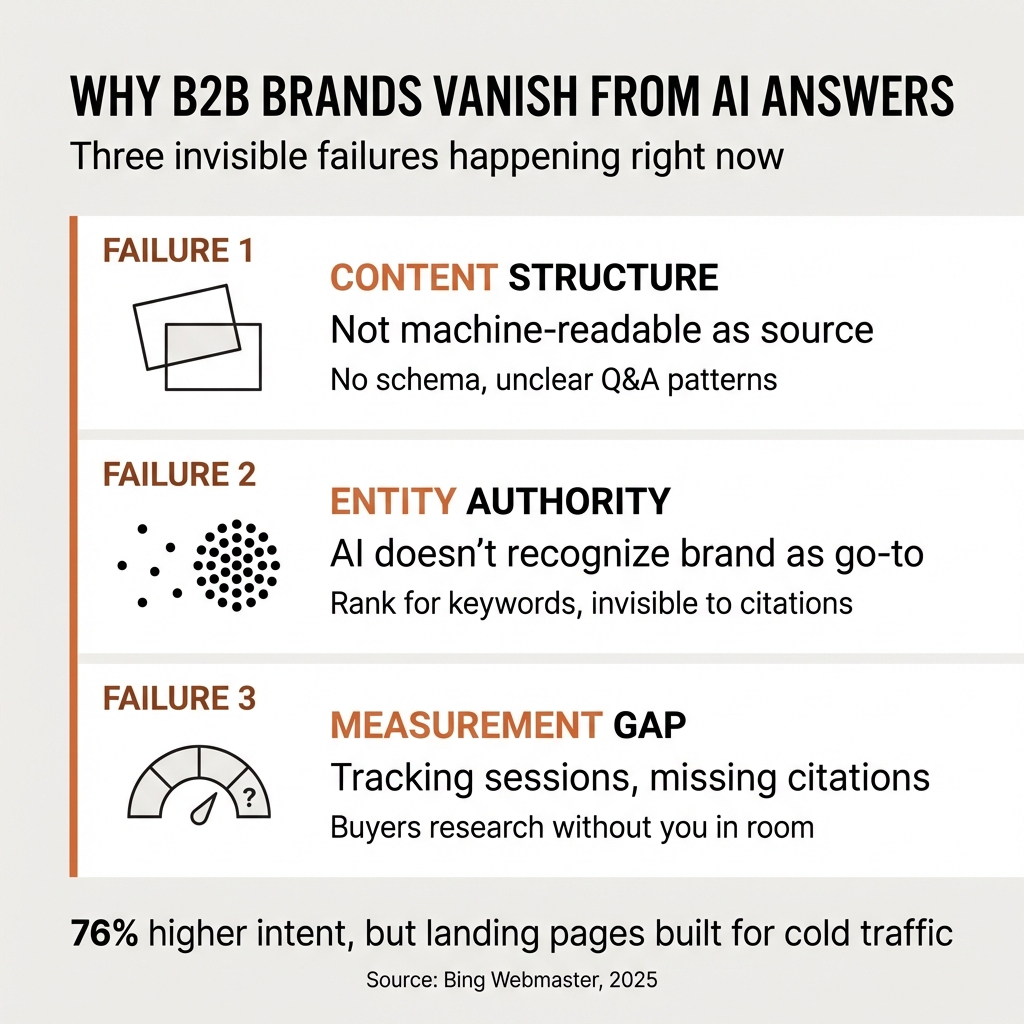
I've been documenting a pattern across B2B organizations, a specific moment when leadership realizes their entire digital infrastructure is misaligned with how buyers actually discover and evaluate solutions.
The triggering event is consistent: they search for their own brand in AI tools and discover they're completely absent from categories they thought they dominated.
Rankings look stable. Traffic dashboards show "fine." But when someone overlays AI citation data on top, the organization can see that actual buyer research is happening without them in the room.
The Real Problem Isn't Integration
When organizations say they need to "integrate AEO and SEO," they're misdiagnosing the issue.
They're not struggling to merge two tactics.
They're struggling with the fact that their entire digital footprint was built for blue links and clicks—not for being cited as an authoritative answer in AI and answer engines.
Three failure modes surface simultaneously:
Their content isn't machine-readable as a source. Most B2B sites lack the structure, schema, and clear Q&A patterns that AI systems need to confidently quote them.
Their brand has weak entity-level authority. They rank for keywords, but AI systems don't consistently recognize their brand, executives, or assets as the go-to authority across the broader web ecosystem.
Their metrics don't match how discovery works now. They're still measuring sessions, rankings, and form fills—completely blind to citations, mentions, and share-of-voice inside AI answers where buyers are already researching.
Where the System Actually Breaks
The critical break happens at what I call the "expectation handoff", the moment between the AI answer and the first owned touchpoint.
AI has pre-qualified the buyer around a very specific problem, feature set, or comparison. But the page they land on shows generic hero copy, broad category messaging, or gated content that doesn't continue the exact conversation they just had.
The data reveals the structural mismatch: Copilot-assisted journeys are 33% shorter on average, with 76% higher intent conversion rates compared to traditional search.
AI-driven users arrive much hotter and further down-funnel. Yet they hit UX and CTAs designed for cold SEO traffic—navigation mazes, top-of-funnel content, or "talk to sales" forms that assume they're still in early education.
The questions buyers asked in AI, the use cases they clarified, the competitors they compared—none of this context makes it into the CRM. Sales treats them like any other lead instead of picking up exactly where the AI conversation left off.
The Infrastructure Misconception
The biggest misconception slowing organizations down: thinking "integrating AEO and SEO" means standing up a whole new AI funnel and tech stack.
Most teams start with new platforms, AI widgets, and separate "AEO initiatives" when 70–80% of the opportunity is in restructuring their existing top-performing SEO pages so they can be safely quoted, cited, and continued by AI systems.
They treat AEO as a parallel channel instead of a multiplier, spinning up isolated "AI content" that competes with or cannibalizes the equity they've built over the years.
Organizations that move fastest don't boil the ocean.
They take their top 20–50 revenue-driving SEO pages and add clear Q&A sections, strengthen entity signals, align landing experiences to AI-style prompts, and wire just enough intent capture to feed sales.
Once they see AI-assisted traffic converting above baseline and deals moving faster on those core journeys, they expand instrumentation from a working pattern—not from trying to architect the perfect system on day one.
The Proof Point
The first real signal that the unified system works: a lift in conversion rate on AI-sourced and mixed traffic, with fewer touches per opportunity.
When the system works, visitors coming from AI tools show materially higher form conversion and lower bounce compared to historical averages. Sales sees more first meetings turning into proposals, with shorter time from first touch to qualified opportunity.
The pattern I'm documenting represents a broader shift: successful organizations are treating their best existing assets as answer-ready authority sources, not building parallel infrastructure.
The convergence isn't about tactics merging. It's about organizations recognizing that the infrastructure they built for algorithmic visibility needs to serve human trust-building at the same time—or risk disappearing from the discovery layer entirely.


Comments
Post a Comment