The Governance Paradox in Enterprise AI
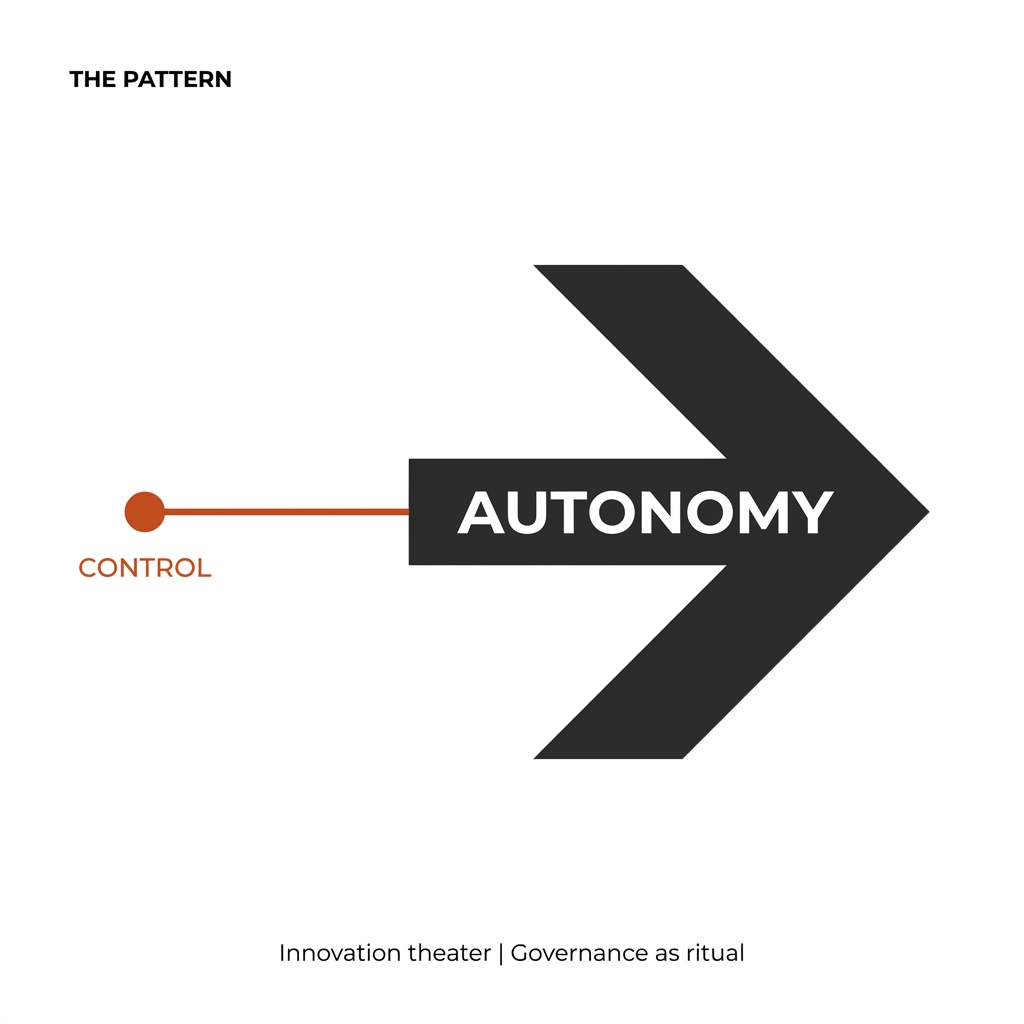
I've been documenting a pattern in enterprise AI adoption that reveals something organizations won't say out loud. They're building control systems while performing innovation theater.
The surface narrative celebrates autonomous intelligence. The underlying structure reveals institutional anxiety about relinquishing control.
This isn't a technology problem. It's an ethnographic artifact, a window into corporate belief systems about autonomy, risk, and authority.
The Performance of Innovation
Organizations are rehearsing autonomy inside a cage they don't intend to unlock.
What appears as bold experimentation functions as a negotiation between two incompatible logics: innovation demands speed and messy feedback loops, while governance demands predictability and traceable accountability. Agentic AI stresses this fault line because it stops being "just a tool" and starts acting like a semi-autonomous actor that can plan, execute, and touch real systems.
The observable pattern clusters around innovation theater as pressure valve. Pilots absorb executive demands to "do something with AI" without forcing changes to ownership structures, incentives, or operating models. Gartner predicts over 40% of agentic AI projects will be canceled by 2027 due to escalating costs and inadequate risk controls, despite task-specific AI agent adoption jumping from less than 5% in 2025 to 40% by the end of 2026.
The work stays in sandboxes because that's where risk, politics, and accountability can be deferred.
PDF Governance as Cultural Ritual
Governance lives in policy documents, not in systems, invoked selectively to stop uncomfortable moves rather than encode executable boundaries.
I observe this as documentation governance versus operational fabric. Rules on paper that beg to be bypassed versus rails in the road that make the safe path the path of least resistance.
PDF governance manifests as artifacts, committees, and ceremonies that sit around the work instead of inside it. AI principles, model risk taxonomies, and RACI charts live in SharePoint, periodically updated and presented in steering committees but rarely wired into tools or pipelines. Projects move through manual checklists and sign-offs. If something passes the meeting, it's considered governed, even if nothing changed in how the system runs.
The structural tell: risk is managed through persuasion and exception processes, not through default-deny mechanisms or automated enforcement.
Organizations bet on culture and heroics to compensate for weak control surfaces. 98% of organizations report unsanctioned AI use, with 78% of employees bringing their own AI tools to work—creating what amounts to 76% of businesses actively running "shadow AI" within their workforce.
The Credibility Collapse
The first visible breakdown isn't a headline incident. It's the moment people quietly stop treating the governance process as real.
I track this loss of credibility through three observable patterns: rising governance exceptions and workarounds, shadow AI becoming normal rather than marginal, and governance rituals without real decisions. Committees meet, slide decks grow, but deployments rarely change because of governance feedback, and no one can say who is empowered to stop or roll back a misbehaving system.
Organizations don't admit "our governance is fake"—they reframe it. Leadership shifts blame from structure to people, positioning it as a training or mindset gap. They relabel inconsistency as "intentional flexibility" and "principles-based approaches." They recast ungoverned behavior as proof of innovative culture rather than evidence that official governance is being routed around.
The tell: when you hear extensive talk about culture, principles, and empowerment, and almost nothing concrete about what is technically impossible for agents and employees to do anymore, governance has shifted from control system to story the organization tells itself to feel in charge.
The Infrastructure That Never Arrives
Even after forcing events (data leaks, quantified shadow AI exposure, external regulatory pressure), most organizations don't build operational fabric. They build better documentation and call it governance 2.0.
The structural reason: documentation fits existing power structures, budget models, and change tolerance in a way real infrastructure does not.
Governance sits in legal, risk, compliance, and policy offices whose native tools are frameworks, templates, and committees, not control planes and runtime hooks. When the problem is framed as "write and oversee policies," the obvious response to failure is "write better policies," not "re-architect pipelines and entitlements."
It's far easier to fund a governance program (consulting, training, new policies, a steering committee) than to fund deep engineering work across product, data, and infrastructure to embed controls. Policy work closes audit findings and produces visible artifacts quickly. Infrastructure work is slower, cross-cutting, and often booked as cost with no short-term KPI win.
Organizations have decades of muscle memory for "add a policy, adjust a process, create a RACI," and very little for "treat governance as a first-class platform capability."
The path of least resistance runs through Word, PowerPoint, and Confluence.
What Enterprises Actually Believe
The complete pattern reveals a core belief organizations act on but won't say out loud: we want the productivity of autonomous systems, but we do not, under any circumstances, want to live with true autonomy.
Their behavior encodes three implicit convictions. Autonomy is treated as a risk surface, not a value, something that must be bounded, logged, and overrideable at all times. Humans must remain the ultimate locus of control and blame. Governance models insist AI is "a tool, not a decision-maker," revealing deep reluctance to cede any final agency to systems. Trustworthy autonomy means managed dependence, not independence. Autonomy is acceptable only when typed, tiered, and surrounded by guardrails that keep it instrumentally useful but structurally subordinate.
Publicly, they reframe these convictions in the language of optimism. They talk about "enabling human-centric, trustworthy AI" and position guardrails as structures that "unlock responsible innovation at scale." They frame autonomy as acceptable "as long as it is accountable," but the non-negotiables (traceability, override, auditability) reveal that anything resembling independent will is off the table.
The rhetoric of "enablement" functions as cultural lubrication for constraint. It lets organizations quietly tighten control while publicly telling a story about progress, the only story most stakeholders are prepared to celebrate.
Enterprises want instrumental autonomy—systems that act and adapt for them, but reject sovereign autonomy, systems that genuinely own decisions or goals. They're building architectures where AI can do more and more work while remaining fundamentally a managed, reversible extension of human intent.
Autonomy is acceptable only to the extent that it can be continuously observed, constrained, and overridden by humans when it matters.


Comments
Post a Comment