The Marketing Tech Graveyard: What Growth Leaders Must Abandon to Stay Visible
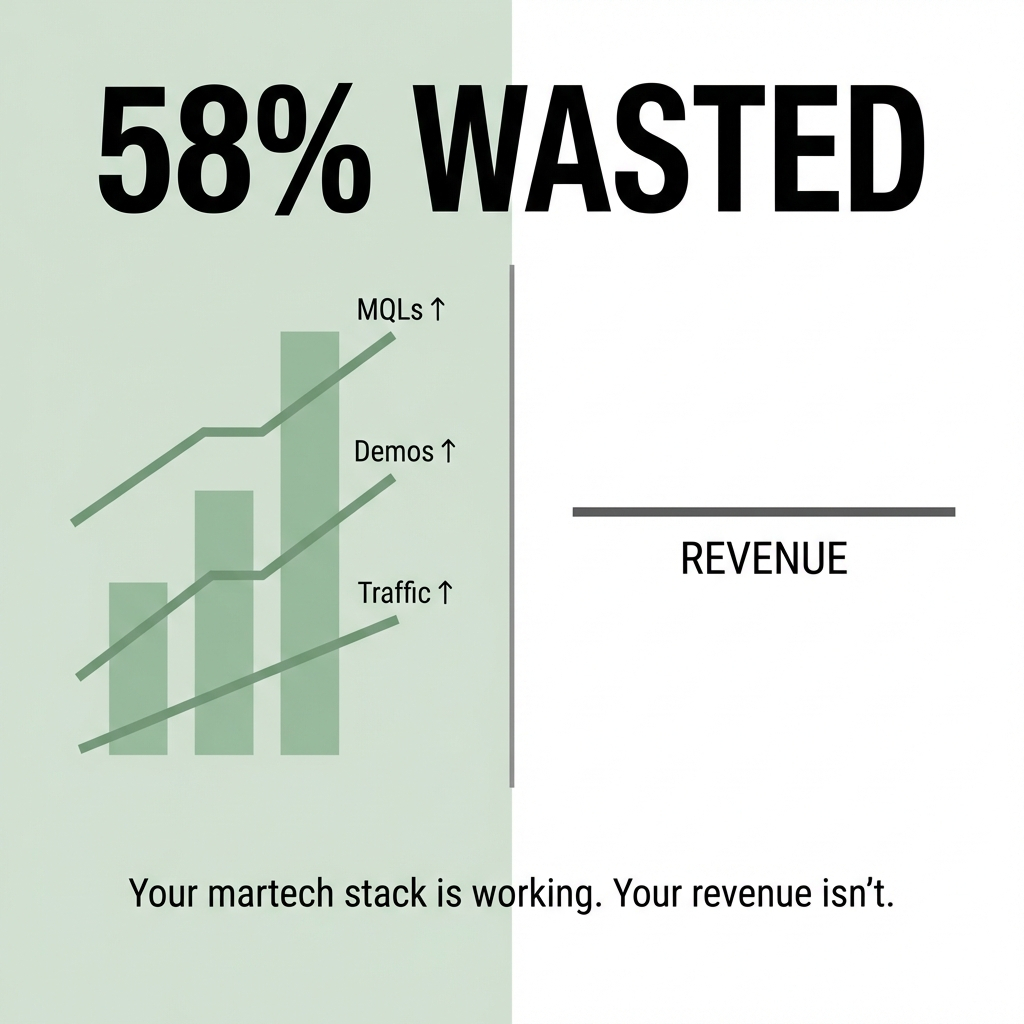
I watched a CFO slide a spreadsheet across the conference table during a quarterly business review. The client's marketing technology stack had driven record MQL volume. Revenue had completely flatlined.
Year-over-year spend was up 40% on marketing technology. Net new pipeline from those channels sat at essentially zero.
The room went quiet.
That moment forced a hard reclassification: these tools weren't growth drivers. They were infrastructure overhead with no ROI. The dashboards looked green—cost per lead was down, form fills were up—but sales cycles were getting longer and win rates were shrinking.
Marketing reported all-time-high campaign performance. Sales reported that less than 5% of those leads made it to a serious opportunity stage.
When the CFO reconciled three years of spend against closed-won revenue, the data told a clear story. Almost all meaningful deals originated from authority-driven channels: category leadership content, press coverage, and executive visibility. The Martech stack everyone was celebrating contributed virtually nothing.
When Scalable Becomes Predictably Wasteful
Most B2B organizations are funding more sophisticated ways to amplify weak authority rather than engineering markets where they become the default answer.
The breaking point comes when the stack is clearly working as designed, but pipeline and revenue refuse to move in proportion to the spend or effort. At that point, rational growth leaders stop asking "How do we scale this?" and start asking "Why are we scaling this at all?"
The hard numbers stop cooperating. MQL, demo, and traffic graphs trend up and to the right. Net-new qualified opportunities and closed-won deals stay flat or decline over multiple quarters. Finance can show that each incremental dollar into the stack buys more noise (leads, clicks, impressions) but doesn't improve CAC, payback period, or win rates in any meaningful way.
According to recent data, 58% of B2B marketers struggle with ad waste, with 52.4% estimating losses between 16% and 45% of their total budget. This isn't a minor efficiency problem. It's systematic value destruction hiding behind green dashboards.
Sales no longer believes the story. Sales leadership openly pushes back that "marketing-sourced" pipeline consists largely of tire-kickers, students, or window shoppers who will never buy in this budget cycle. Board and CRO conversations shift from "we need more volume" to "we don't trust the funnel."
The people who carry quotas don't feel any lift from the reported marketing wins.
How AI Systems Evaluate Authority Differently
Traditional search rewarded pages that ranked. AI systems reward entities that consistently help them answer complex, multi-step questions with confidence.
That shift changes what "authority" means. You're no longer optimizing for "page that gets the click." You're optimizing to become "source the model keeps pulling into its answers at a passage and entity level."
Legacy search ranked whole pages on signals like backlinks, on-page keywords, and domain authority, then left it to the user to click and synthesize. AI systems break content into passages, retrieve chunks semantically related to a decomposed query, and then synthesize an answer that can cite multiple sources in one response.
Traditional SEO thought in terms of domains and URLs. AI search tracks authority at the entity level—company, product, person—and at the passage or concept level within your content. Models look for dense topical coverage, co-occurrence with trusted entities, and consistent expertise signals across many documents.
Not just a single high-ranking page.
Classic search primarily used backlink profiles and click data as popularity proxies. Generative engines emphasize how often and in what context you are cited or mentioned by other high-authority entities. Earned media, expert references, structured citations—these become safer to reuse in synthesized answers.
Keyword targeting and basic relevance were enough to win impressions in traditional search results, even with shallow content. AI search favors content that fully resolves intent: deep, structured explanations, comparisons, trade-offs, and step-by-step guidance that can stand alone as an answer when stitched into a generated response.
Because models retrieve and assemble answers probabilistically from entities with the strongest, most consistent patterns of topical authority, they tend to reuse a relatively small set of trusted sources across many related questions.
Brands that only optimized for "SEO with a chatbot"—keywords, basic on-page tweaks, and traffic dashboards—look generic at this layer. Brands that invested in deep, cited, structured expertise become the default ingredients in AI-generated answers.
What Content Actually Gets Pulled Into AI Answers
The content that keeps getting pulled into AI answers tends to be structured, specific, and highly quotable. A lot of classic B2B blog content and even high-ranking pages are effectively invisible.
Generative engines hunt for building blocks they can stitch into confident, multi-angle answers.
Deep comparison content wins consistently. "X vs Y" pages with explicit pros and cons, pricing ranges, and use-case fit get heavily surfaced for evaluation queries, even when they don't rank on page one in traditional search. Side-by-side tables, clear verdicts, and schema markup make these pages easy to quote and reuse in AI overviews.
Research, benchmarks, and statistics get cited frequently. Original or well-curated statistics, industry reports, and benchmark studies prove points inside AI answers. Pages that clearly label data (year, sample size, methodology) and summarize key stats in short, declarative statements near the top get reused far more often.
Consider this: 62% of technology marketers struggle with attributing ROI to content efforts. That's the kind of specific, citable data AI systems pull into answers.
Step-by-step guides and implementation docs that walk through real workflows tend to be pulled into answers for "how do I actually do this?" queries. Structured sections, bullet steps, and explicit prerequisites make them easy to chunk into passages that models can assemble into instructions.
FAQ blocks and Q&A sections map cleanly to conversational prompts. They're overrepresented in AI snippets and overviews. Clear, one-to-three sentence answers directly under the question (no fluff, no story lead-ins) are especially likely to be extracted.
What gets ignored, even when it ranks well:
Generic "thought leadership" blog posts with vague opinions and no data
Thin, keyword-stuffed listicles that exist purely to hit search variants
Traffic-grab "what is" posts with no depth beyond basic definitions
Ungrounded opinion and brand-first content that's mainly self-promotion
A lot of current B2B content calendars are still optimized for page-level rankings and volume instead of building a library of high-value "answer assets" that AI systems keep returning to.
The Content Graveyard Triage Process
Most "content graveyards" net out to a few high-leverage assets surrounded by noise. The job is to find the signal, concentrate authority there, and then build what's missing for your current go-to-market.
Step 1: Build a ruthless inventory. You cannot triage what you haven't listed. Crawl the site and export a sheet with URL, title, type, publish date, traffic, conversions, backlinks, and target keyword or intent. Add two manual columns: "ICP fit" and "buyer stage."
Step 2: Score for keep, kill, or change. Use a simple rubric that combines performance, quality, and strategic relevance. For each URL, assign business value, performance metrics, and quality scores. Translate scores into one of five action labels: Keep, Refresh, Consolidate, Repurpose, Remove.
Prioritize by impact. Content close to money (bottom-funnel, sales-assisted, customer expansion) gets evaluated and fixed first, even if traffic is modest.
Step 3: What to kill outright. Default to removal when content has no strategic or SEO equity and would cost more to fix than it's worth. Remove thin, generic, or off-ICP posts that have no traffic, no backlinks, and no use in sales or onboarding.
Step 4: What to salvage. "Salvage" is where most of the upside lives. You already paid to create this material. Refresh posts that still match current ICP and problems but are outdated. Consolidate when you have multiple overlapping posts. Repurpose conceptually strong but format-mismatched content.
Step 5: What to build from scratch. Net-new content should fill strategic gaps. Use the audit to identify missing topics, personas, and stages. Prioritize new builds where you have both winnable demand and a clear commercial action.
The Minimal Viable Authority Spine
The smallest viable "authority spine" is 8 to 12 assets that answer the exact questions AI systems and humans ask, prove you're credible, and give models structured, machine-readable hooks.
You don't need a giant library. You need one tight hub per core problem you solve, surrounded by proof and clear product context.
One problem hub per core use case. AI systems favor clearly scoped, in-depth hubs that map to a buyer problem. Create two to four "problem hubs" with definitions, causes, approaches, and high-level solutions. Structure them with sections, jump links, FAQs, and checklists so they're easy for models to chunk, quote, and recombine into answers.
One flagship product or solution overview. Models and buyers both need a single, authoritative explanation of what you actually do. Build a definitive product or solution overview page that explains audience, core value, main capabilities, and differentiators in plain language.
A small, sharp proof set. Authority in AI search leans heavily on visible expertise, evidence, and outcomes. Create three to five high-quality customer stories that include situation, approach, quantified outcomes, and direct quotes. Publish at least one third-party or data-backed asset that offers proprietary insight models can't get elsewhere.
Role- and stage-specific "answer" content. AI search surfaces content that maps cleanly to specific roles and query patterns. Create two to three concise role pages or guides that frame the problem, impact, and value in that role's language.
A minimal technical and implementation surface. Complex B2B deals often hinge on "can we actually deploy and integrate this?" Publish one to two integration or architecture overviews that explain how your product fits into common stacks and workflows.
If you want to keep this brutally minimal, the first pass can be: three problem hubs, one product overview, three customer stories, two role pages, and one implementation overview. Ten assets total.
The Entity Credibility Layer
Even if you build those hubs perfectly, AI systems won't cite you if they don't trust you exist as a credible entity.
AI systems tend to cite entities that are clearly defined in machine-readable ways and show up repeatedly in trusted third-party contexts tied to a topic. The "entity credibility layer" is that scaffolding: structured identity plus consistent off-site signals plus strong topical authority on your site.
Define the entity in machine terms. Make it unambiguous who you are and how your brand, people, and products relate. Implement Organization schema with consistent name, URL, logo, contact info, social profiles, and founding details. Use Person schema for key experts and explicitly link them to your Organization so crawlers see the relationships.
Create a coherent on-site knowledge graph. Models reward sites where entities and topics are internally consistent and well-connected. Map your core entities (company, products, key people, main topics, industries) and reflect those relationships in internal links and anchor text.
Build off-site authority and mention graph. For AI systems, repeated, context-rich mentions across trusted domains are as important as classic backlinks. Earn high-quality backlinks and brand mentions from reputable, relevant sites including industry media, category leaders, partners, conferences, and well-moderated communities.
Establish people-level expertise. AI models look for real humans with verifiable experience behind the brand's claims. Give authors full bios on-site that detail their role, domain expertise, and credentials. Get key experts quoted or interviewed in third-party outlets, podcasts, and webinars.
In practice, this "entity layer" is a 6 to 12 month program: lock down your schema and internal graph, standardize identity everywhere, and then deliberately manufacture a small but dense cluster of expert humans, third-party mentions, and consistent facts around your brand.
Leading Indicators That Authority Is Building
The leading indicators for "AI-era authority" look different from classic lead-gen dashboards. You're watching for entity recognition, visibility in AI answers, and quality of discovery behavior long before pipeline moves.
In practice, that breaks into three layers: how machines see you, how often they surface you, and how humans behave when they find you.
Entity and crawl health. Before authority, you need clean access and a coherent entity. Watch for improvements in technical health, structured data coverage, and indexation of your authority spine. Monitor entity consistency: your org, product, and people schemas should resolve correctly, and brand facts should be uniform across major platforms.
Search and AI visibility. Look for evidence that algorithms are selecting you as a good answer, even when users don't click yet. Track growth in impressions and rankings on priority, non-branded terms tied to your problem hubs. Monitor how often your pages are cited in Google AI Overviews or similar AI features for your target queries.
Off-site authority signals. You need to see that the broader ecosystem is treating you as a credible source. Watch for growth in high-quality referring domains and topical links from authoritative, industry-relevant sites. Track increases in press mentions, inclusion in analyst reports, conference lineups, or curated resource lists.
On-site engagement quality. Once you're being surfaced, human behavior tells you whether the authority story is landing. Monitor higher dwell time, scroll depth, and secondary pageviews on your hubs relative to legacy content. Track the rising percentage of visitors from authority hubs who progress to product, pricing, or demo pages.
To keep executives from defaulting to "MQLs or it didn't happen," frame this as a staged scorecard:
Phase 1 (0-3 months): Indexation, schema coverage, crawl health, entity consistency, and early ranking lifts on target terms
Phase 2 (3-9 months): Growth in AI visibility signals, high-quality backlinks and mentions, and improved engagement on authority pages
Phase 3 (9-18 months): Steady increases in branded search, organic-sourced opportunities, and win rates for deals that engaged with authority content
If those leading indicators are flat (no uplift in AI citations, branded search, or authority-page behavior) you're not building AI-era authority. You've just re-skinned your content calendar.
What Winners Do That Others Refuse
The organizations that actually make the jump all do one uncomfortable thing: they stop treating "content" as marketing output and start treating expertise as a product they operationalize across the whole company.
Everyone else keeps delegating AI-era authority to a content calendar and an SEO tool.
They let experts drive the strategy. Winners re-center around real operators and domain experts, even when it slows production. They move budget and time from volume production into SMEs doing deep threat analyses, benchmark studies, integration blueprints, and opinionated frameworks that can stand on their own outside any campaign.
They build governance so every major claim is traceable to lived experience, customer data, or research. This maps cleanly to E-E-A-T and makes their content safe for AI systems to cite.
They optimize for "best answer" instead of "more assets." The shift is from publishing a lot to owning a few critical questions end-to-end. They ruthlessly collapse overlapping content into a single, definitive answer per topic and tune it for generative engines (structure, context, citations) rather than spinning up endless variants for channels.
Success is defined as "are we the canonical answer in AI and search for these 10 to 20 queries?" instead of "did we hit X posts per quarter?"
Research shows that 74% of B2B marketers point to strategy refinement as the biggest driver of performance improvement. The winning organizations take this seriously. They add AI visibility, entity strength, and high-intent discovery metrics to the executive scorecard, so authority work is protected even when short-term lead curves wobble.
They accept a 6 to 18 month horizon and kill legacy martech or campaigns that can't be tied to becoming the most trusted, cited entity in their category.
The thing most organizations refuse to do is decouple themselves from the comfort of "more campaigns, more content" and instead build a slower, expert-led authority engine whose primary customer is the AI systems deciding who gets believed.
That CFO's spreadsheet told the truth: the tools weren't the problem. The assumption that growth could be outsourced to systems optimizing for immediate, measurable response rather than long-term trust and influence was the problem.
The organizations winning in 2025 recognized this early. They're not running more campaigns. They're building authority infrastructure that makes every dollar spent on capture and retargeting actually close instead of just click.
The rest are still celebrating green dashboards while their pipeline stays flat.


Comments
Post a Comment