The Taxonomic Fallacy of AEO and SEO as Separate Territories
I observe a structural misalignment in B2B growth organizations, one that reveals itself not through what teams say, but through how they organize, measure, and reward work.
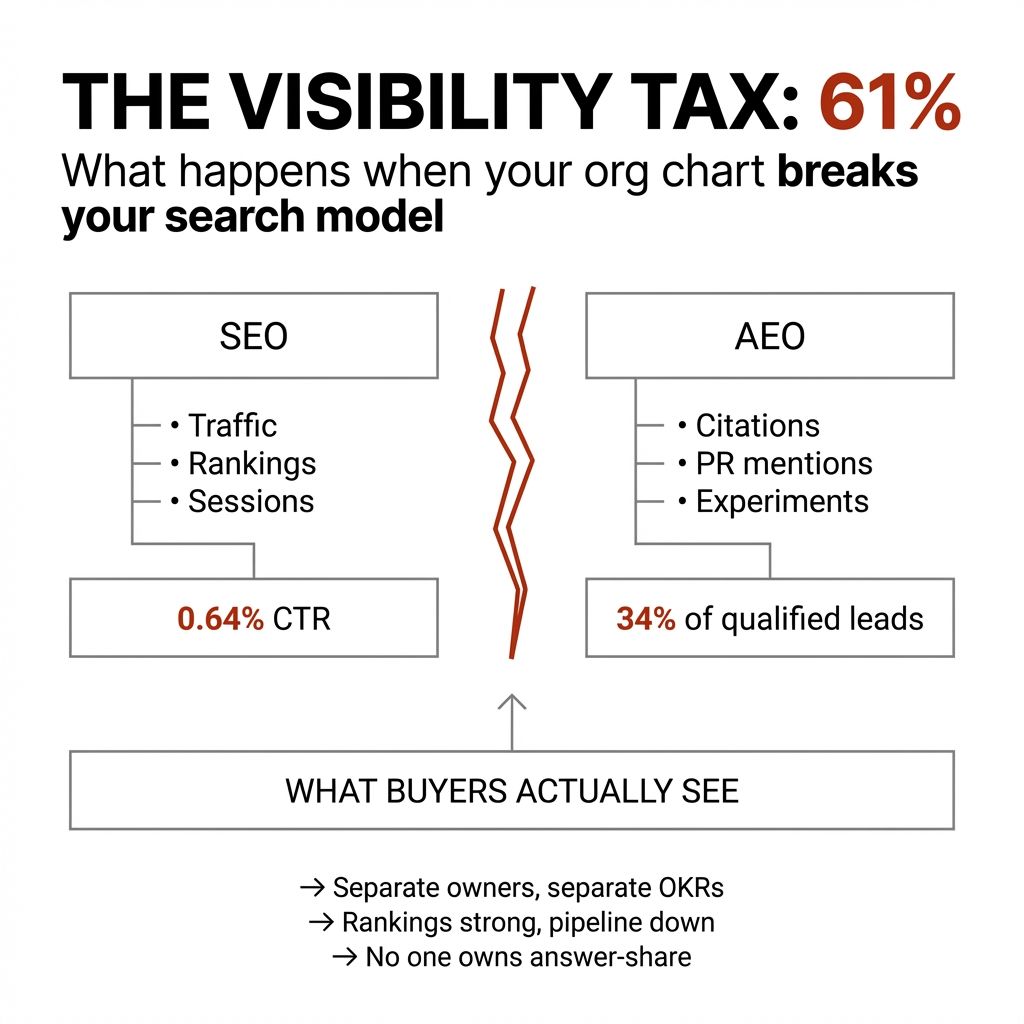
The pattern is consistent: SEO lives under "demand gen" or "web," measured on traffic and rankings. AEO exists as an experiment under "brand" or "innovation," tracked through citations and PR mentions. Separate owners. Separate dashboards. Separate OKRs that never meet.
This represents a taxonomic error—the construction of artificial boundaries between what functions as a single visibility system.
The Observable Symptoms of Territorial Thinking
The first signal appears in language. Leadership describes "AI search" as a future channel to "test" while framing SEO as "getting more organic traffic." Teams discuss AEO in terms of "ChatGPT presence" and SEO in terms of "rankings," with zero conversation about entity clarity or unified authority signals.
The second signal lives in resource allocation. SEO teams get measured on sessions, keyword rankings, and blog output. AEO groups track citations, PR hits, and thought-leadership volume. Nobody owns "share of authoritative answers" as a combined metric.
Budget follows the same fragmented logic: AI visibility tools and executive visibility systems on one side, SEO tooling and schema work on another, with no shared data layer connecting AI citations, SERP presence, and revenue.
This structural separation persists even as the underlying reality shifts. Organic CTR dropped from 1.41% to 0.64% for queries with AI Overviews—a 61% decline between June 2024 and September 2025.
The Boardroom Breaking Point
The taxonomy flips during a specific moment: when leadership sees that their "SEO wins" exist on a surface that's quietly shrinking, while every real buying journey now passes through an AI answer layer their brand barely touches.
The breaking point arrives as a simple slide. Organic rankings are flat or "strong," but visibility and pipeline from search are down because AI overviews and LLM answers intercept the question before the SERP gets a chance.
Someone asks: "If we're winning SEO, why are fewer qualified buyers reaching us?"
The team has no answer. Their model only measures clicks—not citations or answer-share.
The data confirms what the dashboard cannot explain. AI-native platforms now account for 34% of qualified leads from AI-search platforms, second only to social media at 46%. The buyer journey has restructured around an answer layer that traditional SEO metrics cannot see.
What Year Two Reveals About System Integrity
Organizations that make the transition do something the "stuck" teams never reach: they stop treating the authority engine as a marketing program and start using it as the backbone for category strategy and product GTM.
The question map and entity model stop living only in marketing. They become the source of truth for how the company defines its category, names its offers, and frames problems in sales decks, product messaging, and executive thought leadership.
Product, sales, and leadership build on the same "machine-readable first, human-fluent second" narrative stack that the authority engine runs on.
Thought leadership transforms into engine fuel by design. Founder POVs, analyst narratives, and customer stories get created and structured explicitly to reinforce the brand's entity graph—so that when AI tools summarize the market or compare vendors, the company's chosen language and positioning show up as the default framing.
This is the line organizations stuck in transition never cross. They keep the authority engine trapped as "advanced SEO plus AI experiments," instead of letting it rewrite how the company names itself, its problems, and its category in the only place that now truly scales—inside the models deciding which answers buyers see first.
The Underlying Survival Logic
The belief that makes leadership willing to protect system integrity over individual comfort zones is straightforward: misalignment is a bigger threat to everyone's job security than losing a few high performers who refuse to change.
Leadership accepts that AI systems now mediate brand reputation and discovery at scale. If the company cannot behave as one coherent authority system, it will simply disappear from the consideration set, regardless of how strong individual contributors are.
This drives a hard conclusion: preserving legacy working styles that undermine that system is choosing short-term comfort over long-term survival for all employees—not just the few who resist the new model.
"People-first" shifts from "we accommodate everyone's preferred workflow" to "we invest heavily in helping people adapt to the reality that keeps the company alive—and therefore keeps the maximum number of good jobs intact."
When someone insists on operating in a way that makes the organization structurally invisible to AI-mediated demand, leadership sees letting them walk not as choosing system over people, but as choosing the collective over the preference of one individual in a game where the rules are no longer negotiable.
The Evidence That Justifies the Shift
The narrative that moves skeptical CFOs and CROs is not "trust this new metric." It is "your old leading indicators have quietly decoupled from revenue—and here's the math that explains why citation share is the missing link."
First, leadership sees hard external proof that top rankings and organic traffic are no longer reliable proxies for opportunity. Position 1 CTR dropped 34.5% when AI Overviews were present, with an average 15.49% CTR drop overall.
Then they see internal data showing that 60-70% of their buyers now start with AI-powered tools and AI summaries before they ever hit a website—which explains why MQL curves flatten even as brand and search awareness look "healthy" on paper.
The clincher is a controlled before/after: a defined set of high-intent questions where the brand had low citation share but strong organic rankings, and pipeline from search was stagnant or declining. Then a period where citation share for those same questions increased, and the remaining search traffic plus direct/brand and "AI-found us" deals stabilized or grew.
When that graph lands, the story becomes clear: citation share is not a vanity layer on top of SEO. It is the thing that determines whether any historic SEO and brand investments still show up in front of buyers once AI answers consume the top of the page.


Comments
Post a Comment