Turning Confusing Marketing Data Into a Clear, Revenue-First Growth Engine
I watched a SaaS company celebrate its best quarter ever.
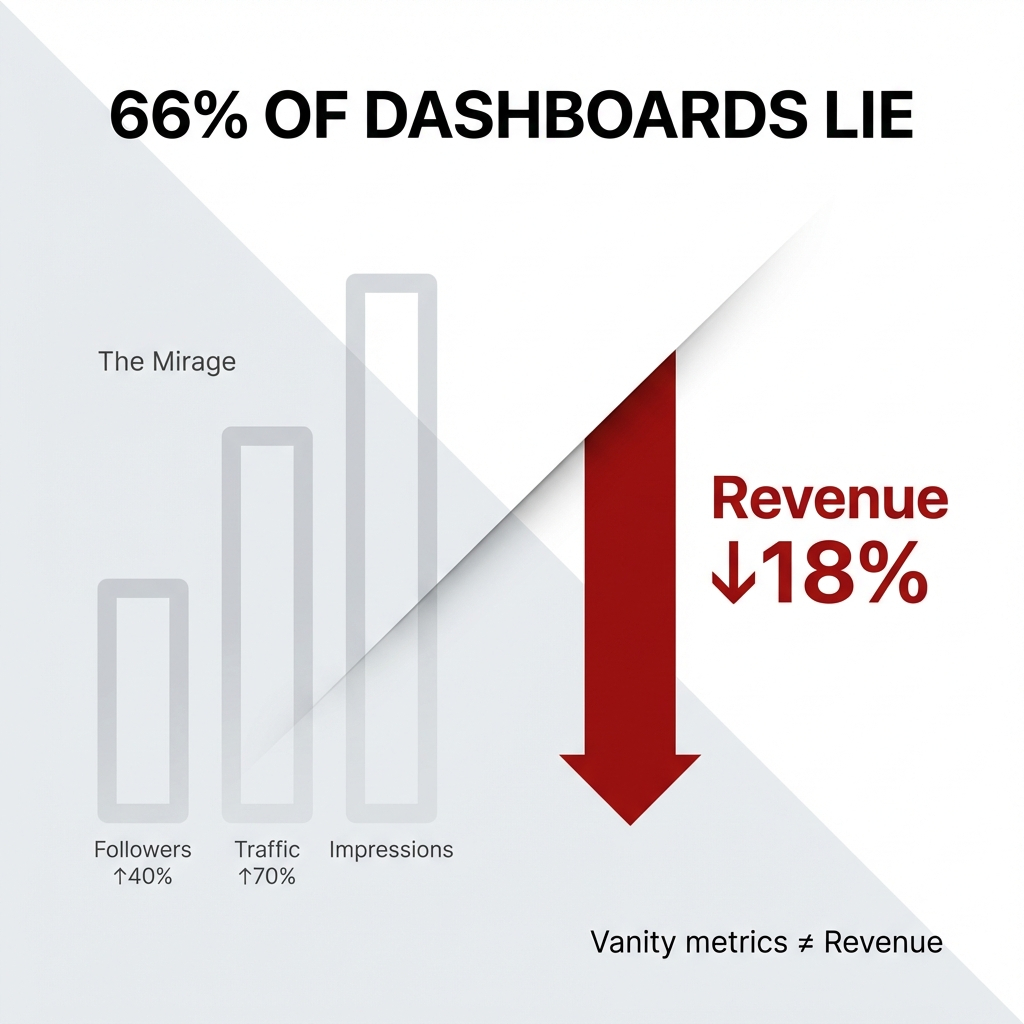
Followers up 40%. Impressions up 70%. Web traffic is at an all-time high.
The marketing team got bonuses. The CEO sent a company-wide email praising the "momentum."
Then the revenue report landed.
They missed their target by 18%. Sales velocity had slowed. Win rates were down. The pipeline was full of leads that would never close.
The dashboard lied.
This happens more than you think. B2B marketing leaders report that 25% of their marketing budget is wasted on efforts that fail to drive outcomes. Organizations with frequently misleading metrics waste 30% of their budget, compared to 23% for those with rarely misleading metrics.
The problem is structural. We built an entire industry around numbers that look good in slide decks but mean nothing to the business.
The Marketing Data Mirage
Two-thirds of marketing leaders say their dashboards sometimes, often, or very often show success that fails to translate into revenue.
Think about that.
66% of leaders report that campaign metrics often look successful but fail to drive actual revenue outcomes. The report defines this as "the Marketing Data Mirage"—a disconnect so common it has a name.
Here's what actually happened in that SaaS company:
The campaigns driving the biggest follower gains were pulling in the wrong personas entirely. People from industries, company sizes, and geos that had near-zero conversion history. The content was broad, entertaining, and trend-jacking. Great for reach. Terrible for attracting serious buyers with the right problems and budgets.
Nobody caught it for six months because success was defined around channel dashboards that reported growth in isolation. Social teams owned followers and engagement. Web teams owned traffic. Nobody was accountable for tying those numbers to a qualified pipeline.
The vanity metrics masked weak positioning and misdirected budget decisions.
The Intent Signal Problem
87% of B2B organizations say their marketing investments produce unreliable or inflated intent signals.
Clicks, downloads, behavioral scores—things that don't reflect real buying intent.
Only 26% of "intent" signals convert to qualified opportunities. That's a massive gap between vanity metrics and actual pipeline contribution.
CFOs increasingly expect marketing to defend spend with revenue impact, not vanity metrics. This creates a dangerous credibility gap when marketing reports vanity wins while leadership sees flat revenue.
The pressure is real. And it's forcing a reckoning.
The Three Metrics That Actually Predict Revenue
When you overlay vanity metrics with pipeline and revenue data, three metrics consistently show up as real predictors of whether a company will hit its numbers:
1. Qualified Pipeline (Not "Leads")
The leading indicator is the volume of opportunities that actually match your ICP and convert at or above historical close rates.
Not total leads. Not MQLs.
Consistent growth in ICP-fit opportunities tracks tightly with future revenue. When follower and traffic spikes don't move qualified pipeline, revenue misses are almost guaranteed.
2. Sales Velocity and Win Rate
Time-to-close and stage-by-stage win rates say more about marketing effectiveness than CTR or impressions.
High-intent, well-educated buyers move faster and close at higher rates. When velocity improves, and win rates rise in target segments, companies almost always land near or above plan—even if "engagement" looks modest.
Research shows that 43% of B2B sales leaders reported an increase in sales cycle length over the past 12 months. Meanwhile, organic inbound leads at 500+ employee companies demonstrate 2x faster velocity than other sources.
Organizations implementing weekly sales velocity tracking demonstrate 34% annual revenue growth compared to 11% for those with irregular tracking patterns.
3. Net Revenue Retention and Expansion
The most reliable predictor of durable growth is how much revenue is retained and expanded with existing customers.
This reflects whether marketing attracted the right problems, budgets, and decision-makers in the first place. Strong NRR and expansion, even with flat vanity metrics, is a better sign of a healthy engine than explosive reach paired with churn and low renewal rates.
The Content That Actually Shortens Sales Cycles
Most "educational" content explains what something is, shares generic tips, or recaps trends. It makes readers smarter, but not necessarily more ready to buy from you.
Content that really shortens sales cycles does two things most educational content never touches:
It changes how buyers make decisions, and it pre-solves the objections that usually slow deals down.
Decision-focused content names trade-offs, frames the category, and clarifies who your solution is and is not for. Buyers walk into sales calls already aligned on the problem, approach, and success criteria.
This content shows up in the sales process. Reps actively send it before or after key calls because it answers the exact questions, risks, and comparisons that normally require multiple meetings.
It's built from win/loss and call data: real objections, internal politics, and comparison questions pulled straight from the field. It explicitly talks about implementation, failure modes, ROI proof, and stakeholder alignment, so buyers can pre-sell the decision inside their org without endless back-and-forth.
Research from Champion Communications found that traditional media efforts yield a conversion rate of 1%, whereas leveraging earned media in conjunction with such techniques increases this conversion rate to 5%, a 400% improvement that comes from credibility over visibility.
The Attribution Gap Nobody Talks About
Single-touch attribution models provide straightforward insights but fail to capture the holistic impact of multiple touchpoints.
This leads companies to misallocate budgets based on incomplete data.
B2B attribution is challenging because the customer journey is long and complex, often involving multiple stakeholders across extended timeframes. Traditional attribution is completely dark to the real impact of authority-building, thought leadership, and brand credibility.
The content that drives the biggest numbers often isn't the content that closes deals. But if you only measure what's easy to track, you'll keep funding the wrong things.
The Structural Change That Makes This Work
The single biggest structural change is creating one shared revenue pod where marketing and sales leaders own the same pipeline and revenue targets, with a single dashboard and joint review cadence.
Once that exists, collaboration stops being "nice to have" and becomes mandatory for everyone's success.
A VP or Head of Revenue owns one number across marketing and sales, with marketing, SDR, and sales leaders all bonused on qualified pipeline, revenue, and NRR—not separate channel KPIs.
Weekly pod reviews use one dashboard: opportunities, velocity, win rate, and expansion by segment, with vanity metrics only as context, never the headline.
This removes escape hatches. Marketing cannot claim victory on leads while sales miss, and sales cannot blame "lead quality" without data, because both are accountable for the same outcomes.
It forces content and campaigns to start from sales reality—call recordings, objections, win/loss data, because those are the levers the whole pod is measured on.
How AI Changes the Game
AI is finally making it possible to stitch messy, siloed data into a coherent, near-real-time revenue picture instead of a pile of disconnected channel reports.
The shift is less about "more data" and more about turning the data companies already have into an always-on revenue model that humans can actually act on.
Five years ago, connecting ad clicks, content consumption, CRM stages, and revenue often meant manual exports and fragile spreadsheets. Today, AI can reconcile identities and events across tools with far less human work.
This makes it realistic to see how a campaign or asset impacts qualified pipeline, velocity, and win rate within days, not quarters, so vanity metrics lose their power as the only "fast" feedback.
Modern AI can process call recordings, emails, and chat logs at scale, tagging objections, competitors, and decision dynamics that used to live only in reps' heads. That turns qualitative data into structured inputs for dashboards and content.
Instead of static reports, AI models can simulate "if we shift budget from this high-CTR campaign to this high-velocity segment, here's the likely impact on pipeline and revenue."
This changes the politics. Executives can see, in advance, how optimizing for vanity metrics underperforms against revenue-focused scenarios.
Why Agencies Keep Selling Vanity Metrics
Agencies resist this shift because the current system makes vanity metrics the most profitable, defensible, and low-risk product they can sell.
Followers, impressions, and click volumes are abundant, cheap to generate, and look impressive in slide decks even when margins are thin and impact is unclear.
As long as the conversation stays at "reach" and "engagement," clients cannot easily prove whether the agency's work drove revenue or would have happened anyway.
Most agencies still bill on retainers and hours tied to activity (posts, campaigns, creative volume), not on qualified pipeline, LTV, or incremental revenue. Their tech stack, SOPs, and junior-heavy teams are optimized for producing and reporting activity at scale, not for deep data integration and revenue analytics.
Case studies that say "doubled followers" or "3x impressions" are easier to produce across many clients than rigorous revenue stories that require access to the client's full funnel.
But the pressure is building.
2026 is shaping up as a "performance beats presence" era. Leaders are explicitly asking, "What did this drive?" and cutting budgets that cannot tie to revenue, retention, or LTV.
Brands are building their own attribution and ROI frameworks, relying less on platform-reported metrics and more on first-party data and incrementality.
A growing subset of agencies is moving to impact-based pricing, tying fees to qualified leads, sales, or revenue outcomes, and using value metrics as their main sales story.
Agencies that stay anchored to vanity metrics become commoditized "content and ads vendors," constantly squeezed on price as clients learn to question clicks and impressions.
Agencies that retool around revenue-connected KPIs (ROAS, CAC, LTV:CAC, qualified pipeline, NRR) gain more strategic access, longer contracts, and board-level credibility. But only by accepting more accountability than the old model ever required.
What to Do in the Next 30 Days
Make one small part of the business the proving ground.
Pick a single segment or product, stand up a shared revenue pod around it, and give that pod one number to own together: qualified pipeline to revenue.
A narrow, 90-day pilot with real joint accountability is more powerful than any org-wide decree.
Choose one focus area (one ICP segment or flagship product) and assign a marketer, SDR/BDR lead, and sales lead to a temporary "revenue pod" with a single, shared target.
Build a simple, shared dashboard for that pod showing only: ICP-fit pipeline, velocity, win rate, and expansion for that segment. Keep followers, impressions, and traffic as secondary context.
Mandate a weekly 45-minute pod review where decisions on campaigns, content, and outreach are made together from that dashboard. Commit to sharing the results directly with leadership at the end of 90 days.
The Proof Point That Matters
When that 90-day pilot wraps, the single most important proof point is this:
For that pilot segment, deals that touched the pod's campaigns and content moved from first meeting to closed-won significantly faster and at a higher win rate than deals that did not.
If velocity and win rate improved together (while the overall qualified pipeline in that segment went up), that's the moment to say, "This is it, roll it out everywhere."
You can point to a simple chart showing: "Pilot pod opportunities closed 20-30% faster with a higher win rate than the control group, using the same sales team and similar budgets."
Ideally, there's one concrete deal story: a complex account that would normally drag for months but closed quickly because the right, sales-informed content and outreach sequence de-risked the decision, and that makes the numbers feel real.
That's when vanity metrics lose their grip.
And revenue becomes the only scorecard that matters.


Comments
Post a Comment