Why Most B2B Marketers Are Chasing the Wrong Metric
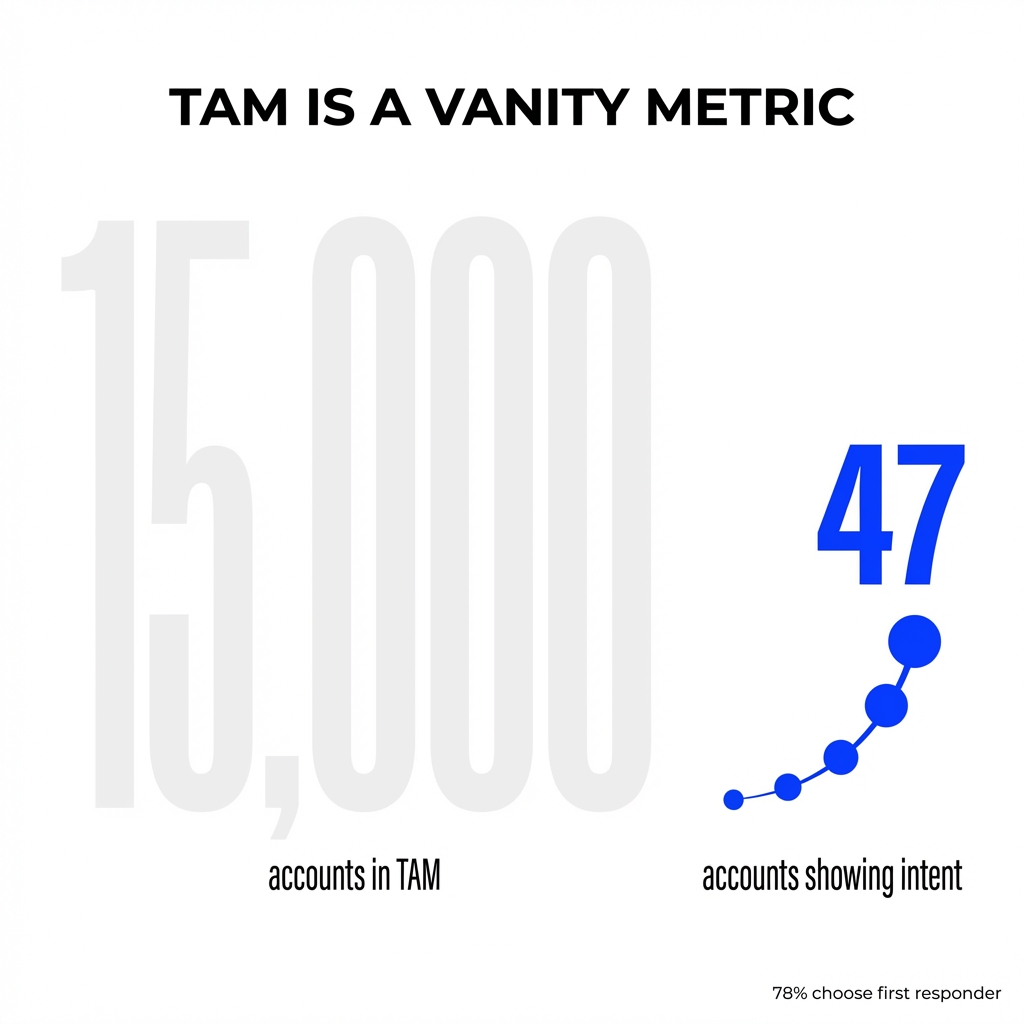
I see it every week. A B2B marketing team launches a campaign with a gorgeous TAM deck showing 15,000 addressable accounts. Sixty days later, they can't tell you which accounts actually engaged, at what depth, or with whom on the buying committee.
Pipeline stays flat. The team keeps reporting on impressions and potential reach while leadership asks harder questions.
The problem isn't effort. The problem is obsessing over market size before proving anyone cares.
What TAM Excitement Actually Hides
When someone gets excited about TAM in the first 90 days, they're usually avoiding the hard work. They haven't figured out which 200 to 500 accounts matter, which exact titles to target, or which specific pains this campaign solves.
They're marketing to a PowerPoint market instead of a real one.
Most B2B deals involve 6 to 8 stakeholders, but TAM presentations are built around a single decision-maker avatar and a single message. You're missing the buying committee depth that actually closes deals.
Here's what they can't answer: Are we getting into the right accounts? Are they engaging? Are we generating early pipeline signals?
When someone brags about TAM, they often can't tell you reply rates from target accounts, meetings with the right titles, or sourced pipeline velocity. The fundamentals are fuzzy or missing entirely.
Intent Signals Outperform Audience Size
I worked with a mid-market SaaS team that spent months reporting on impressions and list size. Pipeline was flat until we forced them to instrument a simple account-progression model.
We tagged accounts by stage with clear engagement thresholds. An account moved from Identified to Aware only when at least two people consumed content or attended an event. It moved to Interested only after a reply or meeting request from a relevant title.
Everything changed.
Instead of "we reached 8,000 companies," they could say "50% of our 300 target accounts reached Aware, 15% hit Interested, 5% are in Consideration." Leadership finally had something actionable to work with.
The data backs this up. Marketing teams leveraging intent data achieve up to 70% higher conversion rates compared to traditional demographic targeting. Intent-driven leads convert at 2-3 times the rate of traditional leads.
They mapped ad-engaged companies directly to CRM deals, showing actual revenue impact rather than click volume. Campaigns that looked strong on reach but moved no accounts through the stages got cut. Campaigns that drove stage progression got more budget.
Pipeline from target accounts increased materially within two quarters. Win rates on ABM-touched deals outperformed the rest of the funnel. Sales cycles are shortened because the team engages accounts already showing buying signals rather than cold outreach to a giant TAM list.
The 30-Day MVP You Can Actually Build
Most teams think they need a massive tech overhaul to run on intent. You don't.
The minimum viable version fits inside tools you already have: website analytics, a CRM, and basic marketing automation.
Start with a brutally simple signal set. In 30 days, you only need a few high-intent behaviors. Website visits to pricing, demo, or docs pages. Repeat visits in 7 to 14 days. Demo or pricing form submissions. Positive replies and meetings from your outbound sequences.
Anything outside that is "nice to know later," not part of version one.
Turn those signals into two or three fields in your CRM. Add Origin Type: Triggered vs Manual. Add Primary Signal: a dropdown with "Demo form," "Pricing page + repeat visit," "Positive outbound reply."
Use simple workflows so that when a form is submitted, or a contact hits a high-intent page multiple times in a short window, or an outbound reply is categorized as positive, the system auto-creates or updates the record and stamps the fields.
No rep checkboxes. No new tools. Just routing and field updates, you can configure in an afternoon.
Build one "intent view" and one scorecard. Create "Trigger-backed opportunities last 90 days" and "Manual opportunities last 90 days" views in your CRM. Add one reporting tile: win rate and average cycle time for Triggered vs Manual opportunities.
That single comparison shifts behavior and leadership attention.
Speed Beats Size Every Time
Here's what TAM presentations ignore: 78% of buyers choose the first responder. Research shows 35-50% of sales go to the vendor that responds first, regardless of market size calculations.
Leads contacted within 5 minutes are up to 100 times more likely to be qualified than those contacted after a 30-minute delay. Yet the average B2B response time sits at a staggering 42 hours.
While marketers obsess over TAM slides, they're leaving a massive competitive advantage on the table.
The system has to surface a small number of high-intent events, bundle them into ready-to-work "moments," and enforce fast, specific follow-up. Otherwise, it becomes another noisy feed reps swipe past.
Only a few behaviors should trigger sales motion: demo or pricing form submissions, multiple visits to high-intent pages in a short window, positive replies, or meeting accepts. Everything else stays in scoring and prioritization. It doesn't ping the rep.
When a signal fires, the rep should get a single object to work on. One task or workspace card that shows who engaged, what they did, which pages or content, and a suggested first message or call angle.
When It Still Doesn't Work
If the pipeline stays flat after 90 days with signals wired, the problem is almost never the plumbing.
It's usually a mix of "we're chasing the wrong people" and "our story doesn't land when we finally get in front of the right ones."
Even sophisticated ABM and intent programs fall over when the ICP is stale or too broad. If your "hot" accounts never progress past first conversations, that's usually an ICP or segment problem, not a signal problem.
A spike in research or content consumption isn't the same as a real project with a budget and urgency. After 90 days, if most "intent" conversations end in "we're just looking," tighten what counts as a trigger. Focus on pricing views, implementation questions, timing, and budget signals.
Many ABM failures trace back to content and messaging that are broad, me-too, or product-centric. When the talk track doesn't map to specific pains in that segment, intent just tells you who to disappoint faster.
Signals open doors. If you have nothing compelling to walk through the door with, it still looks like failure.
ICP Before Everything Else
If you could only fix one thing first (tighten the ICP or sharpen the messaging), tighten the ICP every time.
If you are wrong, no amount of clever messaging will save you. If the who is right, even "good enough" messaging will start to work and give you the data you need to sharpen it.
A precise ICP concentrates budget, signals, and sales effort on companies most likely to buy and stay. This consistently lifts conversion rates and shortens cycles. With a tight ICP, your existing messaging gets more at-bats in the right rooms.
A clear ICP becomes the shared filter for marketing, sales, and product. Who to target, what to prioritize, what to say no to. Once that spine is in place, sharpening the narrative is an iterative exercise on a stable foundation rather than a rebrand every quarter.
Messaging is the expression of positioning to a specific audience. Without a nuanced view of that audience, teams default to vague, "me too" claims that underperform even if they sound polished.
When the ICP is clear and proven, live conversations and performance data from that segment become the raw material to tighten the story with confidence.
The tech can tell you where the heat is. It cannot create heat where the market doesn't truly care.


Comments
Post a Comment