AEO Isn't Lead Generation - It's the Infrastructure Lead Generation Runs On
You keep increasing spend. Leads look fine on paper. But pipeline isn't growing the way it should.
Nobody can tell you why.
This frustration shows up in every growth-focused organization I talk to. CAC creeps up. Lead quality bounces around. Sales says marketing leads aren't qualified. Marketing says sales isn't following up fast enough.
The real problem isn't your ads or your content or your sales team.
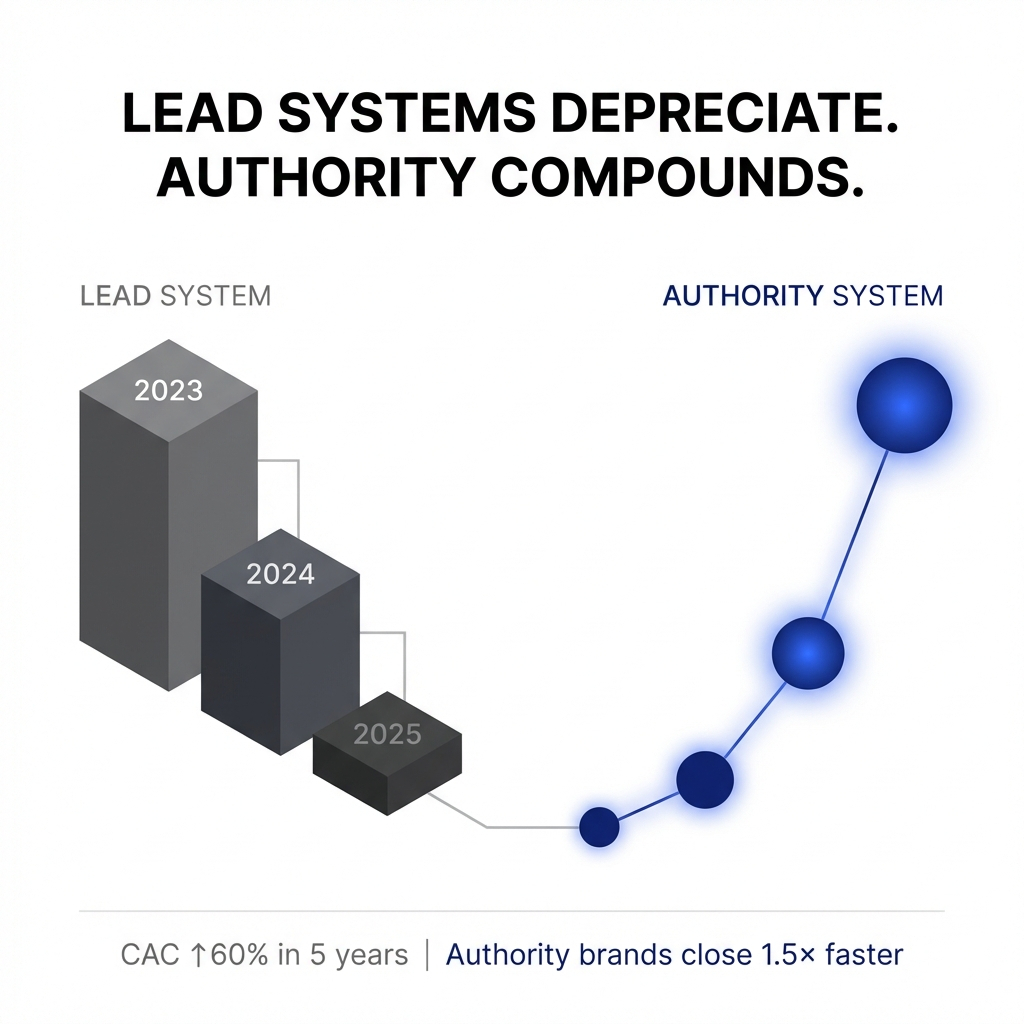
You've built a lead system when you need an authority system.
The Lead System Trap
Lead systems optimize for volume and cost per acquisition. You buy attention through ads, outbound, and short-term campaigns. When you stop spending, opportunities fall off a cliff.
Every dollar you invest depreciates the moment the campaign ends.
According to recent data, customer acquisition costs jumped 60% over the past five years, with a 40-60% spike between 2023 and 2025 alone. Fourth-quartile SaaS companies now spend $2.82 to acquire $1 of new ARR.
You're not imagining it. The math is getting worse.
Lead systems have three patterns that kill growth:
They over-index on paid visibility without building trust. You buy clicks, but prospects still show up to calls asking you to prove you're legitimate. Every conversation starts cold.
They optimize channels instead of the people and brand behind them. Your website converts at 2%, your ads perform okay, but nobody recognizes your CEO or your company when they search. You're spending to stand still.
They fragment efforts instead of building infrastructure. PR runs separately from content. Content runs separately from ads. Outbound doesn't know what marketing is doing. Nothing compounds.
What Authority Infrastructure Actually Means
Authority infrastructure changes the question you're asking.
Instead of "how do we get more form fills?" you ask "how do we become the default, de-risked choice in this category so leads show up already convinced?"
The shift shows up in three places:
Your metrics change. You still track CAC and conversion, but you add share of answer across AI platforms. You measure how often ChatGPT, Perplexity, and Google SGE surface you as the recommended solution. You track executive discoverability and pipeline efficiency.
Research from Superlines shows that ChatGPT processes over 1 billion daily queries with 800 million weekly active users. AI search visitors are predicted to surpass traditional search visitors by 2028. Visitors arriving from AI chatbots convert at rates 23 times higher than traditional search visitors.
This isn't future planning. This is current pipeline.
Your infrastructure changes. You treat your entire digital footprint as a system that must be structured, consistent, and AI-readable. You implement structured data and entity optimization so AI engines can understand, verify, and recommend you. You centralize profiles, press, and proof so your brand resolves as a clear entity everywhere a prospect might look.
Your content changes. You move from sporadic campaigns to a drumbeat of authority articles, interviews, and explainers. You invest in executive visibility so your founders and subject matter experts show up as named, quotable authorities. You design content to be cited and referenced, not just gated and forgotten.
The test becomes: would an AI or analyst logically pick you as the safe, obvious recommendation after reading this?
How AI Platforms Actually Choose Who to Recommend
When an AI platform recommends one company over another, it asks: which entity looks like the safest, most consistent, and most extractable answer to this intent right now?
Then it backs that decision with a stack of signals.
First, it identifies entities. The system classifies intent and identifies brand names, product types, and problems. If your company isn't clearly modeled as an entity connected to that problem space, you're invisible.
Second, it retrieves candidate sources. The AI pulls potential answers from the open web and its indexes. Classic SEO inputs matter here. Crawlability, structured data, topical focus, and technical health make you easier to retrieve.
Third, it evaluates authority and trust. The system scores which sources feel most authoritative and low-risk. It looks for clear expertise, credible authors, transparent sourcing, and a history of high-quality content. It checks for cross-web corroboration: the same facts and positioning about your brand appearing in multiple independent, trustworthy places.
To an AI, a brand that shows up consistently with the same story in multiple trusted contexts is a much safer recommendation.
Fourth, it checks extractability. Even if you're credible, the system needs to lift an answer from your content. It favors pages with clear, declarative statements and well-structured sections. If your copy is fluffy or buried in tangents, the AI skips you for a competitor that's easier to quote.
Fifth, it weighs recency. Recently updated pages beat older content for queries about "best tools" or "latest" approaches. Stale information is a direct liability.
Finally, it resolves brand preference. Brands frequently and positively mentioned in reliable sources as solutions become the default candidates. Entity consistency matters: same brand name, same description, same core claims across your site, socials, bios, and directories. Inconsistency fractures your signal.
This is where authority infrastructure earns its keep. You're not trying to rank a page. You're engineering your entire brand entity to look like the obvious, low-friction recommendation.
What Changes When Prospects Already Trust You
The first conversation feels different when authority infrastructure is in place.
Prospects reference your content by name. They ask about fit, scope, and timing instead of "what makes you different from the five others I'm talking to?" Their questions assume competence instead of questioning it.
Sales teams notice the trust delta immediately. Fewer "this feels risky" objections. More "how would this work for our specific situation?" questions. The energy shifts from convincing to coaching.
The numbers show it too. Recent research found that 85% of B2B buyers have largely established their purchase requirements before contacting sellers, with 81% having a preferred vendor at first contact. That pre-contact favorite wins 80% of deals.
Sales conversations aren't creating preference anymore. They're confirming decisions already made through authority signals buyers encountered earlier.
Companies with higher brand authority close deals 1.3-1.6 times faster and at 30-50% higher rates than cold or unknown brands. Average B2B buying cycles shortened from 11.3 months in 2024 to 10.1 months in 2025 for organizations with strong authority infrastructure.
Authority doesn't just improve conversion. It improves velocity.
Making the Case When You Need Pipeline This Quarter
Revenue leaders need pipeline now, not six months from now.
You win that argument with math, not philosophy.
Start by showing that known brands close 1.3-1.6 times higher and 30-50% faster than unknown brands. Even a modest lift pays back inside a quarter through velocity and conversion improvements.
Frame authority as a CAC and velocity play. You're not asking to pause demand generation. You're asking to make every existing dollar convert better over the next 90 days.
Then scope the work as a 90-day sprint with leading indicators and near-term pipeline goals. Define a narrow niche where you can demonstrate superior proof fast. Tie the sprint to concrete KPIs you can see inside a quarter: branded search volume, reply rates, demo-to-SQL conversion, and stage-to-stage velocity in that segment.
Make authority work ride along with channels you already trust. Turn current campaigns into authority campaigns by tightening positioning, injecting credible proof, and routing traffic to assets that demonstrate expertise. Use content and thought leadership to warm up target accounts before ads or outbound touch them.
Set expectations around what moves first. Leading indicators like branded search, direct traffic from target accounts, and higher intent on inbound forms show up in weeks. Near-term revenue signals like improving win rates and cycle time for "exposed to authority" cohorts show up in months.
The pitch is simple: give us a protected slice of your motion and 90 days. If authority-infused demand doesn't outperform business-as-usual demand on pipeline efficiency this quarter, don't scale it. If it does, you've justified building deeper infrastructure.
Integration Over Addition
Most organizations treat brand and demand as separate teams with separate budgets.
Integration means campaigns do double duty. Every touch generates pipeline now and adds evidence to your authority system for later.
You work from one narrative. Top and mid-funnel assets are built on the same positioning, proof points, and category story that show up in your ads and outbound. Every demand campaign reinforces the same idea you want buyers and AI systems to associate with you.
Your creatives carry proof. Ads and sequences promote real expert assets: deep dives, teardown videos, named customer stories rather than generic downloads. Landing pages are structured like authority hubs with clear stance, credentials, recognizable logos, and tight explanations that can be quoted by people and AI.
Your targeting assumes a longer arc. Brand and demand share the same account list and journey view. Thought leadership and category education ads are aimed at your named accounts before, during, and after performance campaigns. Outreach references that authority exposure so it feels like a continuation instead of a cold reset.
Your budgets live on one dashboard. You track cohorts exposed to authority assets versus those that weren't, and compare conversion and velocity. Revenue leaders see that authority-infused demand wins on the metrics they care about.
The litmus test: if a campaign can't both move pipeline and leave behind a stronger, clearer answer to "who are you and what do you own?" in the buyer's and AI's mind, it's not authority-infused demand yet.
Prioritizing Without Adding Chaos
You don't fix overwhelm by adding more work. You fix it by replacing low-leverage work with moves that hit revenue and authority at the same time.
Pick one business goal. Agree with revenue leadership on one primary 90-day outcome. Map current projects to that goal and pause anything that doesn't connect clearly.
Choose one motion to upgrade. Pick the one pipeline driver you already rely on: paid search to demo, LinkedIn outbound, a flagship webinar. Commit to making that motion authority-infused for 90 days. No new channels, no new experiments.
Swap in authority ingredients. Tighten messaging, add specific proof, and structure pages so they're clear, AI-readable authority assets. Where you were going to ship a generic blog, ship one cornerstone piece that answers a high-value problem in depth and can be reused in ads, outbound, and sales enablement.
Do the smallest viable entity pass. Clean up basics for your company and primary offer. Consistent naming and description, updated key profiles, and organization schema on core site pages that get traffic now. Set up lightweight monitoring on a few high-intent queries and AI surfaces.
This is days of work, not months. It supports the same 90-day goal instead of living as a separate project.
Make tradeoffs explicit. Publish a simple "now, next, later" view so stakeholders see that some campaigns are intentionally parked. Review mid-sprint against the one goal. If a request doesn't move that metric, it waits.
One business goal, one motion, one 90-day authority-infused upgrade. Everything else either feeds that or it's paused.
The Moment Organizations Finally Commit
The moment they commit is when they realize they're not in a lead problem anymore. They're in a future growth and control problem, and the current playbook can't fix it.
Performance hits a ceiling. More spend and more tactics give linear or declining returns. CAC rises, win rates stay flat, and every new channel looks like a slightly worse version of the last. Pipeline feels fragile. If they pause ads for a quarter, the whole system slows.
Buyers are far ahead of the funnel. Revenue leaders see data showing buyers are 60-70% through their decision process before talking to sales. Those buyers already have a short list of trusted names. Sales keeps saying when prospects have heard of them, deals are easy. When they haven't, it's a slog.
They're only talking to 5% of the market. They confront the math. Only a small percentage of their ideal customer profile is in-market at any given time, and almost all budget is aimed at that sliver. Competitors who invested in authority are the obvious choice whenever the other 95% becomes active.
What clicks: we're over-serving today's pipeline and under-investing in tomorrow's. That's why growth feels harder every year.
The emotional shift that unlocks commitment is when they stop seeing authority as an abstract brand exercise and start seeing it as an asset that makes every future quarter easier. Shorter cycles, better pricing power, higher retention.
They accept that staying in pure lead-chasing is the riskier move. It keeps them exposed to auction swings, copycat competitors, and algorithm changes with no safety net.
Commitment happens when they stop asking "how do we get more leads?" and start asking "how do we become the company buyers and AI already trust before they ever fill out a form?"
Once that question lands, authority infrastructure stops being optional.
AEO as Defense, Not Just Offense
In the AI era, if you don't shape your own entity and answers, the models will do it for you. Often with stale, partial, or wrong inputs.
AI systems can ignore you, misrepresent you, or collapse you into a competitor if your signals are weak or inconsistent. They can effectively erase you from a growing chunk of discovery.
AEO and entity work become a risk function. They reduce hallucination about your pricing, capabilities, or positioning by feeding models clear, structured, corroborated facts.
Treating AEO as "new SEO" underestimates it. It's closer to brand governance for machines.
What's emerging now is that having content AI can quote isn't enough. You need functional assets AI agents can use. AI is being wired into tools and actions. Brands that expose structured, machine-usable interfaces become the ones agents choose to act with, not just talk about.
That means thinking beyond pages and blogs toward structured data, APIs, and interactive tools that clearly express what you do and how an agent could safely invoke you.
The brands that win won't just be cited by AI. They'll be used by AI.
AI has made it trivial to flood the web with mediocre text, which makes human authority more valuable, not less. Depth of experience, original data, named experts, and specific lived points of view are the signals both humans and algorithms lean on to separate real operators from AI wallpaper.
Doing less, but with unmistakable expertise (flagship pieces, real case studies, visible leaders) is often a stronger AI-era authority move than trying to out-volume auto-generated content.
In the AI era, authority isn't just about ranking. It's about becoming the entity the machines and the market both agree is safe to trust and easy to use.
The organizations that internalize that and treat AEO as core infrastructure are the ones that will compound.


Comments
Post a Comment