The AI Authority Advantage: Why 2027's Demand Gen Winners Are Being Decided Right Now
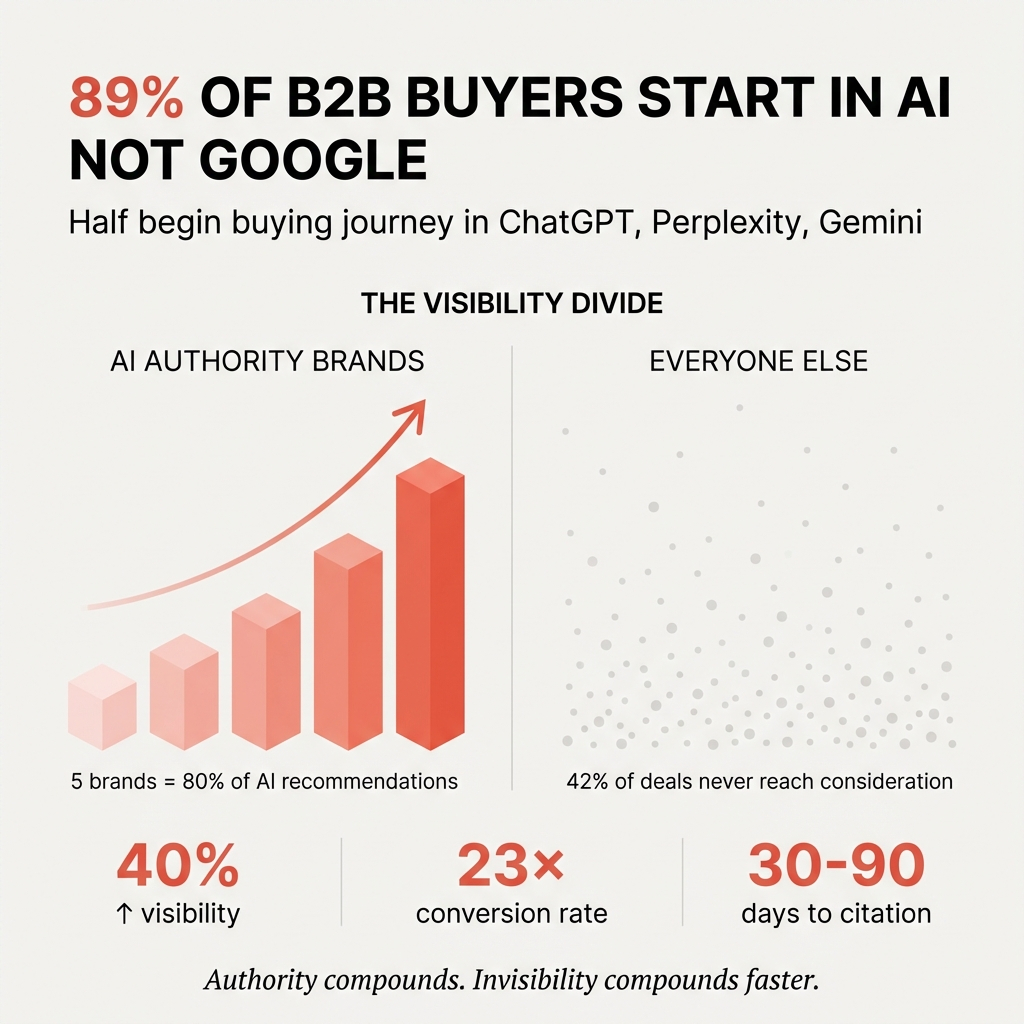
B2B buyers changed how they discover solutions.
89% now use generative AI tools during purchasing decisions. Half start their buying journey in AI chatbots instead of Google.
This creates a binary outcome for your brand: you're either in the AI narrative or you're invisible.
The companies building AI authority infrastructure today will dominate demand generation by 2027. The ones waiting will find themselves locked out of the conversation entirely.
AI Platforms Became Gatekeepers of Trust
When a VP of Treasury opens ChatGPT and asks "what are the top platforms for cash management," the answer shapes their entire evaluation.
Just five brands appear in 80% of top responses across any B2B category. If you're not one of them, you don't exist in that buyer's consideration set.
Traditional SEO optimized for rankings. AI search optimizes for recommendations.
The difference matters.
Rankings show options. Recommendations create preference.
Gartner projects that 70% of enterprise queries will shift to generative engines like ChatGPT, Perplexity, and Gemini by 2025. Your brand needs to be the answer these platforms trust and surface first.
Answer Engine Optimization Creates Separation
Research from Princeton shows that GEO techniques boost visibility by up to 40% in AI responses through statistics inclusion and structured formatting.
Companies implementing AI authority strategy see mentions in ChatGPT, Perplexity, and Google AI Overviews within 30-90 days. More importantly, AI-driven traffic converts at rates 23 times higher than traditional organic search.
This performance gap compounds over time.
While competitors chase MQL volume through gated content and paid ads, AI-authority brands capture high-intent buyers who arrive pre-educated and ready to evaluate.
The mechanics are straightforward:
Build canonical content that answers specific, high-value questions your ICP asks AI platforms. Structure it for both humans and machines with clear summaries, modular sections, and proprietary insights.
Establish entity recognition across platforms so AI systems can confidently attach your content to recognized expertise in your category.
Track AI share of answer as a core metric alongside traditional demand gen KPIs. Measure how often you're cited versus competitors across priority prompts.
Sites with structured data see up to 30% higher visibility in AI overviews. The technical implementation is accessible. The strategic commitment is what separates winners from the rest.
Earned Media Dominates AI Citation Sources
Analysis of over 1 million citations from top LLMs found that 89% of sources come from earned media: news articles, interviews, and trusted third-party content.
Your company blog won't cut it.
AI platforms synthesize multiple sources to build their understanding of category authority. Perplexity's citation patterns show Reddit appears in 40% of B2B software recommendations.
This means authentic participation in community platforms, strategic PR, analyst relationships, and customer review sites directly impact whether AI systems recommend you.
Some publications carry 10x more influence than others in LLM citations. The specific outlets that matter vary by industry, solution, and buyer profile.
The implication: demand generation becomes a cross-functional effort involving PR, community, product marketing, and executive visibility, not just a marketing ops function optimizing conversion rates.
The Measurement Shift: From Traffic to Citations
Success in AI-driven demand generation looks different than traditional metrics.
You're no longer chasing incremental traffic or form fills. You're building citation share, brand mentions in AI-generated answers, and presence in the synthesis layer that sits above search results.
72% of B2B buyers encounter AI-generated overviews during their research process. In tech specifically, 80% of buyers use generative AI at least as much as search for vendor research.
The priority becomes creating high-quality, authoritative content that AI systems confidently reference. Discoverability is less about being the top-ranked result and more about being the trusted source behind the answer.
Track these signals:
• Citation frequency across ChatGPT, Perplexity, and AI Overviews for non-branded category prompts
• Share of answer: how often you appear versus competitors in relevant AI responses
• AI-influenced pipeline tagged in CRM with win rate, cycle length, and deal size comparisons
• Direct and branded traffic lifts correlated with improvements in AI visibility
Companies using AI effectively in sales processes see win rate improvements of 30-50%. McKinsey research indicates AI adoption cuts cycle times by 20-30% in complex B2B deals.
The ROI window is clear: by months 3-4 of implementing GEO strategies, companies see ROI in the 50-150% range. A mature program from month 7 onwards delivers 400-800% or more.
What 2027 Looks Like for Winners
By 2027, the companies that built AI authority infrastructure will run demand engines where AI search, earned media, and revenue operations function as one integrated system.
Their buyers start with AI or blended AI+search. The company's frameworks, language, and brand appear repeatedly in answers across tools. Competitors may still rank in classic search or run ads, but they show up as optional alternatives while the AI-authority brand feels like the obvious choice.
The structural differences:
AI search becomes the primary top-of-funnel channel, with dedicated reviews of prompts, citations, and share-of-answer treated as core acquisition metrics.
Content strategy shifts from blog volume to a tight set of canonical guides, benchmarks, and comparison pages deliberately built as source-of-truth inputs for AI systems.
Revenue operations treats AI-sourced signals, website behavior, and off-site intent as one intelligence fabric that surfaces which accounts are heating up.
Pipeline composition changes. A larger share comes from direct, branded, and partner sources that also mention AI search as part of the journey. Opportunities arrive more solution-informed, speaking the company's vocabulary because they encountered it first in AI answers.
Competitors stuck in traditional tactics still chase MQL volume from gated content and paid campaigns. They see more early-stage leads, but those leads convert worse and take longer because the buyer's real decision happened upstream in AI platforms they don't influence.
The Risk of Waiting
McKinsey estimates that 42% of potential deals never reach consideration when product data is missing from AI-generated responses.
This is the tax you pay for invisibility.
Every quarter you delay building AI authority, competitors gain compounding advantages. The brands that establish themselves as default recommendations in AI platforms by early 2026 will be exponentially harder to displace by 2027.
First mover status in AI visibility becomes the only differentiator that matters when product features commoditize, and traditional marketing channels saturate.
The window to act is now. Not because of hype, but because buyer behavior already shifted. The infrastructure you build today determines whether you're recommended or invisible when 90 million adults use generative AI as their primary search tool by 2027.
Start with one canonical question your ICP asks during evaluation. Build the definitive, structured answer. Make it easy for AI systems to parse and trust. Track whether it shows up in citations.
Then expand systematically.
Authority compounds. So does invisibility.
The companies that understand this are already building. The ones that wait will spend 2027 wondering why their pipeline dried up while competitors they used to beat are now unreachable.
Citations & References
This article draws on research and data from multiple authoritative sources:


Comments
Post a Comment