The Authority Marketing Spine: How Infrastructure Beats Tactics in AI-Driven Demand Generation
Most B2B organizations are exhausted.
They're running more campaigns, producing more content, and feeding more channels than ever before. The activity level is high. The results are inconsistent.
The problem isn't effort. It's architecture.
When 810 million people use ChatGPT daily and AI systems mediate an increasing share of B2B discovery, demand generation stops being a creativity problem and becomes an infrastructure problem. You can have brilliant messaging and still be invisible to the systems that now decide which vendors make the shortlist.
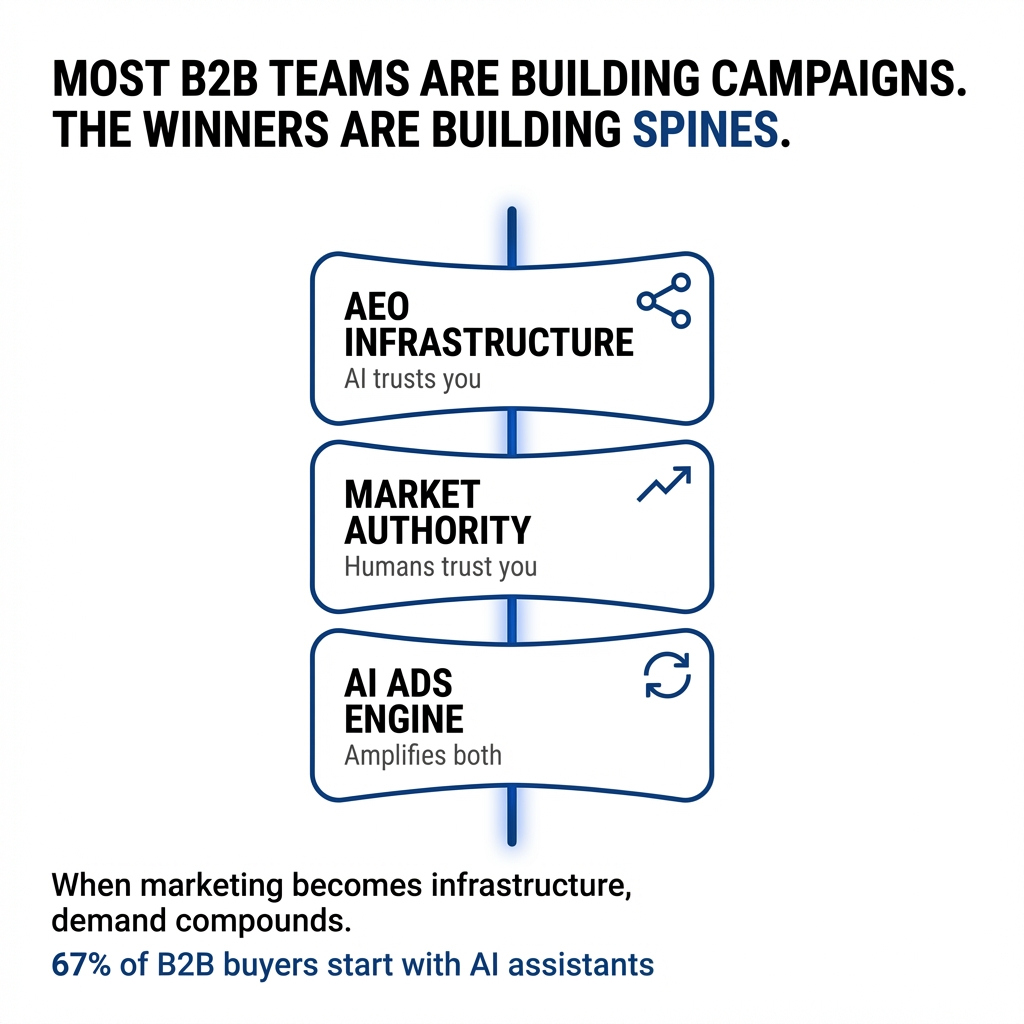
This is why we built Authority Engine around what we call the Authority Marketing Spine—a three-pillar system that transforms scattered marketing activity into engineered authority that AI platforms trust and recommend.
Why Demand Generation Is Actually an Infrastructure Problem
I realized demand generation is an infrastructure problem the same way you realize a city has a traffic problem. The issue isn't too few cars on the road. It's that the roads, signage, and rules weren't designed for the volume and complexity.
At Authority Engine, we built the company around one observation: modern visibility is engineered. AI search and buyer trust reward structured authority signals over scattered marketing activity.
Here's what I kept seeing in B2B organizations:
Teams were doing more (more content, more channels, more spend) but getting inconsistent returns because every motion was isolated. Different messages, different proof points, different attribution stories, different handoffs.
When the market and AI systems can't clearly recognize who you are, what you're best at, and why you're credible, extra activity mostly creates noise.
The inflection point came when we watched genuinely strong companies become effectively invisible while weaker competitors won mindshare because machines recognized their names first. That's a systems problem. Authority signals weren't being produced, connected, and reinforced in a consistent, machine-readable way across the places buyers and AI engines learn what to trust.
We define infrastructure as the always-on system that unifies content, credibility, and distribution so visibility and trust compound instead of resetting every campaign.
If you don't build the underlying authority system first, "more" just increases operational load (more approvals, more content debt, more channels to feed) without a proportional lift in pipeline. When the infrastructure is in place, each new asset and campaign reinforces the same core entities so it compounds in search, in AI answers, and in buyer confidence.
The Three Pillars That Create the Authority Marketing Spine
The Authority Marketing Spine consists of three integrated pillars that work together to create compounding demand generation.
Pillar 1: AEO Infrastructure
AEO Infrastructure positions your brand as the answer AI platforms trust and cite. This pillar focuses on entity coherence, structured identity, and machine-legible trust signals.
What this means in practice:
Your organization and key people are defined as stable entities with the same name, role, category, and attributes everywhere (site, schema, LinkedIn, directories, media, review sites). Organization and Person schema, "sameAs" links, and verified profiles let machines stitch all those touchpoints into a single, unambiguous node in their knowledge graph.
External mentions, reviews, certifications, media coverage, and citations corroborate your claims instead of just repeating them. Content and site structure map directly to how answer engines work—clear Q&A, entity-focused pages, logical internal linking, and technical integrity.
AEO Infrastructure behaves like compounding infrastructure. It doesn't reset every quarter like campaigns. It captures and converts high-intent traffic that arrives already educated by AI systems that trust your authority.
Research shows that content with citations, statistics, and quotations achieves 30-40% higher visibility in AI responses, and websites with author schema are 3x more likely to appear in AI answers.
Pillar 2: Market Authority
Market Authority turns your sales team and leadership into the most visible and trusted voices in your category. This pillar automates executive visibility through authority articles, AI-powered engagement, strategic outbound, and PR.
The shift this creates:
When your executives and team members consistently show up as authorities in the spaces where buyers research, you're building trust before the first sales conversation. Buyers arrive having already seen your people explain concepts, share frameworks, and demonstrate expertise.
This pillar feeds the AEO Infrastructure with fresh trust signals while simultaneously building direct relationships. Publications AI weights heavily (like industry media, respected blogs, and authoritative platforms) become channels for establishing your team as category experts.
Market Authority creates the human layer that makes your brand memorable while the infrastructure layer makes you discoverable.
Pillar 3: AI Ads Engine
The AI Ads Engine delivers predictable attention that amplifies both AEO Infrastructure and Market Authority. This pillar deploys ads within an authority context, creating a performance edge through 24/7 optimization.
Why this pillar matters:
When you run ads on top of strong authority infrastructure, the ads become more efficient. Your cost per action drops because the environment already vouches for you. Prospects who click through find consistent proof across every surface they check.
The AI Ads Engine plugs into the spine you've built. It doesn't operate in isolation. It amplifies the authority signals and entity coherence you've established, creating a reinforcing loop where paid attention drives organic discovery and organic authority makes paid attention more effective.
Authority infrastructure makes ads efficient. The data shows organizations with strong authority infrastructure see 15-20% CAC reduction as the foundation phase takes hold.
How the Spine Creates Compounding Demand Generation
The first thing that compounds isn't leads—it's confidence. AI systems become steadily more confident about who you are, so they start pulling you into more answers, in more places, with more precision.
Here's the sequence we see when the spine is working:
You move from "sometimes mentioned, often generic" to being named explicitly, with accurate descriptions and use cases that match how you actually sell. AI systems stop hedging and start speaking about you with certainty and context.
Your impressions and mentions grow in tightly relevant queries and AI questions—fewer random, off-fit leads and more conversations with your exact ICP. Branded and category searches start to travel together because the systems now map your entity cleanly to that problem space.
Channel performance curves smooth out. Organic and AI-assisted touches show up more consistently as assists. Experiments on messaging and campaigns give cleaner readouts because the routing problem is solved. You're being evaluated as a stable entity, so tests are actually about creative and offer.
Prospects come in having already seen reviews, third-party mentions, and consistent facts about you, so they require fewer calls to reach conviction. You hear more "We kept seeing you everywhere when we researched this" and less "We had never heard of you until your rep reached out."
Sales cycle compression at the same or higher ACV is one of the strongest indicators that the infrastructure is doing its job.
Research confirms this pattern. 67% of B2B buyers start with AI assistants before traditional search, and AI-referred visitors convert at 4.4× the rate of traditional organic traffic. When you're the authority those systems recommend, you capture that high-intent traffic.
What Changes When Marketing Becomes Infrastructure
Once the environment is doing a lot of the convincing, the job of sales and marketing shifts from "create demand and prove we're legit" to "be easy to choose and insanely relevant at the exact moment of intent."
Marketing's work changes:
Marketing spends less time inventing new campaigns from scratch and more time shaping the surfaces AI and buyers learn from (refining entity pages, FAQs, comparison content, and third-party profiles) so they stay perfectly aligned and up to date.
Net new content is planned as deliberate trust-signal generation (reviews, brand mentions, citations, customer stories in external ecosystems) rather than just filling an editorial calendar.
Success is measured less by impressions and downloads and more by visibility in AI results, high-intent traffic, and self-reported discovery. The team optimizes clarity and corroboration instead of cleverness.
Sales' work changes:
Reps walk into conversations where the baseline question is no longer "Why you?" but "How would this work for us?" Discovery goes deeper, faster, into context, constraints, and change management.
Sales focuses on tailoring, sequencing, and risk removal (stakeholder mapping, rollout planning, commercial design) because category fit and vendor credibility are largely pre-solved by the environment.
SDRs and AEs prioritize outreach based on intent and change signals rather than static lists. By the time they act, the account has usually already encountered your brand in trusted surfaces.
The everyday experience changes for everyone:
Marketing feels less like an in-house media agency and more like environment architects (tuning the surfaces that shape how AI and buyers talk about you).
Sales spends less time fighting for basic legitimacy and more time acting as specialists helping already-warm buyers make a good decision with less risk.
The Mental Model That Has to Change
The hardest thing to let go of is the idea that volume and visibility are proof of doing marketing well. Most B2B teams are wired to believe "if we show up more and say it louder in more places, the market will eventually reward us."
In an AI-mediated environment, that belief quietly works against building a spine.
The deeply embedded assumption is:
"Our job is to create and distribute as much persuasive content as possible so we own attention. Authority will follow from visibility."
That made sense when search and social were the main gatekeepers. More content meant more impressions, more rankings, more chances to persuade.
Now AI systems decouple "being known by humans" from "being interpretable and recommendable by machines." You can be respected in the industry and still invisible in the answer layer. Authority now travels as structured, verifiable knowledge over sheer frequency of posts or campaigns.
The old mental model ("authority is the result of doing lots of marketing") has to flip to: "marketing is one of the ways we express an already-engineered authority spine."
Because leaders unconsciously equate health with activity, they organize teams like production shops measured on output and near-term engagement. They treat the website and ecosystem as storytelling real estate instead of shared knowledge infrastructure for humans and AI.
The new, more uncomfortable belief we push organizations toward is: "If we are not in the answer, we are not in the market. Our primary marketing job is to make our expertise machine-legible at decision time."
That forces a reordering from "How do we get more attention?" to "How do we become the easiest entity for systems to understand, verify, and reuse when buyers are asking real questions?"
The Window Is Closing
Right now is a rare reset moment because the answer layer is young, noisy, and still forming its defaults. It's unusually easy to move from "not in the answer" to "the obvious answer" if you build your spine before everyone treats this as table stakes.
Two things make 2024 to 2026 fundamentally different:
AI answers have real adoption, but their mental model of most B2B markets is still thin and uneven. Many strong brands are structurally ambiguous, so systems hedge or default to whoever is easiest to parse.
The competition for visibility has moved above your funnel—into ChatGPT, Perplexity, Google AI Overviews, Copilot, and other answer surfaces that decide what to surface before anyone clicks a link.
That combination—high impact, low structural maturity—doesn't last long. It's like early SEO before everyone understood backlinks. The rules are visible, but the field is under-optimized.
Most serious observers are converging on a similar timeline:
2024 to 2026 is when the answer engine era emerges. AI visibility and Answer Engine Optimization are new motions. A minority of brands invest deeply and learn fast.
2026 to 2028 is when practices harden into playbooks and tools. High-maturity brands spend heavily on AI visibility and treat "source of truth" status as a core strategic asset.
The next 18 to 24 months are when defaults are still being written in models and answer surfaces. It's still feasible to move from invisible to "go-to" in a category with a focused, infrastructure-first push.
After that, you're trying to dislodge incumbents that answer engines already trust by habit.
If you build the spine during this reset window, you gain durable advantages:
You become the reference implementation (the entity answer engines use to explain the category, define terms, and anchor comparisons). That tends to stick.
You lock in answer proximity around key questions, so future model updates and multimodal answers are more likely to reuse your explanations, data, and framing.
You force slower competitors into a catch-up game where they have to unwind years of messy identity and retro-fit trust signals into models that already see you as the cleanest node.
Waiting 12 to 24 months doesn't keep you in neutral. It moves you into a structurally worse position:
If you're not in the answer now, the systems continue training and reinforcing patterns without you. Over time, that absence becomes part of the model's understanding of the market.
Two years of ad-hoc content, rebrands, campaigns, and partner listings created without an authority spine become technical and semantic debt. Cleaning that up while competitors are still compounding is slower and more expensive than building it right now.
You might keep winning events, PR, and analyst love, but if AI can't connect those signals structurally, you become well-known in the human world and functionally invisible to the systems shaping early discovery.
The First Move: See Yourself Through the Machine's Eyes
In week one, the single most important move is to run an AI visibility and entity coherence baseline on yourself. Formally document how the major answer systems currently see and describe your company and where your entity breaks.
In practical terms:
Manually query leading AI and search surfaces (ChatGPT, Perplexity, Google AI Overviews, Bing/Copilot) for your brand, your key people, your category, and your flagship use cases. Capture verbatim how you're mentioned or not mentioned.
Compare that to your own site, schema, LinkedIn, key directories, and review sites to see whether you appear as one stable entity with a clear specialization or as a fuzzy, conflicting set of names, roles, and offers.
The output is a brutally honest map of:
Where you do show up in answers and how accurately. Where you're absent and which competitors fill the gap. The specific inconsistencies in naming, categorization, and proof between owned and third-party surfaces.
If you produce that baseline in week one and socialize it with the same seriousness you'd give a pipeline review, you've already crossed the line from content producers to spine builders. Every subsequent move (entity definition, schema, trust-signal strategy) is then anchored in how the environment actually understands you today.
From Tactical Exhaustion to Strategic Advantage
The Authority Marketing Spine isn't another marketing tactic to add to your stack. It's the infrastructure that makes every other tactic more effective.
When you build the spine first (entity coherence, structured identity, verifiable trust signals through AEO Infrastructure, Market Authority, and the AI Ads Engine) you stop fighting for attention and start commanding it.
Your marketing team becomes environment architects instead of content factories. Your sales team spends time diagnosing and de-risking instead of convincing skeptics. Your pipeline fills with prospects who arrive partially pre-sold because the systems they trust already vouch for you.
The window to establish this advantage is open now. The organizations that treat authority as infrastructure today will be the category leaders AI systems recommend tomorrow.
The question isn't whether AI will reshape B2B demand generation. It already has. The question is whether you'll build the spine that lets you win in that new reality.
References & Further Reading
AI Search Statistics & Adoption:
Superlines. "AI Search Statistics." https://www.superlines.io/articles/ai-search-statistics/
Gracker AI. "Win B2B Buyers with AI Search." https://gracker.ai/blog/win-b2b-buyers-ai-search
Authority Engine & AI Authority Engineering:
Authority Engine. "About." https://www.authority-engine.ai/about
Authority Engine. "Resource Page." https://www.authority-engine.ai/resource-page
News File Corp. "Authority Engine Expands AI Authority Engineering Framework." https://www.newsfilecorp.com/release/283442
Answer Engine Optimization (AEO):
CXL. "Answer Engine Optimization (AEO): The Comprehensive Guide." https://cxl.com/blog/answer-engine-optimization-aeo-the-comprehensive-guide/
Conductor. "Answer Engine Optimization." https://www.conductor.com/academy/answer-engine-optimization/
ThatWare. "Answer Engine Visibility Framework Guide." https://thatware.co/answer-engine-visibility-framework-guide/
Monday.com. "Answer Engine Optimization." https://monday.com/blog/marketing/answer-engine-optimization/
AI Trust Signals & Entity Coherence:
AI Trust Signals. "Trust Signals." https://www.aitrustsignals.com/trust-signals
Semrush. "AI Search Trust Signals." https://www.semrush.com/blog/ai-search-trust-signals/
LexWire. "Entity Coherence." https://lexwire.org/ai-authority/entity-coherence/
Simple Machines Marketing. "AI-Ready Websites: Understanding the New Trust Signals." https://www.simplemachinesmarketing.com/blog/ai-ready-websites-understanding-the-new-trust-signals/
Vertu. "Building Credibility for AI Search: The Complete Trust Signal Framework." https://vertu.com/lifestyle/building-credibility-for-ai-search-the-complete-trust-signal-framework/
AI Visibility & Brand Authority:
Search Engine Land. "Authority in AI Search." https://searchengineland.com/authority-ai-search-469466
XEO Marketing. "AI Visibility vs. Brand Authority: What Actually Moves the Needle." https://xeo.marketing/ai-visibility-vs-brand-authority-what-actually-moves-the-needle/
HMP Global Events. "Marketing 2026: Why Authority Now Beats Visibility." https://www.hmpglobalevents.com/article/marketing-2026-why-authority-now-beats-visibility
CMSWire. "Marketing in 2026: Why Authority Now Beats Visibility." https://www.cmswire.com/digital-marketing/marketing-in-2026-why-authority-now-beats-visibility/
Infrastructure & Implementation:
Pivor. "Authority Infrastructure." https://pivor.io/capabilities/authority-infrastructure
Aezion. "AI-Ready Data." https://www.aezion.com/blogs/ai-ready-data/
Brown Bag Marketing. "AEO and Entity Stacking." https://brownbagmarketing.com/aeo-and-entity-stacking/


Comments
Post a Comment