The Demand Generation Turning Point: What the Future Looks Like for Marketers Ready to Move Beyond 2024 Rules
I know what you're seeing. Your MQL numbers look fine. Campaign performance is green. Lead volume is up.
But something feels off with your pipeline.
You're not alone. This is what B2B marketers everywhere are experiencing in 2026. MQL volume holds steady while marketing-sourced pipeline and revenue per lead stagnate or decline. One CMO called it "a marketing data mirage, driven by misleading metrics, unreliable intent signals, and over-complicated MarTech stacks."
The numbers reveal what's really happening. MQLs convert to SQLs only about 13% of the time, while industry benchmarks show top performers hitting 25-35%. Meanwhile, 85% of marketers report spending more than half their time fixing problems instead of creating campaigns.
The game changed. And here's the opportunity: most marketing teams haven't adapted yet, which means you still have time to build an advantage.
The Invisible Shift in How Buyers Actually Research
Here's what's happening while you're optimizing nurture sequences and A/B testing email subject lines.
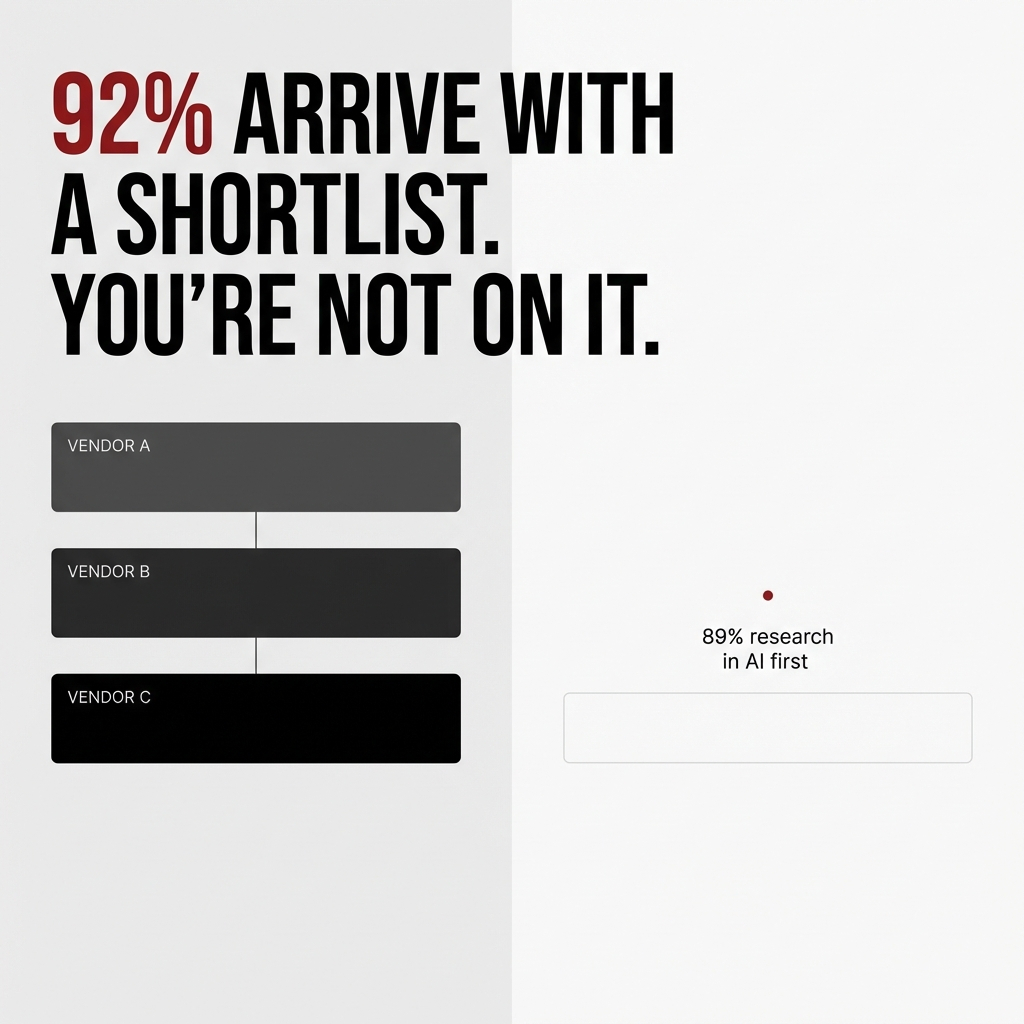
89% of B2B buyers now use generative AI during their purchasing journey. They're conducting their entire research phase inside ChatGPT and Perplexity before you ever know they exist.
The shift is most pronounced among the buyers who will dominate purchasing in coming years. 15% of Gen Z buyers report using AI "a lot" for software purchases, nearly double the 8% usage rate among older generations. 56% of tech buyers rely on chatbots as a top source for vendor discovery, and two-thirds now use generative AI tools as much as traditional search engines.
Your prospects are completing their entire research phase inside AI tools, then jumping directly to shortlists and decisions.
But here's what matters: you can be.
Why You're Not in the AI Answer
When your company doesn't appear in ChatGPT or Perplexity responses, it's not a death sentence. It's a solvable infrastructure problem. AI platforms simply can't find structured, consistent evidence of your expertise yet.
The infrastructure gaps are systematic. Analysis of 680 million citations reveals drastically different citation patterns between the three dominant AI platforms. Only 11% of domains are cited by both ChatGPT and Perplexity.
Most B2B SaaS companies optimize for a single platform, or worse, assume all AI engines work the same way. They don't.
AI systems don't care about your website's aesthetic. They care about how easily they can parse your data. If your technical signals are thin or conflicting, AI will hallucinate or substitute your brand with a competitor.
The visibility outcomes can be measured. In one documented case, an emerging business appeared in 16.5% of relevant AI responses within six weeks of structured optimization, showing up across 39 of 150 questions with 42 cited mentions.
The Conversion Quality Inversion
Here's the part that should excite you.
The traffic that arrives from AI platforms converts at dramatically higher rates than traditional sources when you're visible enough to capture it.
Microsoft Clarity found AI traffic converts at 3x the rate of other channels, while traffic from AI search sources converts 4.4x better than traditional organic traffic. The reason is simple: AI-researched prospects are further along in their decision-making.
Most companies aren't capturing this advantage yet. Which means the opportunity is still wide open.
Nearly 60% of Google searches end with zero clicks. ChatGPT took 4.3% of total search share, and 59% of Google searches now end without a click.
Your prospects are completing their entire research phase inside AI tools. You're measuring success by form fills that represent an increasingly small slice of the actual buying journey.
The 2027 Divergence
Here's the upside: organizations building AI authority infrastructure now will see exponentially better outcomes by late 2027.
LLMs account for only a small fraction of B2B searches today. That number is projected to increase by nearly 1100% within the next two years. Semrush projects LLM traffic will overtake traditional search by end of 2027, with economic value parity expected even sooner due to significantly higher conversion rates from AI-referred traffic.
The market share battle is already underway. Perplexity holds between 6.4% and 8.03% market share of AI chatbots in 2026, positioning itself as the third player behind ChatGPT (82.65%) and Microsoft Copilot (7.22%). ChatGPT maintains 47% preference among B2B buyers and over 800 million users, making it the critical platform for business recommendations.
By late 2027, you'll see two very different paths forward.
The first path leads to disproportionate share of AI-driven discovery. These companies appear in 40-60% of tracked high-intent prompts, often in the top 3 vendors. Their AI-sourced traffic converts at 2-3x higher rates. Their marketing-sourced pipeline grows faster than marketing spend as "free" AI exposure compounds.
The second path means staying stuck in single digits or completely absent from AI answers. These companies spend more each quarter to get the same or less. Their lead-to-opportunity rate stays stuck sub-15%, with growing piles of unworked MQLs.
The good news? You get to choose which path you take. And the window to make that choice is still open.
The Organizational Reckoning
I understand the challenge. Most marketing teams inherited structures built for campaign execution, not for engineering persistent authority systems that AI platforms recognize.
As buying committees grow larger, sales cycles become longer, and digital noise intensifies, marketers are under pressure to deliver high-quality, revenue-ready demand. The shift requires moving from volume-based lead generation to precision-driven demand strategies that align tightly with sales and business outcomes.
According to Forrester's most recent Buyers' Journey Survey, "41% of B2B buyers report having a single vendor in mind when they first begin the purchase process, and 92% had a shortlist."
By the time a potential buyer comes to your website or fills out your form, their shortlist is already set. This is where your opportunity begins.
The key question is simple: can large language models interpret your company's data and messaging? If GenAI systems can identify and understand your offering, you'll make every buyer's shortlist.
The Content Inflation Crisis
AI-generated content has flooded the market, making distinctiveness harder and traditional volume plays less effective.
72% reported AI generated content hurt brand distinctiveness and 76% reported creating content that is not tied back to a data-driven strategy. B2B marketing is heading into 2026 with more noise, higher costs, and fewer opportunities to earn real attention.
Visibility is no longer guaranteed by publishing volume. What matters is whether your content signals relevance to AI systems trained to extract key audience insights.
Success is no longer achieved by content volume but by the clarity and precision of the signals marketers send to AI-driven systems.
The Hard Conversation You're Not Having
The honest conversation sounds like this: "We have a choice. We can redesign how we create and measure demand for an AI-first world, or we can accept slower growth at higher cost as our new normal. I believe we should choose growth."
The reality is clear: your core discovery surface has moved from Google and ads to AI answers and peer loops. This isn't a crisis. It's a chance to build authority infrastructure while most of your competitors are still optimizing the old playbook.
You can keep squeezing incremental gains from nurture, sequences, and ads. Or you can recognize that AI search is deciding who gets considered before anyone hits your site, and position yourself to win that moment.
Here's what you need to know: AI-sourced visitors convert 3-4x better. Zero-click and AI overviews are changing the efficiency equation. Every quarter you invest in this infrastructure, you compound an authority advantage that becomes harder for competitors to overcome.
What Separates Leaders from Laggards
The marketers making this shift successfully in 2026 understand something fundamental: their opportunity isn't to defend the old machine, but to own the physics of how AI now decides who gets to grow.
They see "AI authority" as infrastructure worth building. They recognize that AI systems are already evaluating, summarizing, and either citing or ignoring their brand thousands of times a day. The opportunity is to shape those outcomes.
This is not an SEO knob to turn. It's a trust and governance problem: are you machine-recognizable, machine-understood, and machine-trusted as the answer for specific problems?
They treat AI visibility as a C-suite-level infrastructure decision, not a campaign experiment.
The laggards still chase impressions, clicks, and MQLs. The leaders have internalized a different game: become the canonical source the models learn from, not just another page they might quote.
They accept short-term adjustments as the investment in a new competitive moat. They understand that some metrics must shift while you build the system that will drive outsized returns.
The opportunity compounds. Every month you invest in AI trust equity, you strengthen an advantage that becomes embedded in the models themselves, creating lasting preference.
The winning mindset is this: your opportunity is to make your company legible and preferable to machines that now mediate demand, building a funnel that actually describes how buyers decide today.
What This Means for You
By late 2027, the organizations that rebuild around AI authority infrastructure will operate revenue engines that look fundamentally different, and better.
They'll capture higher-quality traffic that converts at 2-3x rates. Their marketing-sourced pipeline will grow faster than spend. Their sales cycles will be 10-30% shorter because buying groups arrive already aligned on problem definition and vendor fit.
The ones that stay on the old playbook will work harder for less.
The opportunity in front of you is clear: build the authority infrastructure that AI platforms recognize and trust. The alternative is continuing to optimize a demand generation machine for a buyer journey that no longer exists.
The opportunity is growing every month. And it's still yours to capture.


Comments
Post a Comment