Why Smart Companies Are Engineering Authority Instead of Just Creating Content
I've watched B2B companies pour resources into content production for years, treating authority like a volume problem. Publish more articles, distribute across more channels, optimize, and repeat.
The moment that changed my thinking came when I saw AI answer engines consistently ignore the highest-volume publishers in a niche and instead surface brands that had tight entity clarity, consistent expert voices, and strong third-party validation. These brands were publishing far less content.
When a lean team outranks enterprise competitors across AI assistants with a fraction of the content volume, the old playbook stops making sense.
What AI Platforms Actually Prioritize
In the AI era, authority is determined less by how much you publish and more by how coherently the ecosystem recognizes you as the best answer on a tightly defined problem.
AI systems model the same cues humans use: depth of topic focus, reputation of the people behind the content, and how frequently third-party sites reference and corroborate your claims.
Content recognized as entities in knowledge graphs is 50% more likely to appear in featured snippets and knowledge panels. Websites with established entity presence see 25-35% higher click-through rates in search results.
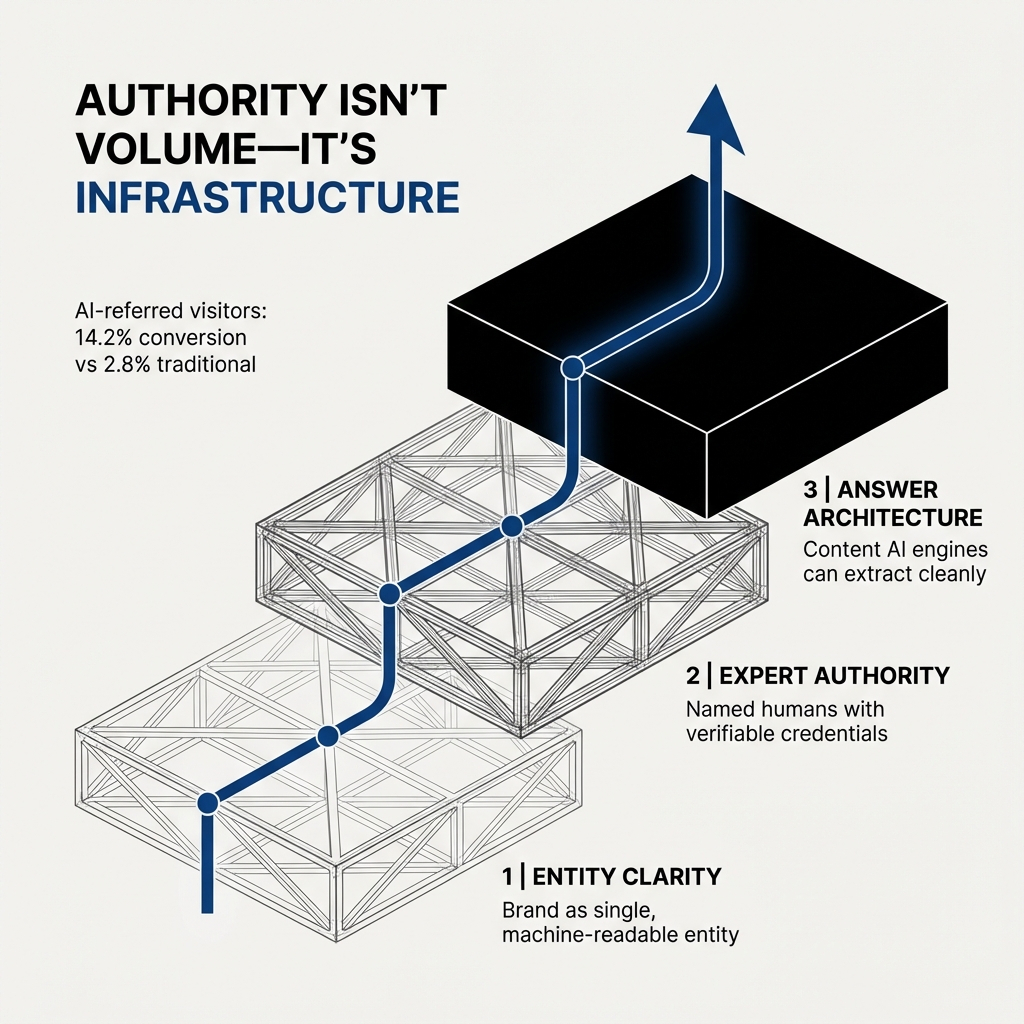
The structural signals that give early movers an unfair advantage are already measurable. AI-referred visitors convert at dramatically higher rates—some studies show 14.2% compared to Google's 2.8%.
The Three-Layer Authority Ecosystem
The companies winning in AI-driven discovery have built a three-layer infrastructure that positions them as the default choice.
Layer one is entity clarity. Your brand exists as a single, well-defined entity in knowledge graphs and directories, with consistent naming, metadata, and schema. AI can confidently point to who you are and what you're trusted for.
Layer two is executive and expert authority. Your real humans, founders, executives, subject-matter experts—become recognizable entities with visible, verifiable expertise. Named authorship with credentials, structured Person schema, and thought leadership that gets cited across media and podcasts.
Layer three is answer-ready content architecture. Your site and content are designed so AI engines can extract clean, unambiguous answers: clear information architecture, tight topic clusters, and schema that makes pages machine-legible.
Most teams live in layer three today, publishing articles and guides without realizing that layers one and two are what make AI choose you over competitors.
How Authority Infrastructure Creates Compounding Returns
I worked with a mid-market SaaS company that was publishing excellent content and was still basically invisible to AI assistants. They had deep guides with data and frameworks, a clean on-page structure, and everything traditional SEO said to do.
The problem was structural. The company name collided with other brands, descriptions varied across platforms, and articles were published without named experts. AI systems couldn't confidently lock onto a single entity.
We standardized the brand description everywhere, implemented robust Organization and Product schema, and switched major assets from anonymous bylines to named leaders with clear credentials synced across all platforms.
Within two months, their content started appearing as cited sources in AI answers for high-intent category queries. The interesting part: we didn't rewrite all their content. We re-wrapped it in a clearer entity and expert framework.
The traffic from AI citations was small at first, but those visitors converted at materially higher rates. Prospects arrived already educated, with better deal sizes.
The Measurement Shift That Matters
You need a separate measurement system for authority infrastructure versus content performance. The first increasingly drives the second.
For infrastructure, track how often your brand is cited or mentioned in AI answers across assistants for key category queries, what position you appear in, and whether there's a link. Isolate AI referrers into their own channel and track conversion rates, SQLs, and pipeline from that cohort.
Around 93% of AI Mode searches end without a click, which is more than twice the rate of AI Overviews. Traditional traffic metrics mask the real authority game happening in AI answers.
Authority can compound even when traffic doesn't spike. AI can recommend you, shape the narrative, and send a small stream of extremely high-intent visitors who turn into an outsized pipeline.
The 90-Day Evidence Window
Most B2B marketing leaders face pressure to show results in 90 days or less. The asset you're building, authority infrastructure, pays off in months 4-6 and beyond. But you will have hard evidence inside 90 days that it's compounding in the right direction.
Structure work so the first 30-60 days focus on entity cleanup, schema, expert profiles, and AI visibility baseline. The next 30 days show movement in AI citations, branded demand, and AI-sourced conversions, even if absolute numbers are small.
Give executives a separate authority infrastructure dashboard that highlights AI visibility and citation share for a fixed basket of buying prompts, entity accuracy, and branded query lift. They see the curves bending before sessions or pipeline catch-up.
To relieve pressure, pair long-term infrastructure with 1-2 quick-win initiatives that move traditional metrics inside 90 days. Refresh a high-intent page for both AI visibility and classic SEO, or launch one authoritative asset that becomes both an AI citation target and a clear assist in late-stage deals.
The Single Decision That Changes Everything
If you realize you've been funding content output instead of building authority infrastructure, the most important decision you can make in the next 30 days is this: stop funding "more posts" by default.
Freeze any net-new "nice to have" content briefs for one month and redirect that budget to understanding how AI currently sees your brand and your experts. Commit to a 30-day authority sprint: entity audit, expert mapping, and AI visibility baseline.
Once you make that call, everything else follows. You start designing content to reinforce a clear entity and expert graph instead of adding to the noise.
The companies that prioritize authority infrastructure over short-term tactics are seeing accelerated pipeline growth within 90 days and building moats that competitors can't replicate. The real moat is becoming the authority that those AI systems are trained to trust and surface first.


Comments
Post a Comment