From Control Theater to Outcome Architecture: How to Rebuild Your AI Marketing Strategy in 90 Days
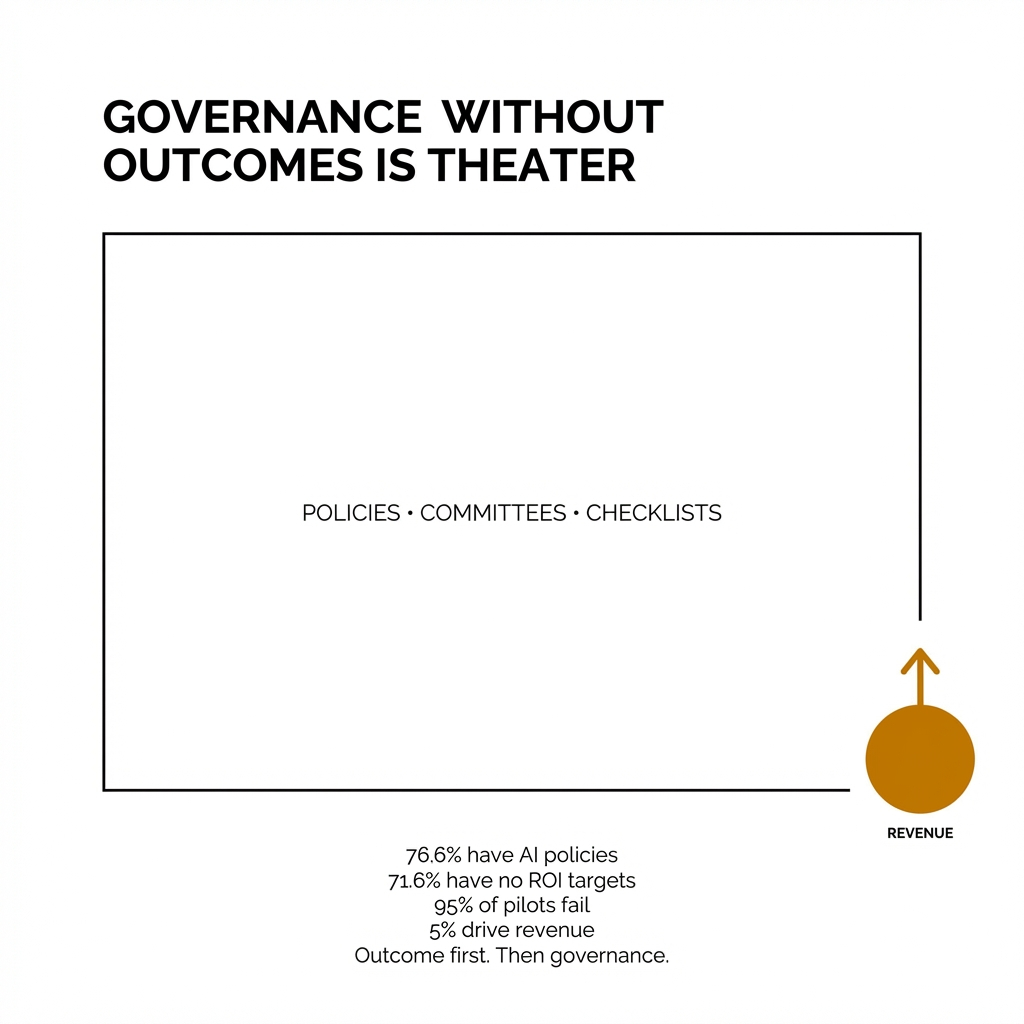
Most marketing teams are performing AI maturity theater: policies, committees, and tools—but no shared definition of success or way to connect AI to revenue.
76.6% of marketing teams have AI policies, yet 71.6% lack ROI targets. Meanwhile, 95% of enterprise AI pilots fail to deliver business impact. Governance arrived faster than strategy.
What Governance Theater Looks Like
I watched a mid-market B2B brand with a mature governance stack—AI council, detailed policy, vendor checklist—struggle with a clear use case: mine win-loss data to fuel targeted content for one ICP segment over 90 days.
Every conversation got routed through governance. Instead of asking what pipeline lift they needed in 90 days, the first questions were about risk definitions and review lanes. The approval workflow became the design constraint. They removed the data sources that made the use case powerful to minimize policy friction.
When asked how they'd know it worked, the answers were: "We followed policy," "We used approved tools," "We documented review correctly." Only after prodding did anyone mention conversion or cycle time.
The AI policy became the product. They optimized for passing their own governance process instead of creating pipeline.
Why Speed Triggers Control Instead of Strategy
When AI moves faster than leaders can regulate it, three things appear: loss of control, fear of public failure, and pressure to look responsible. Governance artifacts are legible signals—you can ship a policy in a quarter.
Strategic paralysis is politically dangerous. Reckless experimentation is career-risky. Governance theater offers the middle path: "We're moving carefully," which plays well in board decks.
The Real Resistance to ROI Targets
The resistance isn't "we don't care about ROI." It's "we're afraid to commit to numbers we don't structurally control."
Leaders point to model changes and shifting platforms. Underneath is fear: they'll be held accountable for vendor roadmaps, data quality, and measurement systems 75% of marketers admit are already broken.
They frame AI as "capability building" or "productivity"—language that gives cover when spending exceeds returns.
The Five-Step Shift: Governance-First to Outcome-First
I move teams through a ruthless sequence: pick one outcome, design one 90-day bet, wrap necessary governance around it, wire in feedback, then scale or kill it.
1. Outcome Before Anything Else
"In 90 days, what single number do you want to move that you'd defend in a board meeting?" Pipeline, win rate, demo volume, CAC, cycle time. If AI didn't exist, would this still be a priority? If not, it's a science project.
2. Tie One Pilot Directly to That Outcome
Design a single, narrow pilot whose only purpose is moving that number in 90 days. What are you willing to stop so this has real oxygen? Who owns this metric by name, not committee?
3. Rebuild Governance Around the Outcome
Flip the logic. Instead of "What lane does this go through?" ask "What's the minimum governance to hit the outcome without reckless risk?" Which controls are optics versus real risk? If this rule made you miss the outcome, would you keep it?
4. Create Tight Feedback Loops
Wire in measurement from day one. Simple pre-post baseline on the primary KPI plus leading indicators monitored weekly. Use directional signals rather than waiting for perfect attribution.
5. Scale Only What Proves Value
At 90 days, run a brutal review. Did you move the outcome? Was governance fit-for-purpose or friction? Three decisions allowed:
Scale: Roll the pattern and codify minimal governance.
Refine: Adjust and run another 60-90 days.
Stop: Declare it a lesson, shut it down, free budget.
The hardest part: saying "this well-governed thing didn't move the number" and killing it instead of hiding it under innovation theater.
Governance vs. Theater: Five Diagnostic Markers
Does your structure make it easier or harder to deploy AI that moves a business metric?
1. Outcomes Are Explicit: Every AI system ties to a defined business purpose, owner, and KPI. Theater = detailed policies with no map linking models to revenue, efficiency, or risk targets.
2. Governance Is Embedded: Policies translate into automated checks and workflow guardrails. Theater = PDFs and manual checklists while real work happens in shadow AI.
3. Authority Is Real: Someone can approve or block deployments, with examples of decisions changed. Theater = committees meet but no one can point to a material decision governance altered.
4. Risk and Performance Balance: Risk controls calibrate to use case. Theater = everything treated as high-risk, same policy applied indiscriminately.
5. Measurement Covers Trust and Value: Leaders track both trust metrics and business metrics. Theater = dashboards focus on compliance artifacts: trainings completed, policies published.
What Building for Iteration Means
Structure your team to run many small, safe, outcome-tied AI bets in short cycles:
Short cycles: 4-12 week loops with clear hypotheses, baselines, and scale/refine/stop decisions.
Experimentation as default: Structured tests, A/B where possible, analytics wired from day one.
Lightweight governance: Risk-tiered policies with fast lanes for low-risk experiments.
Feedback by design: Leading and lagging metrics reviewed on cadence, learnings rolled into playbooks.
Teams built for iteration talk in hypotheses: "We think AI-assisted scoring will lift SQL-to-opportunity 10% in 8 weeks." Teams built for predictability talk in narratives: "We're rolling out AI personalization this year," with few testable specifics.
Why This Matters Now
AI's pace is exposing how uncomfortable organizations are with learning in public. Governance theater offers a way to look in control of process when they're not yet in control of outcomes.
The organizations that win in the next 12-18 months will flip the sequence: outcome first, then governance. They'll run tight 90-day cycles, kill what doesn't work, scale what does. They'll build outcome architecture instead of control theater.
You can perfect internal definitions of high-risk AI while competitors run outcome-first experiments and capture your segments. The opportunity cost compounds.
Start with one outcome, one 90-day bet, one decision at the end.
The choice: be good at governance or good at growth.


Comments
Post a Comment