How to Build AEO Infrastructure That Actually Generates Leads
When your excellent content stays invisible in ChatGPT and Perplexy, the problem usually isn't quality.
The problem is infrastructure.
AI systems can't understand who you are, verify what you do, or trust you enough to recommend you. Your content exists in fragments across the web with no clear connection between the pieces.
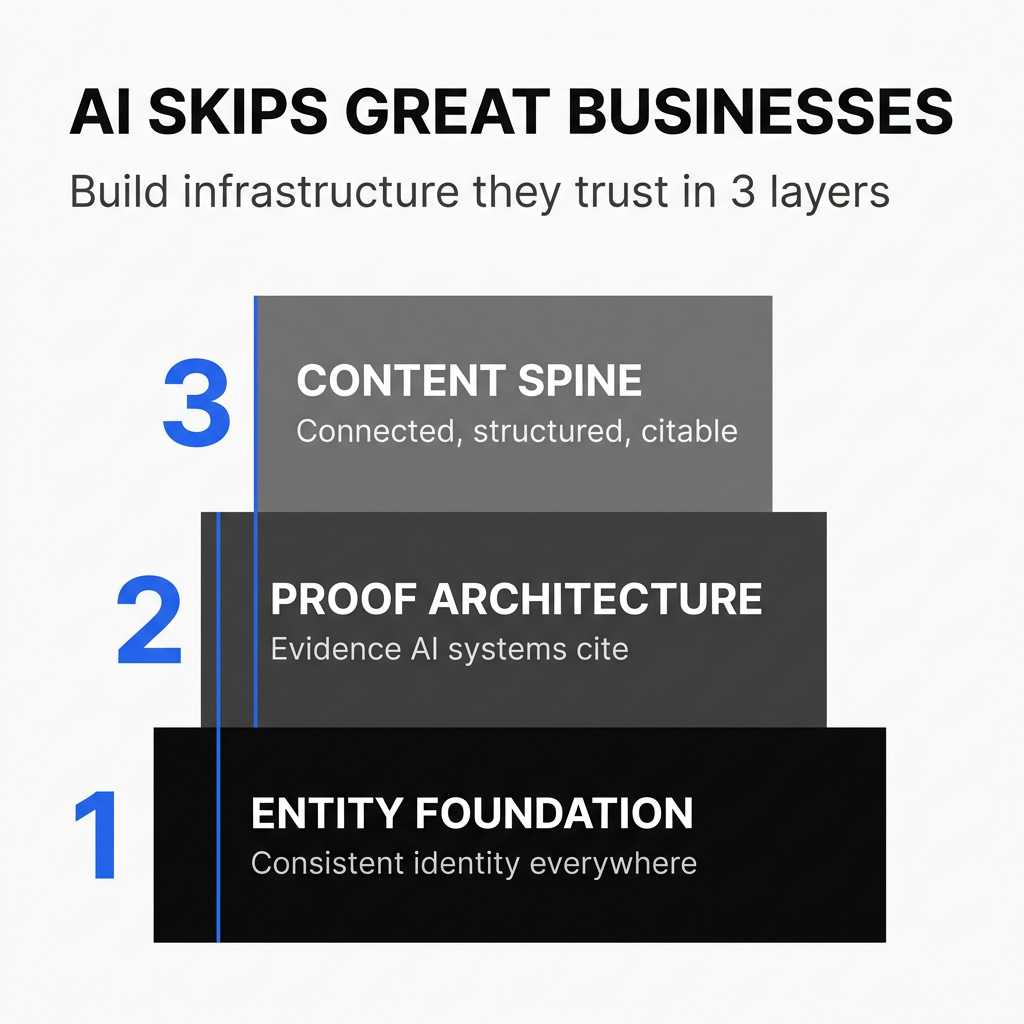
I've built this infrastructure for Authority Engine and watched it transform how we show up in AI-generated answers. The framework has three layers, and each one builds on the last.
Why AI Systems Skip Over Great Businesses
AI-driven search engines reward coherence across your entire digital ecosystem.
When your brand name appears slightly different across platforms, when your expertise areas shift from page to page, when your proof points live in disconnected silos, AI systems see fragmentation. They default to better-structured competitors even when your content quality is higher.
Research analyzing 680 million AI citations found that only 12% of AI-cited URLs match Google's top 10 results for the same query. Traditional SEO success doesn't automatically translate to AI visibility.
Nearly 89% of AI citations come from completely different sources depending on which model users query. Your content appears in one AI platform but stays completely invisible in another.
Layer One: Entity Foundation
Your entity layer teaches AI systems who you are.
This means your brand, your executives, your products, and your proof points need consistent naming everywhere they appear. When your CEO is "John Smith" on LinkedIn, "J. Smith" in press mentions, and "John" in your blog bylines, AI systems see fragmentation.
Start here:
Write down your official details on one sheet: exact business name, address, phone, website, and a one-sentence description in plain language.
Open your website (home, footer, contact, About), Google Business Profile, LinkedIn company page, and primary social profile. Make the name, address, phone, and URL match your sheet character-for-character on all of them.
This tells every system: "These are all the same business. File them together."
Websites with strong entity signals experience up to 40% higher visibility growth over 12 months compared to sites focused solely on keywords. When search engines recognize you as a strong entity in your niche, every page you publish benefits.
Layer Two: Proof Architecture
AI systems need evidence before they cite you.
Your proof architecture makes validation machine-readable. Case studies, customer reviews, third-party benchmarks, certifications, media mentions these aren't just marketing assets. They're authority signals that AI systems use to evaluate trustworthiness.
The mistake most companies make is treating proof as scattered files. A case study PDF here. A testimonial buried on a product page there. Reviews on a third-party site with no connection back to your entity graph.
Proof needs structure:
Ask every happy customer for a review on 1-2 priority platforms. In your ask, nudge them to mention the specific service or problem they came to you for. This ties your entity to those topics in natural language.
Create one deep proof asset with named examples and clear structure. Pick your most important use case. Make it thorough, specific, and properly marked up. Attach it to your core entity.
Join relevant professional bodies, local chambers, industry associations, or partner programs that list members publicly. Ensure those profiles clearly describe your specialization using the same language as your site.
Schema markup can boost your chances of appearing in AI-generated summaries by over 36%, transforming generic information into structured data that AI systems can confidently cite.
Analysis of ChatGPT's top citations found that 67% go to first-hand data and original research. Brands that publish original data, internal benchmarks, or proprietary analysis earn significantly more AI citations than those rehashing existing information.
Layer Three: Content Spine
Your content spine connects everything together.
Publishing content isn't the same as building infrastructure. A content spine means every piece of content is explicitly attached to entities and proof, topics cluster around your core expertise areas, and structure makes content "snippable" for AI answers.
Build your spine:
Pick your 3-5 "conference topics" the talks you would give over and over. These become your core topics. Make sure each topic is specific enough that you could be the go-to expert locally.
Rewrite your homepage hero, services page, About page, and Google Business description. In each, explicitly state in everyday language: who you are, who you serve, and the main problems you solve.
Create one "pillar" page per core topic. One page that is "the big guide" for each main problem, with clear headings that cover the obvious sub-questions a customer would ask.
Princeton researchers tested nine optimization tactics across 10,000 queries and found that content structure alone can increase AI citation visibility by 40%. AI systems treat document structure like an API contract for information extraction.
When you write blog posts, FAQs, or case studies, link relevant phrases back to the right pillar page. Cross-link related posts so AI can see a cluster of content around each topic.
What This Looks Like In Practice
A regional B2B services firm came to us invisible in AI search. When we asked ChatGPT or Perplexity about their category, the AIs either skipped them or gave vague non-answers.
The audit revealed three gaps:
Entity gap: Slightly different names and descriptions across the site, LinkedIn, Google Business, and directories. AI systems couldn't form a confident, singular entity for the brand.
Proof gap: Almost all validation lived on assets they controlled. No case studies with identifiable companies. No credible third-party reviews. Nothing structured that AI could cite as evidence.
Depth gap: Surface-level content with no coherent topical cluster. No implementation guides. No risk/tradeoff pieces. Nothing that demonstrated the depth AI systems need to treat you as a primary authority.
We locked in one canonical identity and pushed it everywhere. We helped them pick three tight problem spaces and built pillar pages around those problems. We worked on getting the rest of the internet to back up that story through reviews, credible listings, and lightweight digital PR.
In 8-10 weeks, they moved from "AI has never heard of us" to being cited in 20-30% of tracked recommendation prompts in their specialty cluster.
The Compounding Effect You're Building Toward
AEO infrastructure compounds in ways traditional SEO never did.
When you build authority at the entity level, every new piece of content inherits that authority. Your next article gets discovered faster. Your insights surface in more AI answers. Your brand becomes the default reference point in your category.
Once entity data is consistent and content is properly structured, each new piece of content builds on the authority foundation automatically. One enterprise client saw a 69% increase in clicks for non-branded queries after implementing entity linking at scale.
Competitors who rely solely on keyword targeting struggle to replicate this effect. They can copy your topics, but they can't copy your entity graph. They can't copy your proof density. They can't copy the structural coherence that makes AI systems trust you.
Clicks from search results pages with AI Overviews are higher quality. Users spend more time on the site. They're more engaged. AI results give people more context about a topic overall, which provides a more engaged audience.
Where To Start Without Overwhelming Your Team
You don't need to rebuild everything at once.
Week one: Fix your "ID card" everywhere people already see you. Write down your official details. Make the name, address, phone, and URL match across your website, Google Business Profile, LinkedIn company page, and Facebook page.
Week two: Rewrite one "front door" to say what you really do. Pick your homepage or primary services page. Add one clear sentence at the very top: "We help [type of customer] with [top 2-3 problems/topics] in [location/market]."
Week three: Trigger a small wave of topic-rich reviews. Make a list of 5-10 happiest recent customers. Send each a personal message asking them to leave a short honest review and mention the specific problem you helped them solve.
New AEO-optimized content achieves first AI citations within 3-5 business days of publication when proper entity foundation, proof architecture, and content spine are already in place.
The Long-Term Maintenance Rhythm
Think of this like maintaining a reputation, not running a campaign.
Weekly: Publish or engage in your lane. One small action a week a short post, comment, or answer about your core problems on LinkedIn, Google Posts, or your main social channel. Ask at least one recent customer for a review on your priority platform.
Monthly: Quick coherence audit. Spot-check your homepage, About, main service pages, Google Business description, and LinkedIn company page. Ask: "Do they all still say the same thing about who we are and what we're for?" Review what you actually published and label each as "core, support, or off-topic."
Quarterly: Tune the lane. Rerun an AI visibility check by asking ChatGPT, Perplexity, and others: "Who helps with [anchor problem] for [your audience/location]?" and "What is [Brand]?" Check if profitability, demand, or proof has shifted. Clean up drift by retiring or merging pages that are off-message.
If you keep this light cadence, you preserve the clarity and trust you've built with AI systems and compound it over time.
The Shift That Changes Everything
The companies winning in AI search aren't doing more. They're building better infrastructure.
They've stopped treating content as a series of one-off tasks and started building systems where authority compounds. Where every piece of content strengthens the whole. Where AI systems can confidently cite them as the answer.
You're closer to this than you think. You already have content. You already have proof. You already have expertise.
You just need to connect it into infrastructure that AI systems can trust.
Start with your entities. Add your proof. Structure your content.
The rest follows.


Comments
Post a Comment