The Infrastructure Opportunity Marketing Leaders Are Looking For
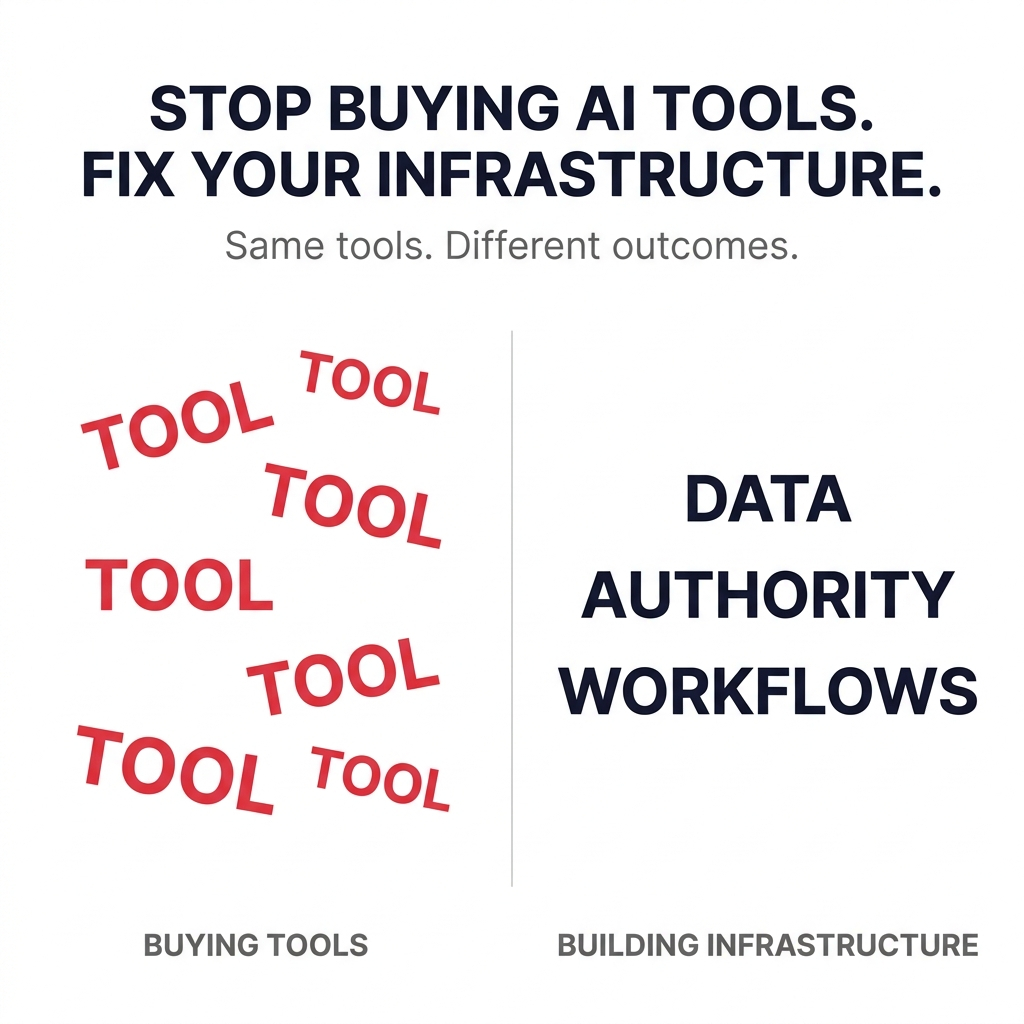
Your competitors are buying AI tools. You're about to build the infrastructure that makes those tools actually work.
Why AI Tools Fail
Marketing executives buy AI ad optimizers and content generators, then plug them into fragmented CRMs, inconsistent brand narratives, and ad accounts never engineered for learning loops. Performance plateaus. CAC climbs. Teams burn hours reconciling reports.
AI tools only work as well as the infrastructure they're plugged into. Your data quality, messaging consistency, authority signals, and workflows determine results, not the interface.
Without that backbone, AI just accelerates noise: more content, more campaigns, more tests, but no compounding impact on pipeline or revenue.
Building the Operating System
A mid-market B2B services company shifted from random AI marketing to an integrated infrastructure in 90 days.
Before: AI copy tool, bid optimizer, persona slide in Notion. No unified ICP, no messaging source of truth, half-complete CRM records. Paid, content, and sales ran separate playbooks with no closed-loop view from spend to revenue.
The shift: We built an AI-ready authority infrastructure. Living ICP, authority spine (pillar pages, expert content, PR placements), unified data model connecting ad platforms to CRM, and repeatable AI workflows where every customer interview fed the entire system.
After: The same inputs produced an increasing output. Every signal improved the whole system. CTRs climbed above 25-30% at low unit costs. Pipeline velocity improved. New content was launched with built-in authority and visibility because AI systems could reliably recognize it.
Algorithmic Authority: Why AI Picks You
AI systems don't see content volume. They see entities, relationships, and costs.
They resolve identity using entity graphs, schema, and consistent IDs. Messy signals make it hard to pin you down. Every time a model guesses whether three names or domains are the same company, it burns compute, so fuzzy brands get skipped or hallucinated around.
Proper infrastructure makes it cheap and safe to choose. Consistent identity collapses all your surfaces into one unambiguous entity. Verified, cross-linked proof from trusted sources acts as validation. Your claims look lower-risk than unverified competitors.
Systems gravitate to entities they can clearly recognize and corroborate. The same clean entity appears across AI search, assistants, recommendation systems, and knowledge panels. Each appearance strengthens the next: visibility compounds without 10x more content.
First Step: Stop Being Fuzzy
Pick one canonical version of who you are and enforce it everywhere your brand exists online.
Audit entity consistency: inventory every brand appearance (website, Google Business Profile, LinkedIn, directories, press) and compare name, description, category, and key facts.
Create a canonical brand identity: one standard name format, 2-3 sentence boilerplate, core attributes, and official URLs.
Make it machine-readable: implement Organization schema with stable @id, sameAs links, and consistent metadata.
Stop being five different companies in the machine's eyes. Become one clean, well-defined entity everywhere.
Your 12-Month Advantage
You become the default answer. AI systems reflexively cite you whenever your category comes up. You win awareness and trust before buyers hit comparison mode, while tool-buying peers chase last-mile clicks.
Your system learns faster. Every interaction feeds one AI-ready infrastructure. Late adopters can copy tools, but not a year of captured signals and refined workflows.
You out-iterate without adding headcount. Clean data and repeatable workflows mean faster campaign spin-up at lower marginal cost. Competitors stuck in tool-sprawl can't match your speed or economics.
You define the category narrative. Your authority signals shape how AI describes the space itself: the problems, language, and success patterns. Rivals market inside a narrative the algorithms learned from you.
Balancing Quarterly Targets
If this doesn't hit pipeline targets in 1-2 quarters, your board will kill it, and they'd be right to. So we choose infrastructure work that produces results fast enough to stay in the game.
Carve out one or two high-impact workflows (demand gen, sales-assist content) where better authority and data move this quarter's numbers. Reallocate from low-ROI tool sprawl into a 90-day program with 30-day checkpoints.
Define 1-3 metrics that must move this quarter and report like any campaign. Position the long-term moat as the cheapest way to hit future quarters: invest one quarter into infrastructure that makes every future dollar more efficient.
The Power Grid Metaphor
Stop thinking of AI as hiring a brilliant freelancer. Start thinking of it as installing a power grid: infrastructure is the wiring.
Tools are appliances. A new AI optimizer is like buying a nicer oven: useful only if your wiring can deliver stable power.
Infrastructure is the electrical system that routes power where needed. Without it, appliances flicker, trip breakers, or sit unused.
This explains failure without blame: the oven isn't broken, our wiring wasn't designed for this load.
AI tools are how you consume power. Infrastructure is how you move it. In a world going all-electric, fixing the wiring is no longer optional.
References & Further Reading
Authority Engine Launches AI Ads Engine with 37% CTR Performance
Entity Authority and AI Search Visibility - Search Engine Land
Authority Engine Announces AI Authority Engineering Framework
How Generative AI is Forging Productivity in Sales and Marketing - Bain
Entity SEO Guide: Building Clean, Recognizable Brand Entities
How Entity SEO Supports Brand Authority in AI Search - Schema App
Marketing in the AI Era: Balancing Short-term and Long-term Value - PwC


Comments
Post a Comment