Why AI Engines Choose Some Brands and Ignore Others
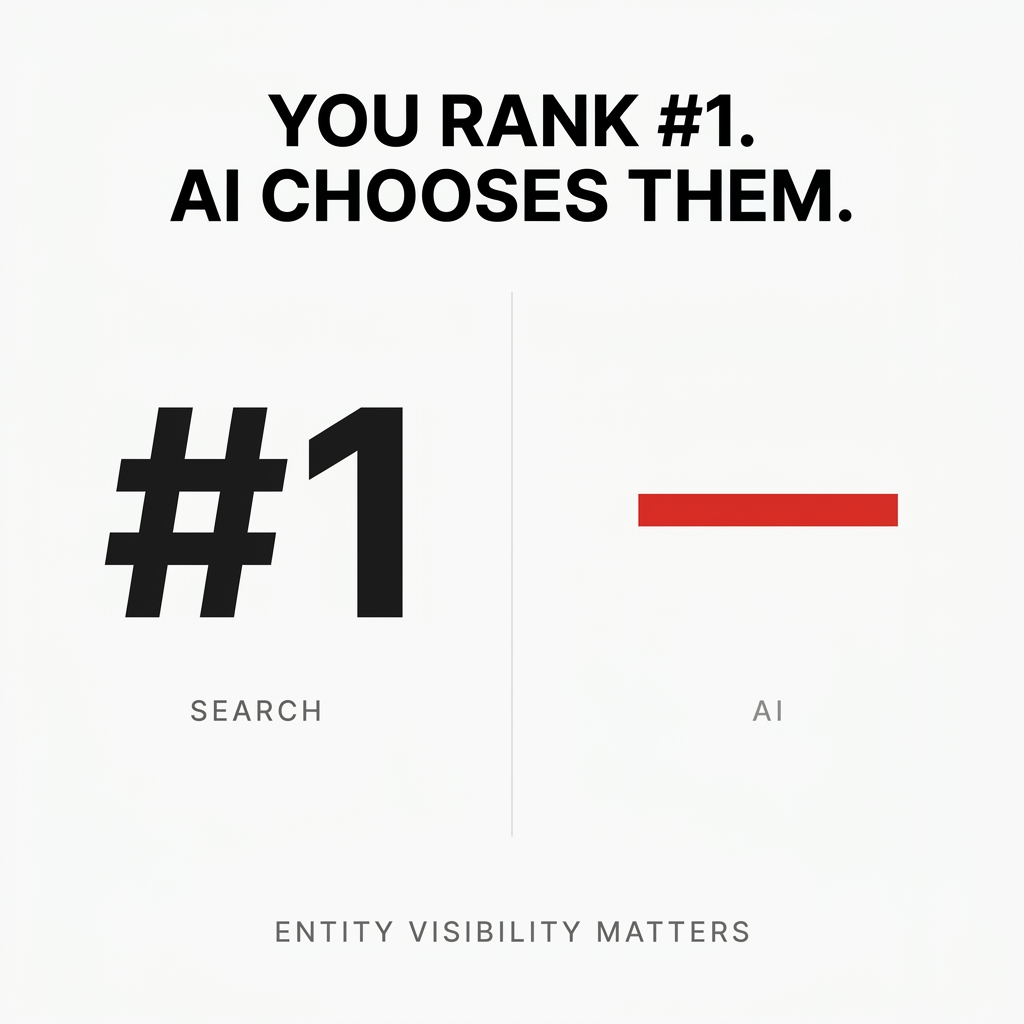
Your brand exists in search results. Your content ranks. Your site gets traffic.
But when someone asks ChatGPT, Perplexity, or Google's AI Overview for a recommendation in your category, you disappear.
The brand that shows up has similar content quality. Similar domain authority. Sometimes less traffic than you.
So why does the AI choose them?
The Answer Lives in How AI Systems Decide What to Trust
AI engines don't rank pages anymore. They recommend authorities.
When you search traditionally, Google shows you 10 blue links and lets you decide. When you ask an AI, it synthesizes an answer from 2-7 sources and presents them as the answer.
That shift changes everything.
The AI has to be confident enough to put your brand name in its response. It has to trust that you represent accurate information. It has to understand who you are as an entity, what you're known for, and how you connect to the broader knowledge graph.
Most brands fail this test because they optimized for human readers and search crawlers. They never built the infrastructure AI systems need to understand, trust, and cite them.
Entity Recognition Is the Entry Point
AI engines evaluate you as a node in a web of people, brands, products, and claims. They ask: who are you, what are you connected to, and how coherently does the wider web confirm that story.
This happens through entity recognition. The AI runs named entity recognition to detect your brand, your CEO, your product. Then it links those entities to IDs in knowledge graphs like Google's Knowledge Graph, Wikidata, or internal graph IDs.
That linking step upgrades your brand from a phrase in an H1 to a node in their internal graph.
Once you're recognized as an entity, the AI checks:
Your graph structure and relationships. How your entity connects to others: Organization → Brand → Product → Offer → Reviews, plus founders, locations, industries, use cases. Clean, nested relationships make it easy for AI to see you as a coherent, well-defined node.
Consistency across the wider web. Whether your name, description, category, and key facts match across your site, LinkedIn, Google Business Profile, directory listings, and press. Inconsistent or conflicting descriptions weaken entity trust even if you have strong content.
External corroboration. High-trust third-party sources like Wikipedia, Wikidata, major business databases, and authoritative media that confirm your entity and link back using the same name, URL, and descriptors.
When these signals align, you become a trusted entity. When they conflict or stay thin, you remain optional background noise.
Schema Markup Turns Content Into Machine-Readable Infrastructure
Most brands think schema is nice-to-have SEO hygiene. It's actually the infrastructure that makes you visible to AI.
When schema is missing, the AI has to guess what your brand is, what a page is about, and how it all connects. You're high-friction and easy to skip.
When schema is in place, you're pre-labeled and low-friction. The AI can recognize you quickly and with high confidence.
Pages with comprehensive schema are 36% more likely to appear in AI-generated summaries and citations. That's because schema removes guesswork around context, relationships, and attribution.
FAQPage schema gives the AI a ready-made map. Each item is a Question with a name (the exact question text) and an acceptedAnswer text (a self-contained answer). AI systems can grab that pair and render it almost verbatim in an overview or chat answer.
HowTo schema defines the task and contains ordered HowToStep objects, each with a name and text describing that step. The AI can lift those steps as a clean, ordered list in an AI Overview, voice reply, or chat response.
Schema turns your content into labeled building blocks that map directly onto the blocks AI engines need to assemble their own responses. Plain text alone forces the model to guess those boundaries.
Modular Content Architecture Makes You Reusable
AI engines don't think in pages. They think in entities and their connections.
A typical flow is: identify the key entities in the user's question, traverse the knowledge graph to find trusted entities and their attached content chunks, cross-check facts across multiple entities and their relationships to verify what's safe to say.
If your brand entity is well-defined, consistently corroborated, and surrounded by a clean internal content graph, you're much more likely to be pulled into that reasoning chain.
This is where modular content architecture matters.
Instead of publishing scattered blog posts that repeat similar ideas, you build a content knowledge graph. Each piece reinforces a coherent topical map. Every asset connects back to your core entity and strengthens your authority in specific problem spaces.
The AI evaluates whether your entity has coherent, interlinked content clusters around its core topics. A tight topical map that radiates from your core entity tells the engine: this brand owns this subject.
Modular content acts as the building blocks AI systems need to understand context, intent, and expertise across multiple query patterns. Each module can be extracted, cited, and reused independently while still rolling up into a unified authority profile.
What Being Chosen Actually Looks Like
When you implement entity core, schema infrastructure, and modular content architecture, you stop being optional background reading. You start behaving like a pre-approved building block in the AI's answer library.
You show up more often, in better positions, on more valuable queries.
You become easier to select. Your brand, people, products, and key topics resolve to a single, stable entity. That lowers the model's risk in citing you. Your content gets ingested, tested, and reused more often than unstructured peers.
You show up in AI overviews and snippets. Brands see measurable lifts in AI Overview citations and impressions for the entities they've optimized. You appear for non-branded, problem-oriented queries in your category because the engine now understands you as an authority on those entities and topics.
You get cited on better queries. The mix of queries where you're cited shifts toward your priority entities. The AI pulls you for the exact topics, use cases, and product categories you've structurally mapped. You're more likely to be included in comparisons and recommendation lists where the model must pick a small, trusted set of brands.
Your profile stabilizes across AI platforms. Different AI systems converge on the same name, description, and positioning for your brand because they're all reading from a clean, corroborated entity graph anchored by your site. Fewer hallucinated details. Your category, HQ, pricing model, and core features align much more closely with how you describe yourself.
The clearest signal you've crossed the threshold is that your brand starts showing up predictably and repeatedly in AI answers for your core category questions—even when the user doesn't mention you by name.
The Structural Difference That Keeps Competitors Out
When you see a competitor with similar content quality but they're still invisible to AI, the structural difference is almost always this: you look like one clear, validated entity with owned topics, and they look like a pile of pages without a coherent, machine-readable identity and topic map.
The visible competitor has a clean entity spine: organization schema, sameAs, consistent naming, corroborated profiles, and tight content clusters that clearly associate their entity with a specific topic space.
The invisible brand might have comparable articles, but weak or inconsistent entity signals. Different names or descriptions across platforms. Thin or missing schema. No clear topical clusters. AI systems can't confidently treat them as the authority behind that knowledge.
In AI's world, that structural gap is decisive. If the model can't unambiguously pin knowledge to your entity, it will default to the competitor whose identity and topic footprint are easier and safer to reuse.
The One Thing to Fix First
If you only had the capacity to fix one thing this quarter, build a single, clean entity home.
Create or tighten one page, usually your About or homepage, that clearly defines who the company is, what it does, key products, location, and category. Use the exact words you want AI systems to reuse.
Add Organization schema on that page with a stable @id, and a sameAs array pointing to your official social profiles and major listings: LinkedIn, Google Business Profile, key directories, app stores.
This gives AI systems a single, machine-readable anchor to resolve your brand as one entity instead of a fuzzy set of mentions. That's the prerequisite for every other visibility gain.
It immediately reduces entity confusion and suppression. Organization schema on the entity home is the highest-leverage starting point for AI visibility.
Once that entity home is solid, you can layer on product schema, FAQ and HowTo, PR, and topical clusters. But without a trusted core entity, all that effort has nothing stable to roll up into.
AI engines are becoming the default entry point for every buying journey. The brands that engineer semantic alignment now build a compounding advantage. The ones that wait will find themselves competing for scraps in a world where being the answer matters more than being on the page.


Comments
Post a Comment