Why Your AI Marketing Stack Needs Infrastructure
You've spent real money on AI tools. Your team uses them daily. But when someone asks what you've actually won, the answer gets uncomfortable.
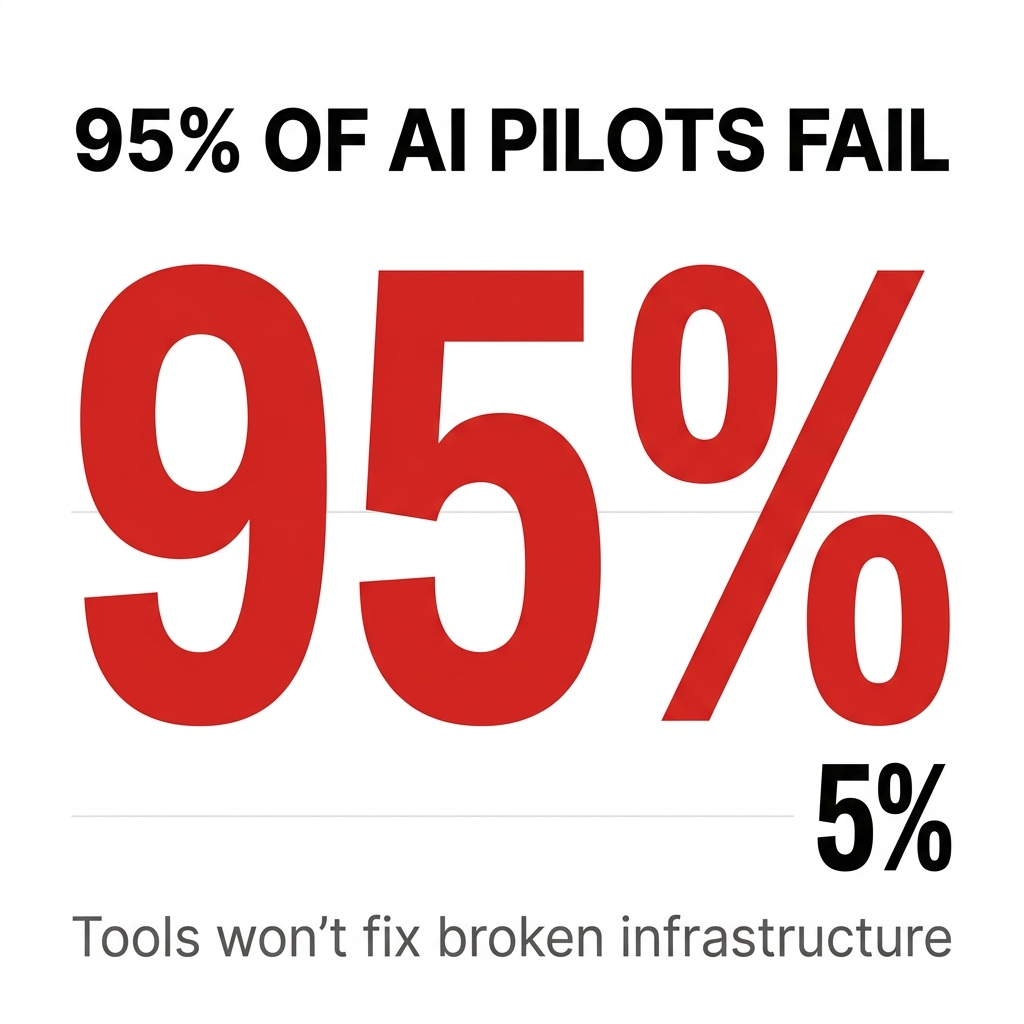
The numbers tell the story. 95% of AI pilots fail to deliver measurable ROI. 42% of companies scrapped most of their AI initiatives in 2025, up from just 17% the year before.
The problem isn't your team's effort. It's that you're treating infrastructure as tactics.
The Tool Accumulation Trap
Your stack keeps growing. 93% of marketers saw new AI features added to their tools in 2024. Every platform promises efficiency. Every vendor shows case studies.
So you add another AI writer. Another optimization tool. Another analytics dashboard.
The outputs feel generic. The brand voice gets diluted. The results don't compound.
Here's what's actually happening: you're piling tactics on top of broken infrastructure. More tools can't fix a foundation that was never built for AI-era discovery.
The Invisible Problem
While you optimize campaigns and generate content, AI systems are deciding which brands to recommend. ChatGPT serves over 300 million users weekly. Perplexity handles 100 million queries per week.
These platforms don't rank pages. They recommend authorities.
Your brand needs to exist as a coherent entity in their knowledge graphs. It needs structured proof signals. It needs cross-validated authority markers that AI systems trust.
Traditional marketing metrics weren't designed to measure this. You can't see the gap until you ask AI systems directly: "Who should someone hire for this problem?" If your brand doesn't appear in those answers, you're invisible where it matters most.
Why Teams Stay Stuck
Adding tools feels like progress. It's easy to defend in meetings. It creates visible activity.
Building authority infrastructure feels risky. It requires ops, data, and IT. It forces uncomfortable questions about what you're actually the authority on. It exposes whether your positioning holds up under scrutiny.
Tactics let you say "we're testing a few more things next quarter." Infrastructure work requires admitting the model needs to change.
The psychological comfort of tool accumulation keeps teams in motion without momentum.
What Infrastructure Actually Looks Like
Authority infrastructure isn't another tool. It's how your brand shows up as a unified, trustworthy entity across every AI system.
It means:
Canonical entity definitions that ops, data, and marketing own together
Structured proof signals that AI systems can verify
Cross-functional workflows where authority health gets tracked like uptime
Measurement systems that capture AI visibility alongside traditional metrics
When a professional services firm cleaned up entity fragmentation across nine locations and implemented proper schema markup, they moved from zero AI recommendations to appearing in answer engines for 40+ related queries within 90 days.
The difference wasn't more content. It was treating authority as infrastructure.
The First Move
You don't need CEO approval to start. Pick one high-value slice of your business. One product line, one region, one service category that leadership cares about.
Pull in one person from ops, one from data, one from web. Meet weekly for six weeks. Your only job: make that slice show up consistently when AI systems answer questions in your category.
Clean the entity data. Implement structured markup. Link proof signals. Measure before and after.
When you can show a 20-300% lift in AI visibility for something that matters, the conversation about scaling changes. You're no longer asking for permission to try infrastructure thinking. You're showing what happens when you stop treating it as optional.
The teams winning in AI aren't the ones with the most tools. They're the ones who realized the game changed from optimizing tactics to building systems that AI platforms trust.


Comments
Post a Comment