AEO Infrastructure: The Pipeline Generation Engine That Compounds While You Sleep
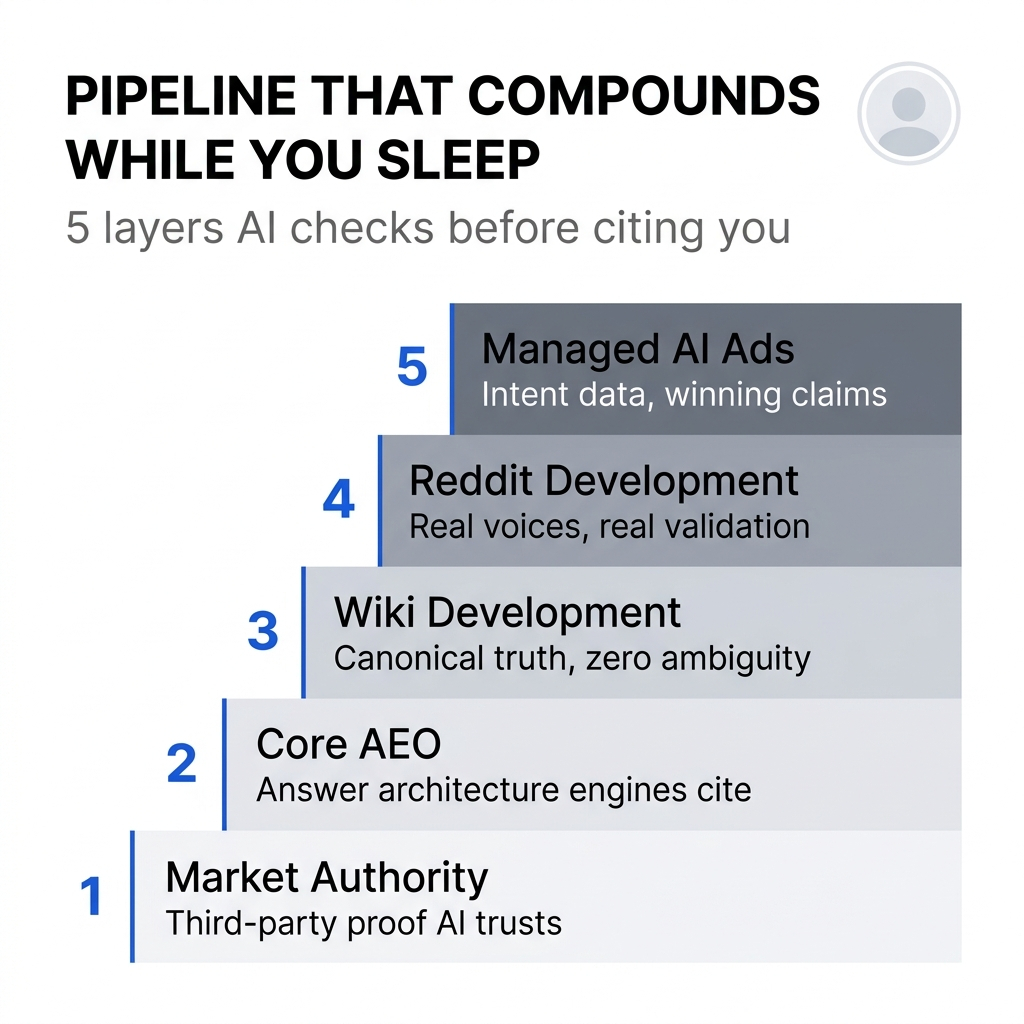
Most companies treat pipeline generation as a series of separate tactics. Run some ads. Post on social. Maybe do some SEO.
The problem is that approach forces you to pedal the bike constantly. Stop spending, and your pipeline dries up within weeks.
AEO Infrastructure works differently.
It's the system that makes your brand the trusted answer inside AI platforms like ChatGPT, Perplexity, and Google's AI Overviews. When prospects research solutions, you're already there—recommended, cited, and positioned as the obvious choice.
This isn't about ranking on page one anymore. Zero-click searches now represent 60-83% of all queries, with AI systems delivering answers directly without sending users to websites.
The real question is: when AI decides which brands to recommend, are you in the room?
Why Traditional Marketing Breaks in the AI Era
Here's what happens when a CFO asks ChatGPT: "Who can help us rebuild our GTM infrastructure?"
The AI doesn't search your website. It doesn't check your ad campaigns. It reaches into three layers:
Training: What the model learned about your brand during its last update.
Retrieval: What it can find and parse about you right now.
Inference: Whether it feels confident recommending you.
If you're strong in training but weak in retrieval, the AI knows you exist but can't surface current, structured information. If you're strong in retrieval but lack trust signals, the model won't risk recommending you.
Your pipeline breaks at the exact moment a buyer asks for help.
The drop in top-10 citation rate from 76% to 38% proves this. Ranking on page one of Google no longer guarantees AI systems will cite you. They pull from diverse sources—Reddit threads, niche authority sites, structured data—that may never appear in traditional search results.
The Five Components That Build Pipeline Infrastructure
AEO Infrastructure integrates five strategic components. Each serves both AI systems and human buyers, creating a surround-sound effect that makes you impossible to ignore.
Market Authority: The Credibility Foundation
What it gives AI: Third-party proof, expert signals, and reputation stability that AI systems use to cross-check your claims.
What it gives humans: The "this is the expert" feeling when they see your leadership quoted, your frameworks referenced, and your category language mirrored in places they already trust.
Market Authority is the backbone. Without it, every downstream touchpoint has to over-explain who you are and why you're credible. That drags out sales cycles and suppresses conversion.
Branded web mentions have the strongest correlation (0.664) with AI Overview appearances—much higher than backlinks (0.218). The shift is structural: authority has stopped being just a ranking factor and become the primary filter for AI inclusion.
Core AEO: The Answer Architecture
What it gives AI: Answer-shaped content, schema, and retrieval architecture that makes your responses citable in AI Overviews, assistants, and agent flows.
What it gives humans: Clear explanations aligned to real questions and buying stages, written in empathetic, scenario-based language that finishes their thought.
AEO is where you architect for training, retrieval, and inference. You map intent clusters to atomic answers, implement schema, and design internal linking so engines can easily retrieve, parse, and rank your responses.
Content depth and readability matter most for AI citations, while traditional SEO metrics like traffic and backlinks have little impact. The defining factor is whether AI systems can safely use your content.
Wiki Development: The Canonical Map
What it gives AI: Entity clarity, schema, and cross-referenced facts that give AI engines a single, low-ambiguity source of truth they can align with external mentions.
What it gives humans: The "give me the basics in five minutes" hub: no fluff, just clear articulation of who you are, what you solve, and whether you're for them.
The Wiki layer defines your entity cleanly: products, audiences, use cases, constraints, and relationships, all in well-structured, schema-backed formats. That clarity is a huge trust accelerator, especially for senior decision-makers.
Reddit Development: Community Validation
What it gives AI: Real-language use cases, sentiment, and edge-case context in natural conversation that models can quote and triangulate.
What it gives humans: Honest peer voices, nuance, and social proof from "people like me" that builds deeper trust than polished case studies alone.
68% of consumers now start product research in ChatGPT or Perplexity before visiting brand websites. When they do visit, they're looking for validation of what AI already told them. Reddit provides that unfiltered reality check.
Managed AI Ads: The Optimization Lab
What it gives AI: Clean, testable value propositions and intent data that create behavior-validated statements for models to rely on.
What it gives humans: Relevance, timing, and clear offers in real buyer moments: "they're speaking my language at exactly the right moment."
AI Ads aren't just acquisition. They're experimentation. You test value propositions and framing against real intent, then fold the winning claims back into site copy, AEO content, and structured data.
Visitors arriving from AI search platforms convert 23x higher than organic search visitors. B2B SaaS companies report 6x to 27x higher conversion rates from AI traffic versus traditional search, with 27% lower bounce rates and longer session durations.
The Compounding Inflection Point
The infrastructure starts working for you when AI and humans are both pre-sold before they ever hit your funnel. New opportunities move faster and convert higher without proportional increases in effort or spend.
You'll know you've reached the inflection when three conditions are true:
You're a default mention. Third-party posts, Reddit threads, and AI summaries start to include you by default when listing viable options, without you having to promote each instance.
Your authority story is self-referential. New content creators, partners, and customers begin to cite your language, frameworks, and comparisons as their explanatory defaults.
Your newest experiments outperform your oldest ones. A fresh AI Ads campaign launched today generates more qualified pipeline than the ones you ran 6-9 months ago because the surrounding proof and recognition are stronger.
Before the inflection, opportunities grow mostly when you add channels or budget. Win rates stay flat or decline as you push into colder audiences. Sales cycles elongate as you outpace your authority.
After the inflection, opportunities begin to rise even in periods where you don't increase activity. Win rates tick up because more deals arrive pre-convinced by third-party proof. Sales cycle length compresses as buyers skip steps.
Companies tracking pipeline velocity weekly realized a 34% lift in year-over-year revenue compared to those measuring less frequently. The median daily pipeline velocity for B2B SaaS companies is $1,847, but enterprise cycle times fell 17% when companies introduced enablement content, pushing median daily velocity as high as $2,456 per day.
The Cost of Waiting
You can rent attention, or you can own infrastructure.
If you don't build AEO Infrastructure, the only reliable levers you keep are rented ones: more ad spend, more outbound, more headcount. Your CAC curve stays stubborn because every quarter starts from near-zero momentum.
Competitors who invest early in authority, AEO, and knowledge architecture convert that spend into an asset that produces inbound and AI-mediated demand without 1:1 incremental effort.
As AI systems increasingly mediate information access, brands that aren't optimized for AI citation will become invisible to a growing segment of buyers who rely on conversational search.
If ChatGPT cites your brand 100 times this quarter, those mentions feed future model updates that make your brand the default answer for related queries. AI models reinforce existing citations through training data loops, creating compounding advantages for early movers.
Once a competitor becomes the model's default example for a category, their data and feedback loop get richer faster. That's classic compounding: every day you delay, their lead grows non-linearly.
The GEO market is projected to reach $7.3 billion by 2031 from $886 million in 2024—a 34% CAGR. Companies seeing positive GEO ROI report 300-500% returns within 6-12 months, with an ROI of $3.71 per $1 invested.
From Pedaling to Governing
In the early build phase, your calendar is filled with hero projects. You're standing up Wiki hubs, restructuring key pages, rolling out first schema implementations. You're scrappy with authority—outbound PR, first case studies, first podcast features. You're testing Reddit narratives and running wide AI Ads experiments.
It feels like a transformation program.
In the bike-governing phase, the infrastructure is generating most of your qualified demand. Your team is mainly steering and tuning it.
Leadership runs a short operating-cadence meeting focused on pipeline quality and speed. You review pipeline velocity by segment and source: AI-origin, branded, partner, Reddit, cold ads. You flag which questions, pages, and communities produced the fastest, healthiest deals.
The key question is "Where is the machine over or under producing?" rather than "What marketing stunt do we need?"
Instead of big content pushes, the team focuses on micro-iterations. You update a handful of high-intent answer pages based on call notes and what's winning in AI search. You adjust internal links, FAQs, and schema so those answers are easier for engines to parse and rank.
Authority work becomes selective amplification. You evaluate inbound invitations against the core narrative and priority intents. You choose a small number of high-leverage authority pieces to create and plug them back into AEO pages, the Wiki, and sales assets.
AI Ads run as a permanent optimization loop on stable budgets. You launch a few new ad tests mapped to proven high-value intents each week. You feed winning phrasing and objections back into AEO content, Wiki copy, and sales talk tracks.
Community work is about showing up where it truly matters. You monitor a short list of relevant communities and jump into threads only when you can add unique, credible context. You capture recurring language, objections, and use-case stories and route them into content, messaging, and enablement changes.
The difference is clear: in the early phase, the calendar is filled with hero projects. In the bike-governing phase, it's filled with disciplined rituals that keep a running machine pointed at the right markets and questions.
What Separates Winners from Stalled Efforts
The companies that make it to the governing phase treat AEO Infrastructure as an operating system for the whole GTM organization. They don't keep it functionally siloed as "marketing's thing."
They put a single owner over the system and tie that to revenue, not vanity metrics. That owner has real authority to change processes, content, and even sales behavior.
In the winners, sales, marketing, and RevOps actually work differently once the infrastructure is in play. Sellers are trained to use authority content, AEO answers, and the Wiki as the default way to educate and advance deals. GTM meetings revolve around shared data and signals from the infrastructure.
They stay aggressive through the messy middle. They treat the mid maturity stage as something to push through, maintaining urgency moving from structured to connected maturity: closing data gaps, killing zombie processes, and standardizing on the new operating rhythm.
They use AI and data as glue between components. Signals from AI Ads, AI-mediated discovery, and community behavior feed straight into AEO priorities, Wiki updates, and sales enablement.
They align culture around one GTM system. They use maturity frameworks and operating cadences as internal language, so everyone knows what "good" looks like and what level they're working toward.
The companies that stall keep it functionally siloed. Everyone keeps running their old playbooks. The new infrastructure becomes "some nice content and a knowledge hub we sometimes link to."
They declare victory after the first wins. They ship the first wave, see an uplift, and then let old habits and silos creep back in until the system degrades.
They tolerate parallel realities: different teams telling different stories, measuring different things, and optimizing for their own dashboards.
The companies that make it don't just install AEO Infrastructure. They install it as the GTM operating system and force every function to run on it.
The Real Moat in the AI Era
As AI becomes the new front door to every buying journey, the real moat is becoming the authority those AI systems are trained to trust and surface first.
43% of marketers are actively implementing AI search optimization as a core 2026 strategy, yet only 14% currently use AI citation tracking: representing the largest measurement gap in the current SEO landscape.
The brands that will consistently appear in AI-generated answers five years from now are the ones that spent the past several years building the kind of brand that the web has decided is worth citing.
AEO Infrastructure is how you become that brand. It's the system that makes you found, trusted, and chosen in the moments that matter most.
You can keep pedaling the bike, or you can build the engine that compounds while you sleep.


Comments
Post a Comment