AI Attribution Is Creating Marketing's Unbridgeable Divide
Right now, 30.67% of your purchase conversion data is vanishing before it reaches Google's algorithms.
Chrome didn't kill cookies, but Safari and Firefox already block 34.9% of your tracking. The EU AI Act's €35 million fines kick in August 2026.
And while most marketers celebrate that "AI makes marketing more accessible," they're overlooking what's actually happening: AI plus attribution is creating a two-tier market in which early adopters gain compounding advantages that competitors cannot overcome through effort alone.
The Attribution Paradox Nobody Talks About
AI automation makes tracking both more critical and more complex.
When AI manages your advertising campaigns, it creates multiple touchpoints across channels that don't align with standard first-touch or last-touch attribution frameworks. Machine learning algorithms create non-linear customer journeys that traditional attribution models simply cannot capture.
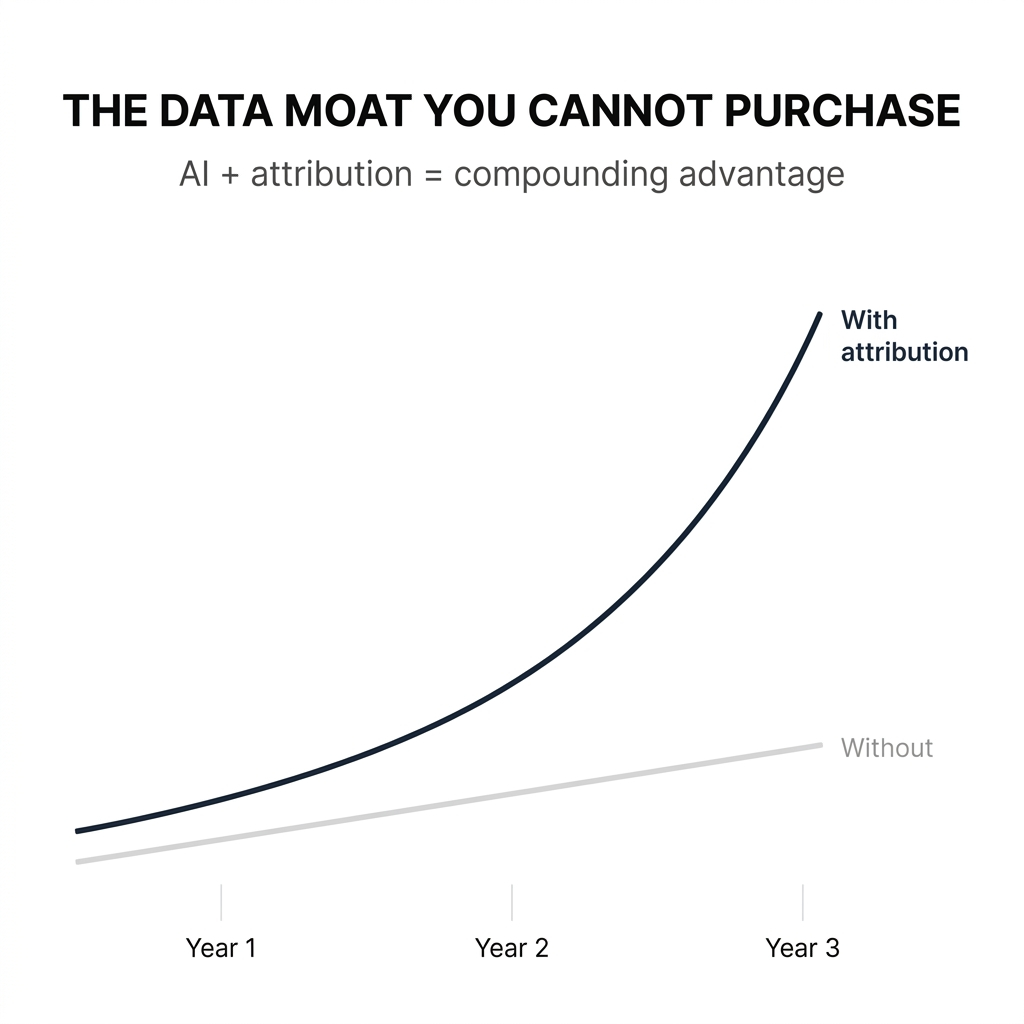
Here's the uncomfortable truth: better attribution data improves ad platform AI algorithms, leading to better targeting and higher ROI across all campaigns. This creates a powerful feedback loop.
But only if you can actually measure it.
Organizations with accurate conversion tracking and AI systems that process more data get better at predicting what works. Their competitors, still guessing at attribution and manually adjusting bids, fall further behind.
The gap between data-driven marketers and everyone else is widening.
The Data Moat You Can't Buy Your Way Across
Two advertisers running identical campaigns with identical budgets will see dramatically different results if one has accurate conversion tracking and the other doesn't.
This isn't about having more data. It's about having structured data that AI systems can actually use.
By 2026, 74% of B2B marketing teams are expected to use AI marketing analytics to stay competitive. Companies adopting predictive marketing analytics report 32% better lead quality and 27% faster sales cycles.
But here's what the statistics don't tell you: organizations leveraging AI marketing analytics experience these gains because they built the infrastructure first. They didn't just add AI tools to fragmented systems.
They treated attribution as strategic infrastructure, not a reporting tool.
When your AI systems can connect content consumption, AI touchpoints such as citations and recommendations, and downstream outcomes such as pipeline and revenue, you can train models on causal patterns rather than vanity metrics.
Every quarter of good signals makes your models sharper. Your budget allocation improves. You generate cleaner data. Your models get sharper again.
Competitors stuck in "last-click plus platform reports" never enter that loop.
Privacy Regulations Accelerate the Divide
The EU AI Act is no longer a regulation on the horizon. Prohibited AI practices have been enforceable since February 2025. General-purpose AI obligations have applied since August 2025.
On August 2, 2026, the full weight of high-risk AI system requirements comes into force, bringing penalties that exceed even GDPR: up to €35 million or 7% of global annual turnover for the most serious violations.
The deprecation of third-party cookies, increased privacy enforcement, and consumer awareness have elevated first-party data from a marketing preference to a business necessity.
Organizations with robust first-party data practices gain a competitive advantage by deepening customer understanding without relying on external data sources. Privacy regulations actually favor first-party data collection when done correctly.
This means the organizations that invested early in proprietary attribution infrastructure now have an asset their competitors cannot replicate by simply buying better tools.
You can't purchase years of clean, connected customer data. You can't shortcut the organizational discipline required to maintain unified identity resolution across web, CRM, product, and offline touchpoints.
The moat isn't the technology. It's the data quality and organizational capability that took years to build.
Schema Markup as Competitive Infrastructure
Most teams treat schema markup as an SEO checkbox. Organizations winning AI citations treat it as strategic infrastructure.
Schema markup can boost your chances of appearing in AI-generated summaries by over 36%. Your competitors might be getting 3x more AI citations simply because they're using schema markup types you've never heard of.
Roughly 43% of consumers now use AI-powered tools daily when researching brands or businesses online.
When you implement a comprehensive schema versus sites without structured data, research shows a 36% improvement in citation rates. With 43% of consumers regularly using AI search tools, the urgency for schema optimization continues to grow.
But schema markup is infrastructure, not a magic bullet. It won't necessarily get you cited more on its own. It's one of the few things you can control that platforms like Bing and Google AI Overviews explicitly use.
Organizations that win treat schema as the machine-readable blueprint of their business: who they are, what they sell, what each piece of content is, and how it all connects.
The same IDs and entities that appear in public structured data also exist in internal event schemas. That's what lets attribution engines say, "This opportunity engaged with Article X about Entity Y, which we know is driving AI citations in Topic Z queries."
This isn't just a better measurement. It's a closed-loop optimization system in which attribution data feeds back into AI algorithms that adjust targeting and messaging in real time.
The Two-Tier Market Reality
The real competitive advantage isn't explaining what happened last quarter. It's predicting what will happen next.
Marketing teams can now forecast pipeline, anticipate demand, and identify high-value opportunities before they appear in the CRM. McKinsey reports that companies using AI for advanced analytics see faster decision-making and stronger business performance.
But there's a pattern in who actually achieves this.
Nearly half of companies with over $5 billion in revenue have reached the AI scaling stage, compared with just 29% of companies under $100 million.
The divide between brands that adapt and those that hesitate is widening fast, powered by agentic systems, unified identity layers, and measurement frameworks that expose what actually drives growth.
75% of companies now use multi-touch attribution instead of single-touch models. Companies that switched saw their cost per acquisition improve by 14-36%.
The takeaway is clear: teams that only measure are already behind teams that forecast. Attribution explains yesterday, but prediction drives tomorrow.
What This Means for Your Organization
AI adoption is near-universal at 88%, but only 6% of organizations extract real business value.
The gap is not in tooling. It's in strategy, data readiness, and governance.
For B2B marketers, the competitive advantage lies in closing this execution gap, not in adding more tools.
Organizations that treat AI attribution as infrastructure rather than a reporting layer are building systems that compound over time. They're creating feedback loops where better data leads to better AI decisions, which generate better campaign performance, which produces more conversion data, which further improves AI accuracy.
Organizations that still operate on fragmented systems, rely on last-click attribution, and use platform-reported conversions are competing in a fundamentally different game.
They're optimizing for yesterday's metrics while their competitors engineer tomorrow's advantages.
The question isn't whether AI will transform marketing attribution. It already has.
The question is whether your organization will be on the right side of the divide.


Comments
Post a Comment