AI Governance Isn't Slowing You Down—Bad Governance Is
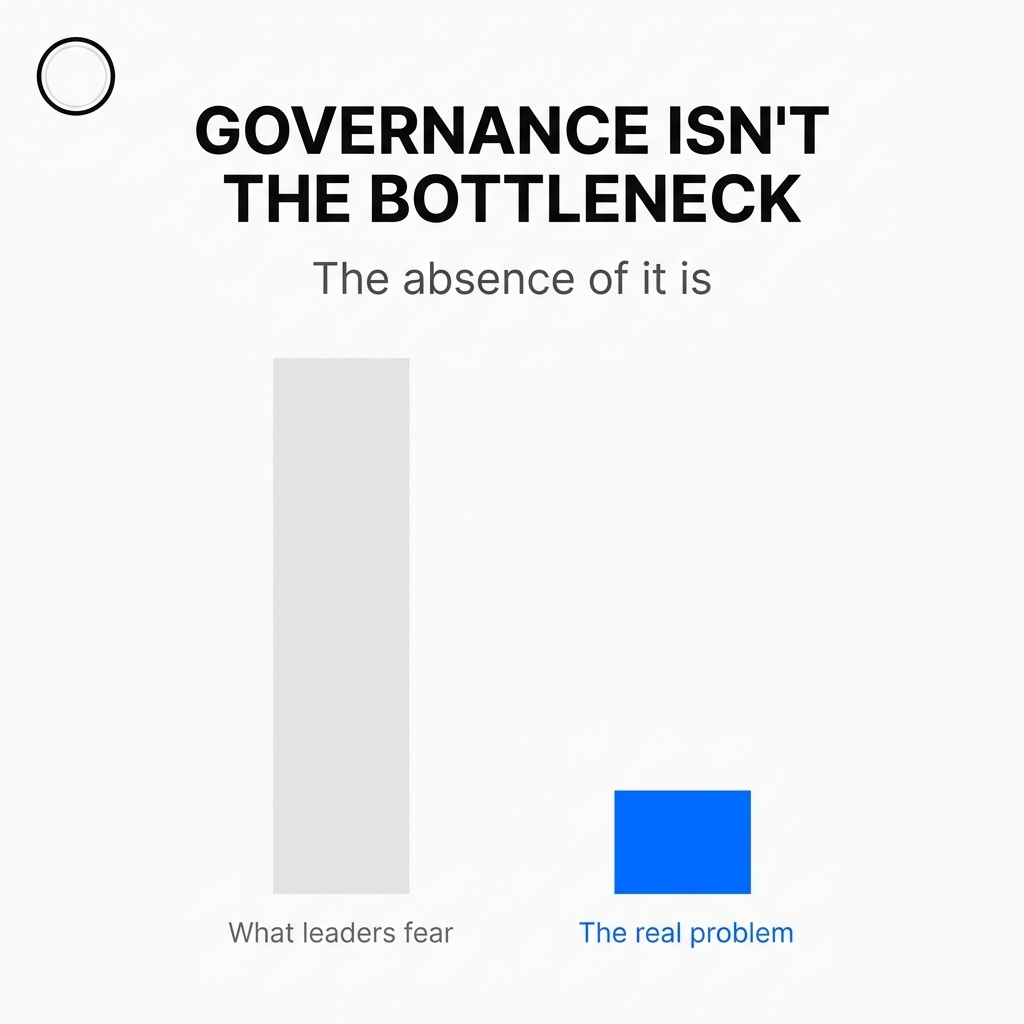
Most AI governance frameworks are designed to slow things down.
The ones that work are designed to make "yes" faster.
The difference is whether governance is built by people who've never shipped a workflow or by operators who need to scale. This piece breaks down what governance looks like when it's owned by the business, not compliance theater.
The Real Bottleneck Isn't Governance—It's the Absence of It
BCG research shows that 74% of companies struggle to achieve value from AI at scale. McKinsey's 2024 Global AI Survey found that 63% of companies using generative AI do not have governance structures in place for managing associated risks.
The pattern is clear. Organizations aren't stalling because they have too much governance. They're stuck because they have none, or they've built what looks like governance but functions as theater.
Rock Lambros, Director of AI Security and Governance at Zenity, asks a simple diagnostic question: "Can you show me where your AI policy lives in your control framework and who was disciplined for violating it last quarter?"
Silence is the answer most of the time. That's compliance theater.
What Compliance Theater Looks Like in Practice
I've seen this pattern repeat across organizations. They have comprehensive documentation that fails to address the most basic operational question: who can shut down a malfunctioning system?
The warning signs are consistent:
Governance processes that rarely result in changes to AI deployments. Extensive documentation that isn't regularly updated or referenced. Governance committees that meet regularly but don't make substantive decisions about AI systems.
One financial institution had beautiful policy decks and a cross-functional AI council. When their contract review system started auto-approving deals outside policy limits, no one knew who had authority to turn it off. Legal blamed IT. IT blamed the vendor. The COO blamed the lack of clear ownership.
They had governance on paper. They had none in practice.
The Ownership Question That Changes Everything
The first question I ask on every engagement isn't about model accuracy or data quality. It's this: Who owns the decision once AI is in the loop?
If there isn't a crisp answer, the project is at risk regardless of how impressive the tech looks.
Most leaders still treat AI governance as "controlling a tool" instead of "owning a decision." Until that flips, everything else is theater.
The last time I saw AI move from "IT project" to actual operating infrastructure was with a global B2B services company drowning in manual contract reviews. For two years, they'd been running classic AI pilots out of IT and data science. People were impressed in demos, but nothing changed in how contracts actually got through the system.
The turning point came when the COO reframed the work: "We're not doing an AI project. We're rebuilding how a contract goes from 'draft' to 'approved,' and AI is just how that workflow runs."
Three things actually happened:
They picked one workflow and gave it an owner. One VP became accountable for cycle time and accuracy on that flow.
They built an authority layer above their legacy stack with canonical objects, explicit states, and governed rules about what AI could auto-classify, when it could propose an approval, and when human sign-off was mandatory.
The overlay became the mandatory path. Sales could not route a standard contract any other way.
Six months later, no one was talking about "the AI pilot." They were talking about "our contract engine." Legal talked about exception rates. Sales talked about days pulled out of the cycle. Finance talked about faster time-to-revenue.
When Governance Becomes the Fast Lane
The best example I've seen of governance making "yes" faster was in a bank's marketing and product org. They wanted AI-generated campaigns and offers, but every idea was dying in review hell.
What they did differently was build governance into the rails, not into meetings.
They created three simple layers for AI use in campaigns:
Low-risk: internal productivity, draft copy, A/B test variants. Pre-approved. No committee. Simple guidelines.
Medium-risk: customer-facing content and offers within standard policies. Pattern-based checks, sampling, and automated guardrails.
High-risk: anything that touched pricing fairness, eligibility, or regulated promises. Formal review, slower path.
Instead of a brand and compliance checklist in a PDF, they turned key rules into automated checks in the tooling. Forbidden phrases, required disclosures, targeting constraints, and data-use limits were enforced at runtime.
If a squad used the approved models, data sources, and templates, they could ship without going back to the central committee each time. Governance happened by design, not by exception.
Before this, a PM would say, "We want to use AI to personalize offers," and the answer was, "Come to the next governance council; we'll see." Everything was a one-off debate.
Afterward, the conversation sounded like: "This is a Medium-risk use. We're using the bank-approved model, only on Tier-2 customer segments, with the standard disclosure block. We've passed the automated checks."
Risk would respond: "If you stay on the paved path, you're green-lit. Just register the use in the catalog. If you want to step outside those rules, then we talk."
"Yes" got faster because the criteria for yes were explicit and encoded. Teams knew in advance how to design something approvable. Reviews focused on true edge cases, not re-litigating the same low-risk patterns.
The signal that governance was working was simple: new AI-powered campaigns went from "one per quarter with three committees" to "multiple per sprint on the paved path," and the risk team still slept at night.
The Budget Line That Reveals Everything
The budget line matters because money is how the company encodes who is allowed to care and who is forced to trade off.
When AI spend lives on IT's budget, it's almost always treated as overhead and experimentation. Success is framed in technical or generic productivity terms.
When it moves to a functional leader's P&L, it becomes a lever. The conversation turns into: "If I invest $X more here, what does that do to my margins or capacity?"
I watched this play out with a logistics company. The CIO's team had spent two years building credibility as "the AI people." Their routing engine was their flagship success. Handing ownership to Ops felt like handing away the proof that they mattered in the next era.
The Head of Operations told me privately: "If this comes into my world and it fails, it's on my number. Right now, if it fails, it's an 'IT issue.'"
The conversation that unlocked it was blunt: "If this engine triples volume handled per dispatcher over the next 18 months, whose success story do you want it to be? And if it breaks on a bad day, who should be on the hook to fix it?"
After some uncomfortable silence, the COO said: "Operationally, this is my world. I do want the upside. I just don't want to be left holding the bag if I can't see how it works."
That was the real issue. Fear of owning an opaque system.
We made three moves to get through the resistance:
We split "how it works" from "what it does." IT kept ownership of models, infrastructure, and technical SLAs. Ops took ownership of workflows, KPIs, and decision thresholds.
We codified a joint RACI for failure. If the engine is down, IT is on the hook. If the engine is up but making bad decisions within the agreed rules, Ops owns fixing the rules and process.
We gave Ops visible control. Max load per dispatcher, acceptable delay ranges, hard constraints the engine could not violate. Seeing those controls in their own dashboard changed the tone.
The turning point came when the CIO finally said: "If this stays under me, it will always be an experiment. If it moves under you, it has a shot at becoming how we actually run the network. I'd rather be the team that made that possible than the team that kept it in the lab."
Four Signals That AI Has Become Infrastructure
Based on everything I've seen across clients, there are four signals that tell me an organization has crossed from "AI experiment" to "AI infrastructure."
There is a named workflow, a KPI, and an owner. The workflow has a name in the operating model. A business leader has that AI-driven KPI on their scorecard. Performance reviews and QBRs talk about that KPI without caveats like "it's just a pilot."
The AI layer is the default path. People don't "go to the AI" anymore. The work flows through it by default. If you turned the AI off tomorrow, core work would stall and you'd declare a Sev-1 incident. Frontline staff complain when it's down, not when it's up.
Rules and authority live in a shared layer. There is a central place where you can inspect "who can auto-approve what, under which conditions." Changing how the process works means updating rules or workflows in that layer, not filing tickets to modify five different systems.
Leadership talks in outcomes, not model stats. Executives don't ask, "How's the model doing?" They ask, "How do we move auto-clear from 50% to 65% without increasing error rates?" AI shows up in board and exec decks as drivers of cycle time, cost, capacity, or revenue.
When I see all four, I stop treating it as "AI work" at all. At that point, it's just how the company runs.
The Biggest Blind Spot Leaders Miss
Most leaders overestimate the risk of "AI going rogue" and underestimate the risk of nobody clearly owning what AI is allowed to decide, on whose behalf, and under which rules.
That's the blind spot that quietly kills more AI efforts than any technical limitation.
They govern models, not decisions. Most governance decks talk about models, prompts, vendors, and data usage. Important, but the real risk and value live in the decisions those systems influence.
No one has written down, "For this workflow, once AI is in the loop, who owns the decision and its consequences?" Escalation paths are fuzzy, override rules are implicit, and when something goes wrong, everyone can plausibly say, "That wasn't really my call."
Leaders realize this too late, usually after the first serious incident, when they discover they have model cards and policy PDFs but no clear answer to, "Who was actually accountable for this outcome?"
A lot of organizations just take their existing IT governance, replace "application" with "AI," and call it a framework. Traditional IT governance assumes systems are relatively static and deterministic. AI systems are probabilistic, adaptive, and increasingly agentic.
You can't bolt that onto old structures and expect it to work. You need an AI operating model that explicitly says who owns strategy, data, risk, model quality, delivery, and adoption.
What Governance Looks Like When Operators Build It
The biggest difference is this: people who've actually shipped AI workflows design governance as rails for shipping. People who haven't design it as rules for saying no.
You can see it in the questions they ask and the artifacts they produce.
Non-practitioners start with: "Let's create a request form and a committee to approve AI projects."
Practitioners start with: "What AI systems already exist, who owns them, and what decisions do they touch today?"
Structurally, that means they build a registry of models, agents, and use cases as a living map, not just an intake queue. Governance is anchored in reality instead of hypothetical future projects.
Non-shippers produce beautiful decks about fairness, transparency, and accountability, but nothing in the stack enforces those ideas.
Shippers ask, "Where does this rule live in code or config?" You'll see risk tiers with concrete controls per tier. Policies encoded as checks in data pipelines, prompts, and workflows.
Non-practitioners love big cross-functional councils with vague mandates. Decisions drag, nobody knows who can actually say yes.
Practitioners are almost boringly explicit. One executive owner for AI governance overall. Clear RACI per use case: who approves data, who approves the workflow, who owns KPIs, who responds when something fails.
They design governance like an operating model, not like a philosophy seminar.
The New AI Moat Is Deployment Speed
The new AI moat that emerges in 2026 is formed by a company's capacity to move quickly without damaging things, rather than by model size or unique data.
Speed has emerged as the first multiplier in this formula. Organizations that shorten the time between concept and execution have a compounding advantage in a world where innovations appear every few weeks.
Speed is now a strategic tool that establishes who leads and who follows, rather than merely an operational statistic.
Survey data reveals that 99% of organizations have experienced financial losses from AI-related risks, with average losses of $4.4 million per company. The most common risks are non-compliance with regulations and biased outputs.
According to McKinsey's Technology Trends Outlook 2025, trust in AI companies has declined from 61% in 2019 to 53% in 2025. These numbers highlight a lack of confidence in AI usage and risks undermining AI adoption at scale.
Strong governance provides the confidence organizations need to invest, scale, and execute AI across markets at speed. Trust in AI, and in the governance behind it, is what turns ambition into durable value.
What This Means for Your Organization
If you're building AI governance right now, ask yourself these questions:
Can you name the business owner whose P&L depends on each AI workflow you're deploying?
If you turned off your AI systems tomorrow, would operations grind to a halt or would people just shrug?
When something goes wrong with an AI decision, can you point to one person who owns the outcome?
Do your governance processes make it easier or harder for teams to ship AI-powered workflows?
The organizations that succeed in 2026 will be the ones that build governance capable of adapting to uncertainty. Looking into the future, the winners will be those who've embedded governance as an enabler from day one.
Governance is becoming a competitive differentiator. Business leaders often talk about artificial intelligence governance as if it's a speed bump on the road to high-impact innovation. The truth is that governance provides the traction for acceleration while keeping your business on the road.
Getting governance right from the start helps you drive in the fast lane and stay there.
The question isn't whether you need AI governance. The question is whether you're building the kind that makes "yes" faster or the kind that makes everything slower.
Most AI governance frameworks are designed to slow things down. The ones that work are designed to make "yes" faster.
The difference is whether governance is built by people who've never shipped a workflow or by operators who need to scale.


Comments
Post a Comment