The Infrastructure Shift: Why Authority Can No Longer Be a Byproduct
Your marketing metrics look fine. Traffic is steady. Cost per lead is acceptable. Your content team is shipping quality work.
And yet, when prospects research your category, your name rarely appears in the shortlist.
This gap between "doing everything right" and "being the obvious choice" is the defining challenge of AI-mediated markets. 37% of consumers now start their searches with AI instead of traditional search engines. When buyers ask ChatGPT, Perplexity, or Google's AI Mode for recommendations, the systems return a handful of names.
If you're not one of them, your funnel never gets a chance to work.
The Old Playbook Assumed Discovery Was Open
Traditional digital marketing was built on a simple premise: if you create good content, optimize for search, and run smart campaigns, buyers will find you.
That worked when discovery was a browsing exercise. Buyers would see pages of results, click around, compare options, and build their own shortlist.
AI-mediated discovery changed the game board.
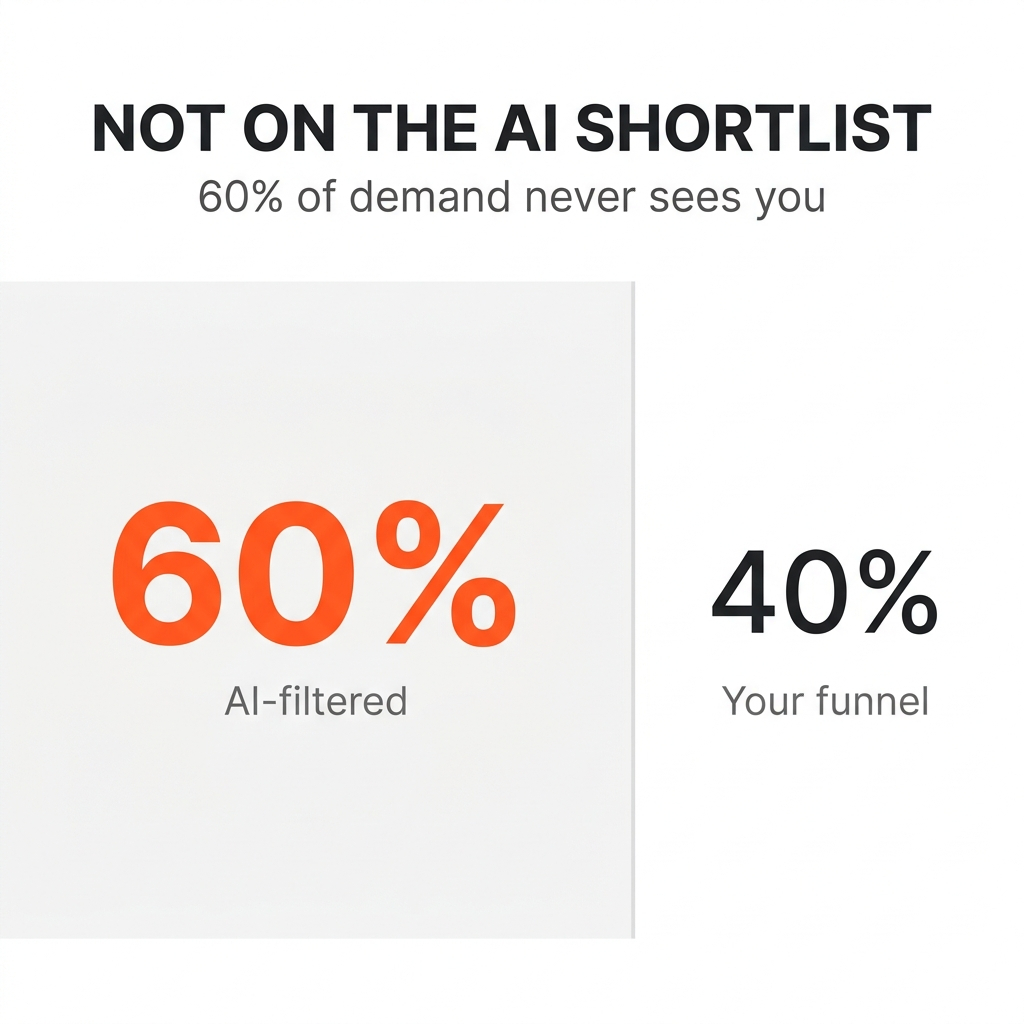
Now, nearly 60% of all searches end without a click. In Google's AI Mode, that figure jumps to 93%. The AI doesn't show buyers "the market." It shows them a pre-filtered set of entities it already trusts.
Your beautiful funnel only activates for the shrinking portion of demand that hasn't already been filtered by an assistant deciding who's worth considering.
Authority Used to Be What Happened After Success
Most organizations treat authority as a lagging outcome.
You do great work. You win customers. You publish smart content. You get some PR. Over time, reputation accumulates. Authority emerges as a byproduct of being good at what you do.
That mental model made sense when humans were doing the discovery work. If you were consistently excellent, word would spread. Your brand would become known.
AI systems don't wait for word to spread.
They construct entity graphs based on patterns they can currently detect. They evaluate whether you exist as a coherent, trustworthy node in their internal representation of your category. They decide who to recommend based on signals they can verify across multiple sources.
If those signals aren't there, being excellent at your work doesn't matter. The system can't bet on you.
What Infrastructure Thinking Actually Means
Treating authority as infrastructure means three specific shifts in how you operate.
From Byproduct to System Goal
You stop hoping authority will accumulate and start designing for it explicitly.
You define a clear target state: your brand must exist as a high-confidence entity inside AI systems, clearly mapped to a specific category, ICP, and problem set, backed by dense, corroborated evidence.
That becomes a design constraint for everything else. If a major initiative doesn't move your authority footprint, you question the spend.
From Campaigns to Permanent Plumbing
Authority work stops being a series of launches and becomes shared, always-on systems.
You create a canonical source of truth for how you describe your company, products, ICP, and core claims. You build guardrails into workflows, so every content brief, PR pitch, website change, and sales asset pulls from that same source.
Your footprint becomes more coherent every month rather than drifting.
From Brand Lift to Capital Allocation
You ask: what portion of future demand depends on AI-mediated discovery, and what is the economic value of being in or out of those answer sets?
Authority work gets funded as infrastructure capex. You're securing distribution and recommendation rights in the new front door to the internet. The alternative is permanent overpayment for rented attention.
You build multi-quarter authority roadmaps with clear milestones and owners. Your CFO sees budget lines that sound like infrastructure, not vibes.
The Signals AI Systems Actually Trust
AI platforms prioritize signals that reduce model risk. They're asking "Can I safely bet on this entity?" more than "Is this page convincing?"
Five signal types consistently matter:
Entity Coherence
One clear, consistent identity across the entire web. Same company and product names, consistently formatted. Aligned bios and roles for key people. Clear, bounded topical focus.
AI systems treat inconsistency as uncertainty and risk. Fragmented naming and topic sprawl lower confidence that the model really knows who you are.
Source and Entity Authority
Evidence that both the domain and the organization behind it are recognized, credible sources on a specific topic. Repeated high-quality coverage of a defined subject over time. Knowledge-graph style presence in structured datasets, industry lists, and recognized directories.
Models maintain topic-conditioned authority profiles. You can be very "big" in general, but weak in the one narrow category the query is about.
Corroboration and Triangulation
Multiple, independent sources saying essentially the same thing about you. Your positioning, claims, and key stats echoed in third-party articles, directories, interviews, podcasts, and reviews.
A single brilliant asset is easy to fabricate. Corroborated patterns across independent sources are harder to fake and statistically much stronger.
Structural Trust
Clean structure that the model can parse. Proper schema and metadata tying entities, content types, and relationships together. Transparent trust pages with clear pricing, SLAs, policies, and compliance information.
Structure and transparency reduce the model's need to guess. A visually stunning page with weak schema and conflicting contact info increases model risk.
Behavioral and Outcome Signals
Evidence that when the system has surfaced for you in the past, things generally went well. Stable or improving sentiment in reviews and social discussions. Absence of major disputes or contradictions around your claims.
Models care whether their recommendation leads to a resolved need without blowback.
The Window Is Narrowing
AI systems are already locking in their defaults. Every week of usage reinforces which companies are "safe bets" in each problem space.
The earlier a competitor becomes the recommended answer for your category, the more their footprint is queried, clicked, cited, and linked as an example. That creates a feedback loop.
If you wait 12 to 18 months, you're not starting from neutral. You're trying to unseat incumbents that the system already believes are the right answer.
Three compounding penalties hit late movers:
Default lists solidify. You miss the phase where defaults are still fluid. The more a competitor is used, the more obvious they look to the model.
Your spending shifts from buying growth to buying scraps. As AI-mediated discovery grows, a larger share of high-intent journeys never touch the open funnel. Your paid spend increasingly targets lower-intent, non-assisted traffic while competitors harvest the leads routed by AI.
The bar to catch up rises every quarter. Acting now, you can shape how entities and categories are written into the graph for your niche. Acting later, you face a denser graph with more competitors already associated with your key queries.
What Success Actually Looks Like
When you become the default answer, the market starts arriving pre-convinced you belong on the shortlist.
A meaningful slice of buyers arrive saying some version of: "Your name keeps coming up when we ask around." "You're clearly in the top two or three we need to talk to for this."
The first call starts with context and fit questions, not "What exactly do you do?"
You see higher win rates in deals where the buying group has already encountered you as a recommended or cited source. Sales cycles shorten because the "why you?" part is half-answered before the opportunity even opens.
Your logo appears repeatedly in recommended vendors’ docs, analyst notes, and internal buyer decks. Even when you lose a deal, you were almost always in the top few evaluated.
CAC stabilizes or improves in the segments where you're the default answer. A higher share of opportunities comes from authority-driven paths. Less spending is required to persuade buyers you're worth talking to at all.
You can show segments or channels where deals tagged as "authority-initiated" have better close rates and LTV. A baseline of demand persists even when you dial back paid.
The Real Choice
You can keep optimizing the funnel you have. Traffic, conversion rates, cost per lead. Those metrics will continue to look acceptable for a while.
But if AI-driven search surged from under 10% of interactions in 2023 to 30% by 2026, and if the systems mediating that discovery are already deciding who gets recommended, then funnel optimization is solving for a shrinking slice of the market.
The organizations building systematic authority infrastructure now capture positioning that reputation-building alone cannot achieve later.
Authority is no longer what happens after you succeed. It's the infrastructure that determines whether you get the chance to compete at all.


Comments
Post a Comment