The Marketing Infrastructure Nobody's Building (And Why 2025 Is Your Window)
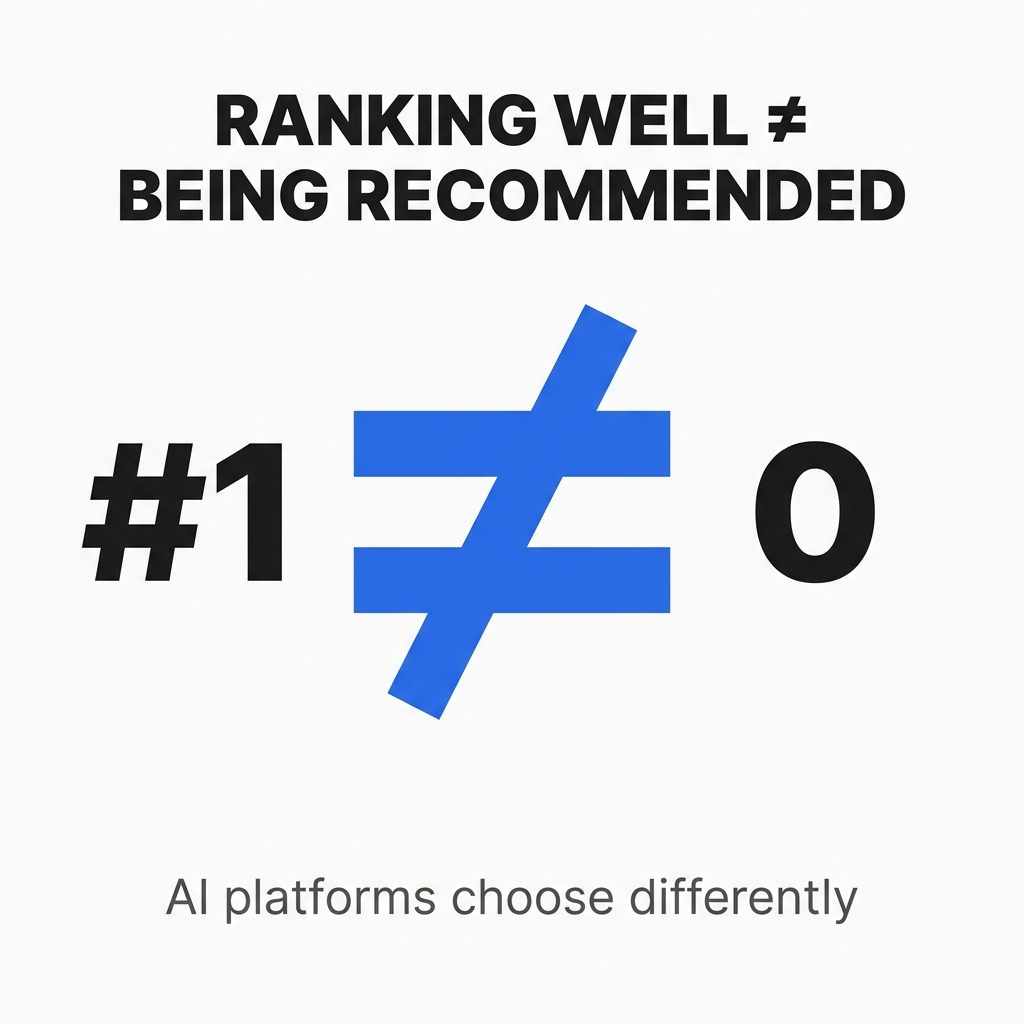
Most marketing teams are invisible where it matters most.
You rank well in Google. Your content library is extensive. Your ads run across multiple platforms.
But when a buyer asks ChatGPT or Perplexity for recommendations in your category, your company doesn't appear.
The problem isn't your content. It's that you've been building for the wrong infrastructure layer.
AI Platforms Pick Winners Differently
Traditional search gave you a ranked list. AI platforms give buyers a shortlist of safe bets.
The data tells a clear story. 60% of searches now end without a click because AI summaries answer the question directly. When an AI Overview appears, click-through rates drop from 15% to 8%.
More revealing: 68% of pages cited in AI Overviews don't appear in the top ten organic results. You can rank well and still be completely absent from the answer.
ChatGPT processes 2 billion queries daily. Perplexity handles 1.2 to 1.5 billion monthly. These platforms don't surface everyone who might be relevant. They name 3 to 10 brands they trust enough to recommend.
If you're not in that group, you don't exist to the buyer.
What Makes a Company "Safe to Recommend"
AI systems behave like risk managers. Before they put your name in an answer, they run a confidence check across multiple signals.
Three patterns determine who gets named:
Entity clarity. The company looks the same everywhere. Same name, category, offerings, and expert faces across your site, LinkedIn, directories, and knowledge panels. AI can quickly resolve "who is this and what do they do" because schema, organization info, and author bios align and repeat across multiple places.
Cross-source validation. Claims about your brand appear in reviews, press, third-party blogs, awards, and community threads. Not just on your own site. When the same fact or brand attribute shows up across several independent domains, citation odds jump dramatically. Cross-source consensus builds confidence.
Low perceived risk. Reputation and sentiment are net positive. No big red flags in reviews or news. The brand shows evidence of real-world performance through case studies with outcomes, professional certifications, and regulatory or industry recognition.
This is authority infrastructure. It's the backbone that makes your brand the default choice in AI-driven discovery.
Why Most Teams Haven't Realized They Need This
Marketing teams still operate on a page-first, keyword-first mental model inherited from classic SEO. The platforms have quietly shifted toward an entity-first, trust-first world.
The gap exists for three reasons:
Teams assume AI equals new UI on old Google. They think "if we rank well, AI will pick us up" and double down on content and backlinks while ignoring entity clarity, author credentials, and third-party proof. Research shows low overlap between top organic results and brands cited in AI answers. The models aren't re-sorting search results. They're re-deciding who is safe to quote.
Trust signals are owned nowhere internally. PR runs some press. Demand gen runs ads. Product marketing builds decks. Customer success collects the odd review. But no one owns "make us a safe recommendation." There's no system that turns wins into dense, cross-channel validation. Authority and credibility look like brand cosmetics instead of pipeline infrastructure.
The risk model is invisible to leadership. Marketers think in terms of visibility and reach. AI systems optimize for "if I recommend this and it goes badly, how likely am I to be wrong and get blamed?" Things like news coverage, regulated-industry certifications, consistent review patterns, and documented expert bios have an outsized influence. They de-risk the recommendation in a way a blog post never will.
AI platforms already behave as conservative recommenders that reward companies with strong authority infrastructure. Most marketing teams are still optimizing for being seen in a results list instead of being the safe bet that actually gets named.
The Compounding Timeline You Need to Understand
If you commit to building authority infrastructure today and follow through, here's what the next 18 months look like.
Months 0 to 6: From invisible to present. Companies implementing focused authority moves go from single-digit appearance rates to 20 to 25% citation rates in 90 to 180 days. You start showing up inside AI answers and overviews for your best-fit prompts, while competitors often don't.
Months 6 to 12: From present to preferred. Authority built in one area radiates into adjacent queries and formats. Citation counts grow non-linearly. Well-executed approaches climb from 10 to 12 citations at month 6 to 30 to 50 by month 12, including queries you never explicitly targeted. Your share of AI voice for category and comparison prompts starts to rival or exceed competitors, even if they still own more raw traffic.
Months 12 to 18: From preferred to hard to dislodge. You build an authority moat. Once you become a habitual citation source, each new external mention, link, or proof asset further increases your probability of being selected again. Citations beget more citations. In AI-mediated discovery journeys, your brand is what prospects see and hear repeatedly as the safe, expert option.
Your citation velocity becomes self-sustaining. AI systems have accumulated evidence that you're accurate and dependable, so they continue to favor you even as new content and competitors enter the field.
What Happens If You Wait
A year from now, a competitor that ignored this will discover three uncomfortable realities.
You're already the low-risk default. Models have a year's worth of citations, cross-domain proof, and consistent entity signals saying "this is the safe choice" for your category.
Their content is often used as a training background while your brand gets named. You've invested in the validation and entity coherence that make you citable.
The bar to displace you is higher. They can't just publish more. They have to close a multi-layer gap in reviews, third-party mentions, expert proof, and structured identity that you've been compounding for 12 to 18 months.
The catch-up effort looks less like "refresh SEO" and more like "rebuild how the ecosystem talks about us" across customers, media, partners, and platforms.
The gap doesn't become mathematically unbridgeable. But it becomes strategically prohibitive for most. The cost, coordination, and time required to dethrone an entrenched safe bet brand in AI answers is more than many boards are willing to sign up for.
The Mindset Shift That Makes This Work
Before you assign an owner or build a playbook, one thing has to change in how you think about marketing infrastructure.
You have to stop thinking of marketing as generating attention and start thinking of it as engineering trust infrastructure that AI systems and buyers can reliably bet on.
Your job is no longer just to get seen. It's to make your company the safest, most provably correct answer in your category, in a way both humans and AI can verify.
Success isn't more content and impressions. It's more independent, consistent, cross-checked signals that say the same thing about who you are and what you're great at. Those signals are what AI systems treat as infrastructure.
The main asset you're building isn't a content library. It's an entity the internet can agree on. A brand with enough coherent proof around it that models feel comfortable recommending you by name.
Once you see marketing as the owner of trust infrastructure instead of just channels and messages, everything else snaps into place. The flywheel, the owner, and the KPIs all make sense.
Without that mindset shift, this work will always look like advanced SEO instead of what it actually is: the plumbing that determines whether your company ever shows up as the answer in an AI-led world.
Your Path Forward
The brands that establish entity authority now, before AI search surfaces fully mature, will be significantly harder to displace later.
2024 to 2025 represents the ideal time to build AEO infrastructure before it becomes table stakes. The window exists because most teams haven't yet realized they need to become one of those safe bets.
You have a choice. Build the authority infrastructure that makes you the trusted answer inside AI platforms. Or watch competitors who do pull away on entity trust and AI visibility while you're still optimizing for page rankings.
The infrastructure you build today determines whether your company exists in the answers that matter most tomorrow.


Comments
Post a Comment