Why Your ICP Keeps Failing: The Signal Infrastructure Most B2B Teams Are Missing
You have a polished ICP deck. You know your target accounts. You've even bought intent data.
And you're still getting 2-3% reply rates.
The problem isn't your ICP. The problem is treating it like a static list when your market moves in real time.
Most B2B teams stop at defining who fits their profile. They miss the infrastructure that tells them when those accounts are actually ready to buy and why they should trust you over everyone else hitting their inbox with the same intent spike.
This is the gap Authority Engine was built to close.
The Three-Part System Your ICP Needs to Actually Work
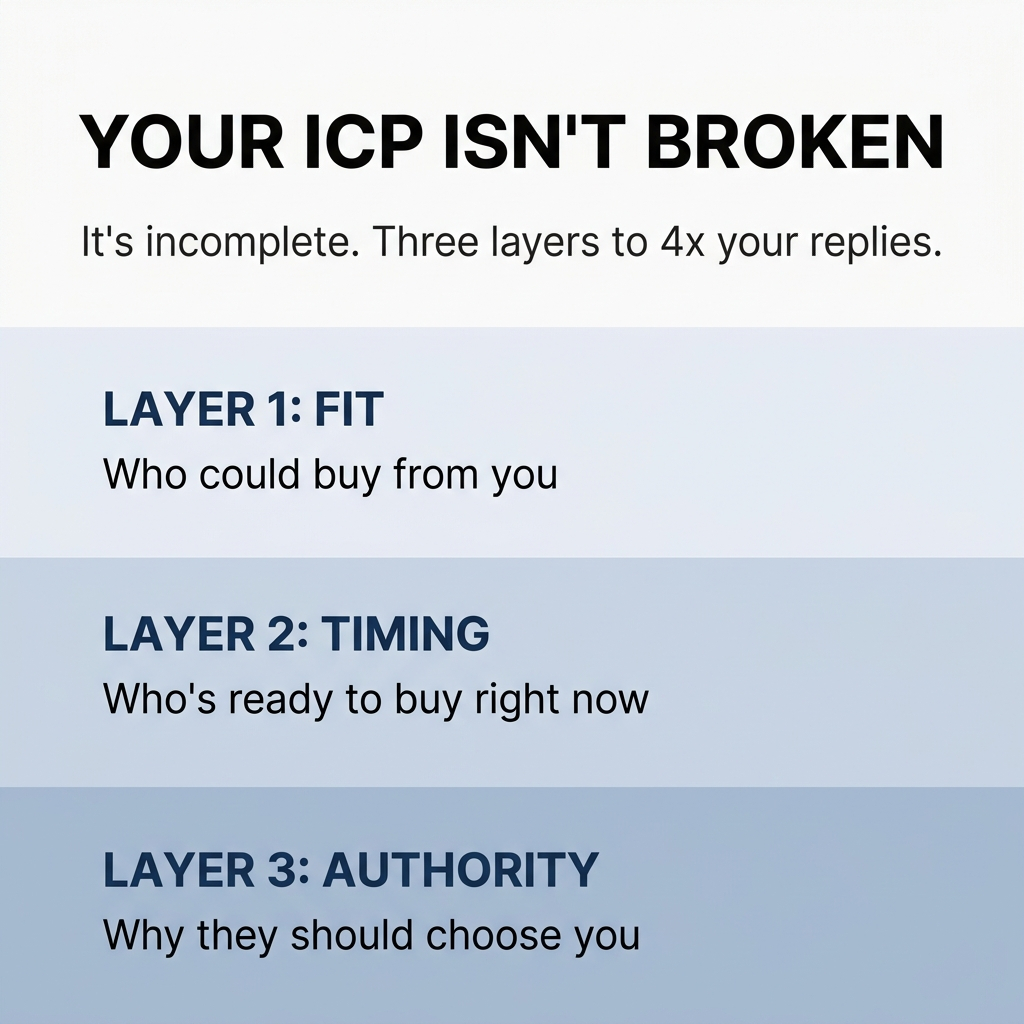
Your ICP isn't broken. It's incomplete.
Think of your current ICP as a map showing where your best customers live. That's useful. But it doesn't tell you which ones are actively looking for help right now, or which ones will actually take your call when you show up.
Authority Engine transforms that static map into a living system with three layers:
Layer 1: Fit
Your traditional ICP criteria—industry, size, tech stack, role. This is table stakes. It tells you the universe of accounts that could buy from you.
Layer 2: Timing
The signal infrastructure that identifies which 10-15% of your ICP is in motion right now. Research behavior, tech changes, hiring patterns, funding events. These signals tell you who's actively wrestling with the problem you solve.
Layer 3: Authority
The proof infrastructure that makes you the safest answer when those high-intent accounts go looking. Entity alignment, structured content, external validation. This is what makes AI platforms and humans both recognize you as the trusted choice.
When all three layers work together, your numbers change fast. One client went from 2-3% reply rates to 8-12% in 60 days. Same ICP, same product, same reps. The only difference was adding timing and authority to fit.
What Signal Infrastructure Actually Looks Like
Most teams think they have signal infrastructure because they bought an intent tool. They don't.
Real signal infrastructure does three things:
1. It captures composite signals, not single data points
A company visiting your pricing page once isn't a signal. A company visiting your pricing page, reading three competitor comparisons, showing up on G2 in your category, and hiring for a role that uses your product—that's a signal pattern worth acting on.
Authority Engine pulls from multiple sources:
First-party behavioral data: Page paths, session depth, return visits at the account level
Third-party intent networks: Research activity across publisher and review ecosystems
Technographic signals: Tool adoptions, system replacements, integration adds
Hiring and funding data: New roles, job posts, capital events that indicate project readiness
We score these signals by strength and stage. Early research looks different from decision-stage comparison. The system knows the difference and routes accounts accordingly.
2. It turns signals into narratives, not just lead scores
Here's where most intent implementations fail. They dump "high-intent" accounts into generic sequences without understanding the story behind the spike.
When Authority Engine flags an account, it doesn't just say "this company is hot." It tells you:
What pressure moment they're in (cost-cutting initiative, platform migration, compliance deadline)
Which stage of evaluation they're at (awareness, consideration, decision)
What specific questions they're likely asking right now
That context changes everything. You're not sending "noticed you were researching X" emails. You're answering the exact question in their head at the moment they're asking it.
3. It activates automatically, not manually
Signal infrastructure only works if it changes what happens in your systems without human intervention.
When an account crosses a threshold in Authority Engine:
They move to a priority tier automatically
Specific plays and messaging get triggered based on their signal pattern
The right proof assets get attached to outreach
Sales gets routed to accounts with context, not just a name
No weekly exports. No manual list building. No signals sitting in dashboards while they expire.
According to recent research, intent signals lose effectiveness within 2-5 days. If your team takes a week to act, you've already missed the window.
Why Authority Infrastructure Is the Missing Piece
Here's the uncomfortable truth: your competitors have access to the same intent data you do.
When a high-intent account starts researching, 10 vendors see the same spike and send nearly identical "we noticed you were looking at X" messages. The account gets hammered. Most messages get ignored.
Authority infrastructure is what makes you different when everyone else shows up at the same time.
It's the system that makes you machine-trustable and human-credible around specific problems. When a buyer or an AI assistant looks you up, they find:
Verified entity data: Consistent brand, product, and people information across every platform
Structured answer hubs: Pages that directly answer priority questions with clear proof and schema markup
External validation: Case studies, testimonials, media mentions, and third-party listings tied to specific problems
Proof density: Multiple sources confirming the same claim, increasing confidence for both humans and AI
This infrastructure compounds. Every piece reinforces the others. When you act on an intent signal, your outreach points to a tightly aligned "answer universe" that proves you're the de-risked choice.
The result: prospects experience you as the trusted answer, not another vendor who saw the same spike as everyone else.
The Performance Gap Between Signals Alone and Signals + Authority
Let me show you what this looks like in practice.
We worked with a B2B services company that had everything "right" on paper. Solid ICP, intent provider, content calendar, RevOps hire. Reply rates stuck around 2-3%. Sales complained the leads were noise.
We kept their ICP but changed two things:
First, we overlaid high-precision signals to find the 10-15% of their ICP showing real buying behavior. Not broad topic interest—actual research patterns, tech changes, and hiring that correlated with active projects.
Second, we built authority infrastructure around the specific questions those accounts were asking. Structured content, proof objects, entity alignment. Everything pointed to the same story: "We're the safest answer to this exact problem."
Within 60-90 days:
Reply rates jumped to 8-12% (roughly 3-4x improvement)
Meeting rates climbed to 6-8% of prospects contacted
Win rates increased 30-50% on intent-qualified accounts
Sales cycles shortened noticeably
The turning point wasn't the metrics. It was reps forwarding replies to leadership that said: "Funny timing—we're in the middle of this exact project. Can you talk this week?"
That's what happens when timing and authority align. You stop interrupting and start answering.
This pattern holds across industries. Teams running signal-based plays report 3x higher meeting booking rates. Companies tracking buying signals see 40-50% higher win rates and 20-30% shorter sales cycles.
How to Build This Without Rebuilding Everything
You don't need to blow up your GTM to make this work.
Authority Engine follows a specific sequence designed to prove value before asking for heavy investment:
Phase 1: Keep your ICP, add timing (Week 1-2)
We treat your current ICP as a fit hypothesis and immediately overlay timing signals. Use your existing firmographic boundaries. Add behavioral, technographic, and hiring signals to find the subset that's visibly in motion.
This gives you a quick shift from "big static list" to "live short list" with minimal change management.
Phase 2: Prove it with focused campaigns (Week 3-12)
Route those high-intent accounts into tightly scoped campaigns. Sharper messaging tied to specific questions. Measure reply rate, meeting rate, early pipeline.
This is the "90-day proof loop." Performance campaigns give executives immediate, measurable upside while we learn which questions and segments respond best.
Phase 3: Build authority where reality agrees (Month 4+)
Once we see where the market is pulling, we invest in full authority infrastructure. Pick the narrow set of questions and segments where campaigns clearly outperformed. Build the structured answer universe there.
Now your best-performing lanes get cheaper and faster. AI systems can see and trust you. Humans encounter reinforcing proof. The same campaigns convert better without more spend.
Phase 4: Feed the loop back into ICP
Finally, we update how you define and use ICP based on what the system learned. Refine definitions to encode the patterns of pressure and proof that actually drive revenue. Replicate the authority + intent pattern into adjacent questions and segments.
The unlock order matters: keep your ICP → layer intent → run targeted campaigns → see where reality responds → build authority infrastructure there → let that reshape your ICP.
The Organizational Structure That Makes This Work
Here's where most implementations fail: the strategy is sound, but the org structure kills execution.
For fit + timing + authority to work, someone has to own it as one revenue system. Not three disconnected projects.
That owner is usually RevOps or a "head of revenue engine" function with explicit authority across marketing, sales, and data. Around that owner, you need a stable pod:
Marketing: Owns authority infrastructure and question portfolio
Sales leadership: Owns outreach execution and ICP feedback
Ops/data: Owns signals, routing, and reporting
All three are accountable to shared revenue metrics, not separate dashboards.
When it works, the handoffs look like this:
Ops maintains the single source of truth and surfaces "Tier 1 / right-now" accounts automatically
Marketing provides playbooks and assets aligned to each score and stage
Sales works only the prioritized accounts and feeds back what's actually happening
Signals update → accounts move tiers automatically → specific plays and assets trigger → sales executes → weekly review closes the loop.
The number one execution killer is misaligned definitions and incentives. Marketing gets rewarded for volume, sales for closed revenue, ops for system stability. When that happens, intent and authority get treated as "extra work" instead of the default way to hit the number.
The strategy dies in the gap between teams, not in the deck.
What This Means for Your Next Quarter
If you're running campaigns off a static ICP right now, you're leaving 3-4x performance on the table.
The accounts you're targeting are the right ones. But you're hitting them at the wrong time with the wrong proof structure. Half your ICP isn't ready. The half that is ready is getting hammered by competitors with the same intent data.
Authority Engine closes both gaps.
The signal infrastructure tells you which 10-15% of your ICP is in motion right now and what pressure moment they're in. The authority infrastructure makes you the safest answer when they go looking.
Together, they turn your ICP from an address book into a revenue system.
The companies that figure this out first will own their categories. The ones that don't will keep wondering why their "perfect-fit" accounts ignore them while competitors with worse products close deals faster.
The game has changed. Your ICP needs to change with it.


Comments
Post a Comment