Your ICP Is Just an Address Book Until You Add Timing and Trust
I watched the same pattern repeat across dozens of companies.
Perfect ICP on paper. Right industry, right size, right tech stack. Beautiful slide decks. Polished messaging.
And 2% reply rates.
Then we'd take a narrow slice of those same accounts, layer in visible buying signals, and rewrite the outreach to answer specific questions those accounts were clearly wrestling with. Reply rates jumped to 8-12%. Meeting rates climbed to 6-8%. Win rates increased 30-50%.
Same reps. Same product. Same price.
The only thing that changed was when we engaged and why that account should care right now.
The Structural Problem With How B2B Defines ICP
The industry got ICP development wrong because it was built for a world where data was coarse, distribution was expensive, and executives needed simple, static lists to plan around.
Firmographic fit became a proxy for everything else and then ossified into dogma.
Three forces locked B2B into this model:
Data limitations. For years, the only scalable, reliable data you could get about accounts was firmographic. Industry codes, employee bands, revenue ranges, HQ location. So ICP templates and CRM fields were built around that, even though it told you nothing about behavior or timing.
Planning and reporting incentives. Leadership needed stable target definitions for territory design, quota setting, and forecasting. They favored ICPs that changed slowly, even as real buyer behavior shifted underneath.
Volume-era playbooks. In the outbound boom, the dominant belief was "more at-bats equals more revenue." The job of ICP became "define a big enough list we can blast," rather than "define the subset where pressure and intent are highest."
In that environment, a static ICP was reasonable given the tools and constraints teams had.
But three big shifts have made that approach structurally obsolete.
What Changed: Signals, Complexity, and AI as the Interface
Continuous, granular signals. We now have live behavioral and intent data. Page paths, research patterns, technographics, hiring, product usage. This data can show fit times timing times pressure in real time, rather than once a year in a slide deck.
Faster-moving, fragmenting markets. ICPs that were "right once" drift quickly as products add use cases, pricing moves upmarket, and segments split. A static definition can be directionally wrong within a couple of quarters.
AI as the buying front door. Buyers increasingly start with AI tools that compress the market and surface only a few "safe" options. These systems reward brands that show clear entity authority and intent-aware relevance, rather than those who merely "fit" a firmographic filter.
According to SiriusDecisions, 67% of the buyer's journey is now done digitally. Buyers are showing signals long before they raise their hand.
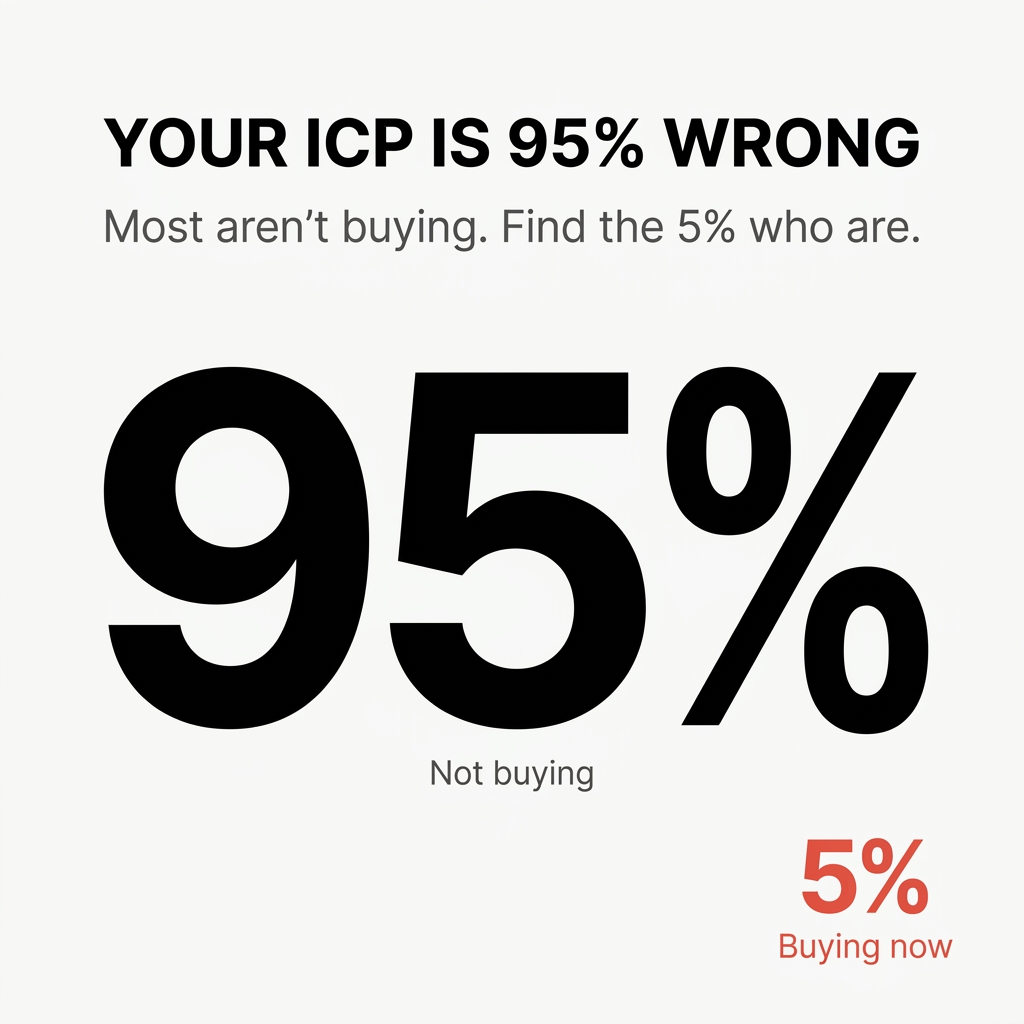
And here's the kicker: less than 5% of your ICP is actively in-market at any given moment.
You're not competing for attention across your entire TAM. You're racing to find the 5% who are actually looking.
The Gap Between Having Data and Using It
Most teams have access to intent data, analytics, enrichment tools. But having the signal doesn't automatically translate into better replies or meetings.
Here's why:
Decontextualized signals. Teams treat an intent spike as a lead list rather than a story. They dump "high-intent" accounts into generic outbound or ads without clarifying why that account is spiking, what stage they're in, and what decision they're wrestling with.
The prospect experiences yet another cold pitch that happens to arrive after they clicked something. It still doesn't read as "you're answering the question in my head right now."
Same data, same spam. Intent data is now widely available, so many vendors are hammering the same accounts off the same triggers. Buyers see 10 nearly identical "noticed you were researching X" messages and ignore all of them.
According to industry studies, average cold email reply rates hit 5.1% in 2024, down from roughly 7% the year before.
No authority or proof for the signal. Even when timing is right, most brands don't have the authority infrastructure around the questions their ICP is asking. Inconsistent data and weak third-party validation mean AI search, recommendation systems, and humans don't recognize you as a trusted entity in that topic.
Without that, acting on intent just directs more people into an environment that doesn't convincingly answer "why you" or "why now."
What Authority Engine Builds on Top of the Data
The missing piece is turning raw signals into engineered relevance and trust around very specific questions in your category.
We model the why behind a cluster of signals. Cost-cutting initiative. Platform migration. AI pilot. Then we tie that to stage-specific questions your ICP is asking.
Then we align outreach, content, and authority assets so that when you act on a signal, you show up as "the trusted answer" in their inbox, in search, and inside AI assistants.
Here's what that looks like in practice:
A canonical answer hub on your site. A structured page that directly answers that question with clear steps, proof, and links to deeper artifacts, marked up with rich entity and FAQ schema so AI and search engines can parse it.
Verified entity and metadata alignment. Consistent brand info, bios, services, and topical focus synchronized across your site, profiles, directories, and review platforms. No conflicting data for AI to average out.
Structured proof objects. Case studies, testimonials, media mentions, certifications, and third-party listings tied back to that specific problem and solution, increasing "proof density" for that question.
Answer-ready content for outreach. Email, social, and sales assets written as compressed, question-specific answers that match the authority story your technical layer is telling.
Think of it as building a small, highly structured universe around each high-value question instead of scattering disconnected blogs and claims across the internet.
The Client Who Went From Skeptical to True Believer
One COO came in convinced that all of this was just a more expensive way to do what they were already doing.
They had a polished ICP, an intent provider, a content calendar, and a RevOps hire. Reply rates were stuck around low single digits and sales complained the leads were "the same noise in a different dashboard."
Their core belief: "Our market is saturated and price-sensitive. No framework will change that. We just need more at-bats and better salesmanship."
They agreed to a small pilot mostly to prove to themselves it wouldn't move the needle.
We kept their ICP but took the top few hundred accounts and overlaid just a couple of high-precision signals. Real research plus real trigger events instead of the broad, fuzzy topics they were using.
Then we rebuilt only a few plays. Outreach and follow-up tied to specific questions those accounts were clearly wrestling with, pointing into a tighter proof story instead of generic assets.
Within weeks, they were looking at side-by-side numbers:
Old way sequences running against generic ICP: low-single-digit replies, long, messy cycles.
System sequences against fit plus timing plus authority: 3-4x higher reply and meeting rates, plus a visible jump in opportunity conversion from those accounts.
The turning point wasn't just the metrics. It was reps forwarding replies to leadership that literally said, "Funny timing. We're in the middle of this exact project. Can you talk this week?"
By the end of the engagement, the same COO who started out skeptical was the one policing old habits.
They stopped approving campaigns that were "ICP-correct but timing-blind," asking first: "Where are the signals? What pressure moment is this built for? Where's the proof that we're the safest answer?"
They redefined ICP internally as "the accounts where we have both a right to win and a reason to be in their inbox this quarter."
How to Decide Which Questions Deserve Infrastructure Investment
We only build infrastructure around questions that sit at the intersection of three things: high buyer pressure, high revenue leverage, and high winnability for you.
Here's the filter:
Start from buyer pressure. Map the actual pressure moments your ICP experiences across the journey, then express those as questions. Look for acute, non-optional problems that reliably force action. If a question doesn't show up in those pressure moments, we don't build infrastructure around it.
Apply the revenue question filter. Keep only questions that directly change pipeline or ACV when they're answered well. Does this question reliably mark, accelerate, or unblock a revenue stage? Is it asked often enough, and in deals large enough, that moving the win rate even slightly has meaningful revenue impact?
Check for winnable right to answer. Do you have real stories, data, or a distinctive approach that make your answer meaningfully better than generic market noise? Does this question align with how you should be known in the market, or does it dilute your core category story?
Overlay timing and intent data. Validate against live behavior and intent. Do we consistently see this question's topics in search behavior, page paths, third-party intent, and sales conversations across your best-fit accounts?
Prioritize into a question portfolio. We don't try to own everything at once. We build a small portfolio and sequence it. Three to five core questions that define your category get full authority infrastructure first. Adjacent or downstream questions we layer in once the anchors are working.
According to Salesmotion, teams using this multi-signal approach see 25-35% higher conversion rates and 30-40% shorter sales cycles compared to teams relying on single-source intent data.
The Sequencing That Makes This Work
Most companies can't flip a switch and suddenly have fit plus timing plus authority all working.
We sequence it so you get proof fast while the deeper authority work spins up.
Phase 1: Keep your ICP, add right-now signals. We treat your current firmographic ICP as a fit hypothesis and immediately overlay timing. Use available signals to find the 10-20% of that ICP that is visibly in motion right now. This gives you a quick shift from "big static list" to "live short list" with minimal change management.
Phase 2: Prove it with campaigns. Route those high-intent ICP accounts into tightly scoped campaigns whose job is to pay for the authority work. Launch focused outbound and AI-driven campaigns to that narrowed segment with sharper, question-based messaging. Measure short-cycle proof: reply rate, meeting rate, early pipeline.
This is the 90-day proof loop. Performance campaigns give executives immediate, measurable upside while we learn which questions and segments are most responsive.
Phase 3: Concentrate authority where the signals and revenue agree. Only once we see where reality is pulling do we invest in full authority infrastructure. Pick a narrow set of questions and segments where Phase 2 campaigns clearly outperformed. Build the structured answer universe there: entity cleanup, schema on key pages, proof-dense hubs, third-party validation.
Now your best-performing lanes get cheaper and faster. AI systems can see and trust you, humans encounter reinforcing proof, and the same campaigns convert better without more spend.
Phase 4: Feed the loop back into ICP and scale. Update how you define and use ICP based on what the system has learned. Refine ICP definitions to encode the patterns of pressure and proof that actually drive revenue. Replicate the authority plus intent pattern into adjacent questions and segments.
The unlock order is: keep your ICP, layer intent and run targeted campaigns, see where reality responds, build authority infrastructure there, then let that new reality reshape your ICP.
The Organizational Structure That Has to Exist
For fit plus timing plus authority to actually work, someone has to own it as one revenue system, rather than three disconnected projects.
Usually that's a RevOps or "head of revenue engine" function with explicit authority across marketing, sales, and data.
Around that owner, you want a stable pod: marketing (authority and content), sales leadership (outreach and ICP), and ops (signals, routing, reporting), all accountable to shared revenue metrics.
When it works, fit, timing, and authority are wired into a single decision flow:
Data and signals maintain the single source of truth, implement fit plus intent plus recency plus engagement scoring, and automatically surface "Tier 1 right-now" accounts to marketing and sales.
Authority and messaging own the question portfolio and authority infrastructure, and provide playbooks and assets aligned to each score and state.
Activation and feedback work only the prioritized accounts, follow the intent-aware plays, and feed back what's actually happening so scoring and questions get refined.
The number one execution killer is misaligned definitions and incentives, which keeps each team optimizing locally instead of for the shared system.
When that happens, fit, timing, and authority slide back into silos. Ops hoards dashboards, marketing runs content campaigns no one uses, sales ignores the scores and goes back to brute-force outbound.
The strategy dies in the gap between teams.
What We Learned From Failures
One of our early mistakes was over-building the system before the market had proven where it actually needed it.
We tried to engineer "perfect" signal models and authority infrastructure upfront, and in a few cases it slowed results instead of accelerating them.
Signal overfitting without enough reality. We stacked dozens of data points into complex scoring that looked beautiful in a dashboard but produced a lot of "false precision." Accounts that looked hot in the model didn't convert any better than average. Sales hated it because they were told "these are gold" and then had the same "who are you and why are you emailing me?" conversations.
What we learned: more signals doesn't equal more truth. We now start with a few high-meaning signals, validate them against actual meetings and revenue, and only then add sophistication.
Authority infrastructure that was right but too heavy. We've also over-built authority infrastructure in the wrong places. In one engagement, we pushed a full authority build around questions the client thought were strategic, but live signals and pipeline later showed those topics were edge cases.
The assets were high quality, but they didn't move top-line metrics the way everyone expected.
What we learned: even "correct" authority work is wasteful if it's not anchored to proven demand and pressure. That's why we're almost dogmatic now about small proof loops before committing infrastructure-level effort.
Underestimating internal friction. We underestimated how much internal governance and incentives can break a good system. In one rollout, we technically wired fit plus timing plus authority, but never got agreement on definitions, routing rules, or SLAs. Marketing celebrated "high-intent accounts," sales ignored them, ops got stuck refereeing.
What we learned: if no one owns the system and no one trusts the numbers, it doesn't matter how elegant the methodology is. Now we won't implement without a named owner, shared metrics, and a cadence to adjust based on what's actually happening in the funnel.
The One-Sentence Reframe
If you stop at "who's a fit" and never engineer when they feel real pressure and why you're the safest answer, your ICP is just an address book, rather than a revenue system.
That's the core tension.
A firmographic ICP is like a 2D map in a world that's gone fully 3D and real time. It still shows roughly where your market is, but it can't tell you who's actually moving, who's under pressure, or who an AI will pick as the safest recommendation.
Authority Engine is built on that structural gap. ICP hasn't failed because people are doing it wrong. It's failed because the data it was designed around stayed static while buyer signals, channels, and AI interfaces went dynamic.
The next decade of B2B belongs to companies that rewire around who, when, and why they trust you.


Comments
Post a Comment